How to Specify a Zirconia Ceramic Bearing: Load, Speed, Fit, Clearance and Environment
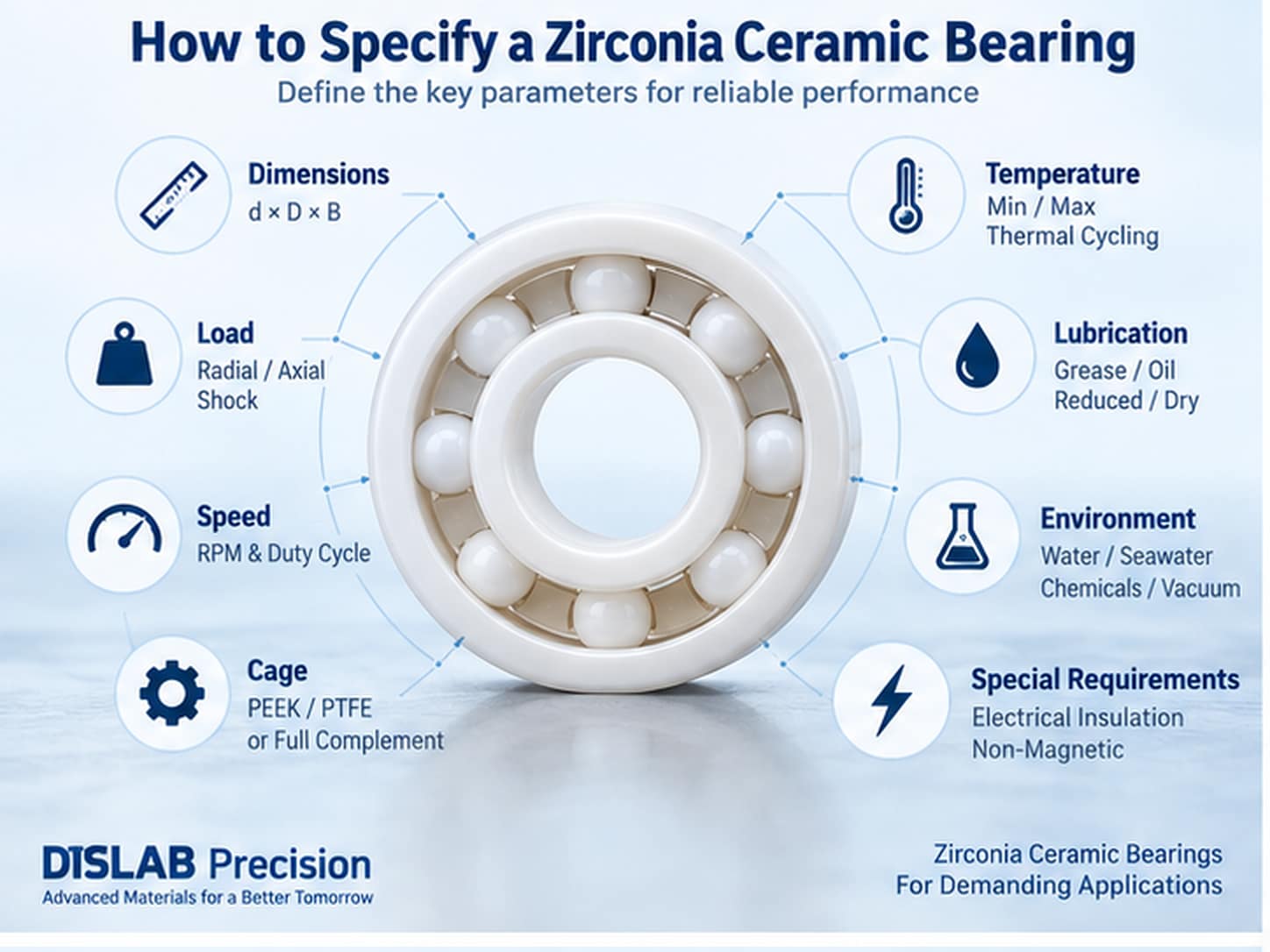
Selecting a zirconia ceramic bearing should not begin with dimensions alone. The correct bearing depends on what it must do inside the actual machine.
A ZrO₂ full ceramic bearing may provide corrosion resistance, electrical insulation and non-magnetic performance, but material choice is only one part of the specification.
Load, speed, fit, internal clearance, cage design, lubrication, temperature and operating environment all influence the final bearing configuration.
1. Start With the Bearing Dimensions
For a standard deep-groove ball bearing, provide the bearing designation if known or the basic dimensions:
- bore diameter — d;
- outside diameter — D;
- width — B.
For example, specifying 6 × 19 × 6 mm is more useful than simply asking for “a small ceramic bearing.”
If the bearing replaces an existing steel bearing, provide the original bearing number whenever possible.
For basic material information, see
What Are Zirconia Ceramic Bearings?.
2. Define Radial, Axial and Shock Loads
Load information is essential because bearing selection cannot be based on size alone.
Radial Load
Acts mainly perpendicular to the shaft and is often the principal load on a deep-groove ball bearing.
Axial Load
Acts along the shaft axis. The acceptable amount depends on bearing geometry, configuration, speed and operating clearance.
Combined Load
Many applications impose both radial and axial forces. Provide both whenever possible.
Shock or Impact
Sudden loading, vibration and impact should be identified separately because ceramic materials behave differently from ductile bearing steel.
Avoid assuming that a ceramic bearing with the same dimensions as a steel bearing automatically has the same catalog load rating.
3. Specify Speed and Duty Cycle
Do not ask only for the “maximum RPM of zirconia.”
There is no useful universal RPM value for ZrO₂ bearings because speed capability depends on:
- bearing size;
- internal geometry;
- cage or full-complement construction;
- load;
- lubrication;
- operating temperature;
- internal clearance;
- duty cycle.
Provide:
- normal operating RPM;
- maximum RPM;
- continuous or intermittent operation;
- hours per day;
- frequent acceleration or deceleration if applicable.
4. Choose Caged or Full-Complement Construction
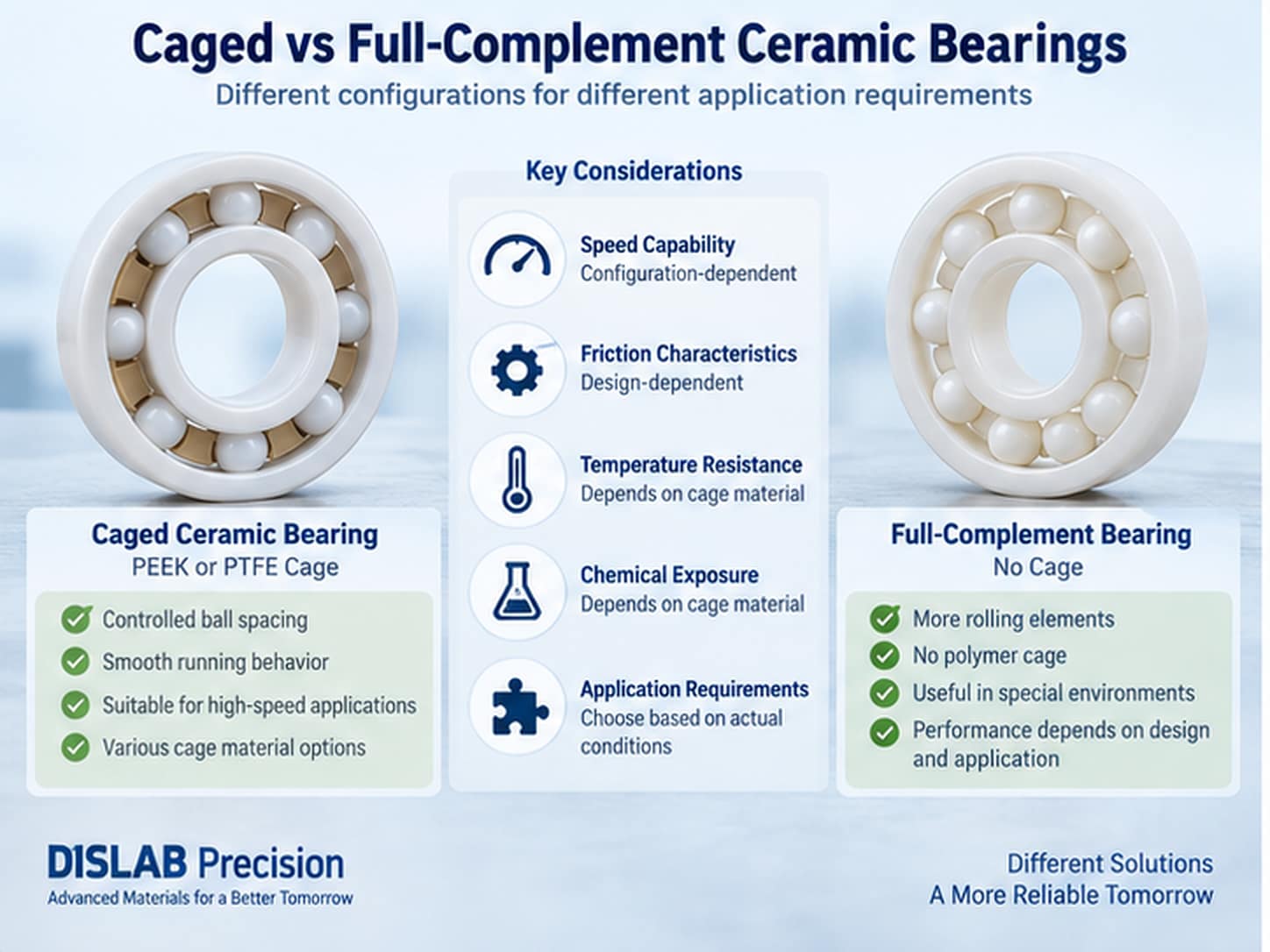
Caged Ceramic Bearings
A cage separates and guides the rolling elements.
Common polymer cage choices for full ceramic bearings include PEEK and PTFE.
A caged configuration may be preferred when:
- controlled ball spacing is important;
- higher rotational speed is required;
- smooth running behavior is important;
- a specific cage material matches the chemical environment.
Full-Complement Ceramic Bearings
A full-complement configuration removes the conventional cage and normally uses more rolling elements.
It may be considered when:
- eliminating a polymer cage is beneficial;
- chemical exposure makes cage material selection difficult;
- the cage would otherwise become a limiting component;
- the application favors a cageless configuration.
For the detailed comparison, see
Full-Complement vs Caged Ceramic Bearings.
5. Select the Cage Material
If a cage is required, the main options may include PEEK and PTFE.
PEEK
Often selected where mechanical strength, stiffness and dimensional stability are important.
PTFE
Often selected where very low friction and broad chemical resistance are important.
Do not select a cage only from the maximum temperature listed on a raw polymer datasheet.
The actual bearing cage must also withstand:
- speed;
- centrifugal loading;
- friction;
- chemical exposure;
- temperature;
- required service life.
See
PTFE vs PEEK Cage for Full Ceramic Bearings.
6. Review Shaft and Housing Fit Carefully
Fit controls how the bearing is retained on the shaft and inside the housing.
An interference fit can also change the dimensions of a bearing ring and therefore influence internal clearance.
Zirconia and bearing steel differ in elastic behavior, fracture behavior and thermal expansion.
For a useful review, provide:
- shaft nominal diameter;
- shaft tolerance;
- housing bore diameter;
- housing tolerance;
- which ring rotates relative to the load;
- expected temperature range;
- existing mounting method.
7. Internal Clearance Must Be Considered With Fit and Temperature
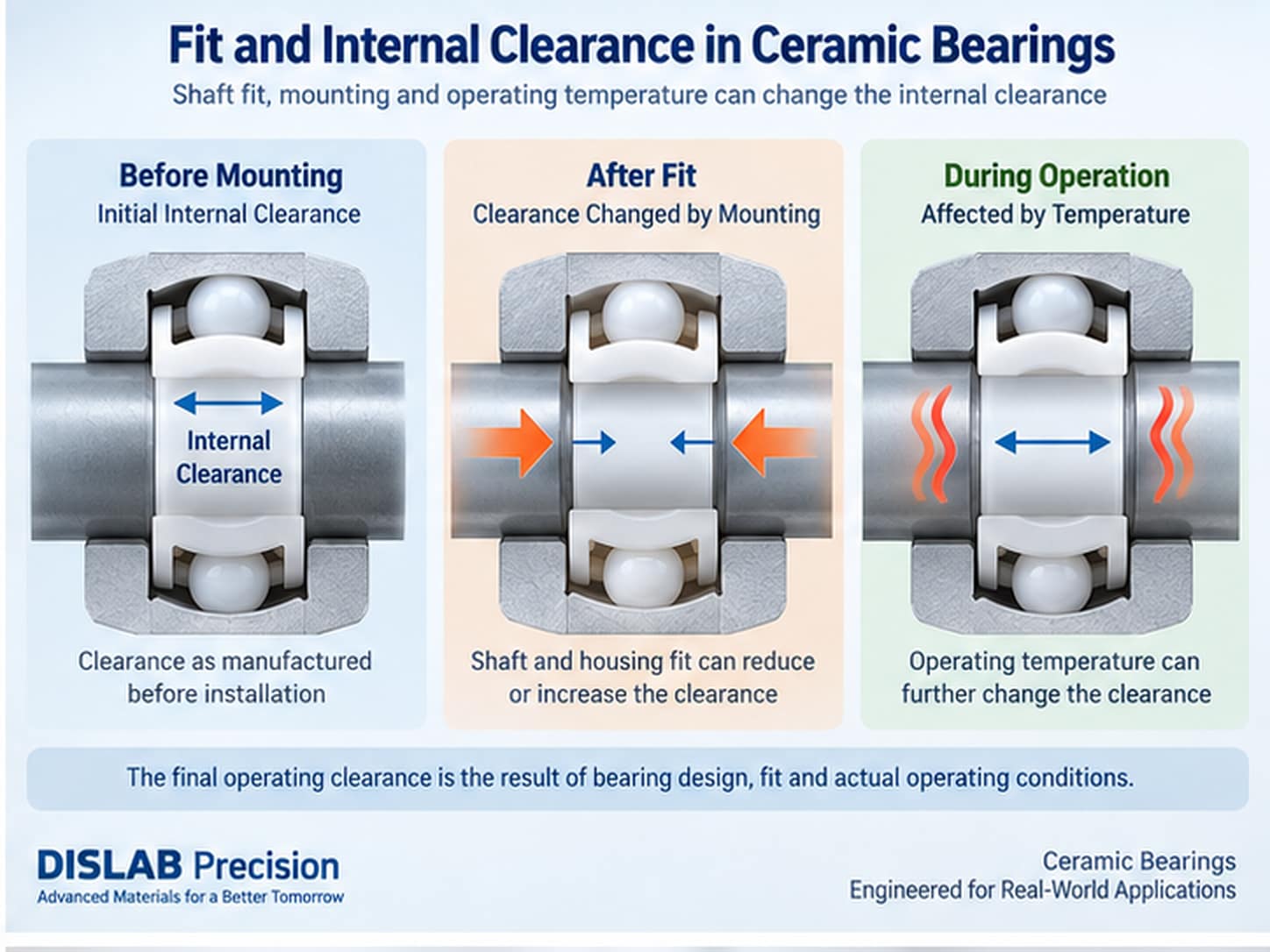
Internal clearance is not just a catalog code.
It changes as the bearing moves through three conditions:
Before Mounting
The bearing has its manufactured initial internal clearance.
After Mounting
Shaft and housing fits can change the effective clearance.
During Operation
Temperature, load and thermal expansion can change the operating clearance again.
Final Requirement
The important value is the clearance that remains suitable under real operating conditions.
For ceramic bearings, confirm the actual clearance requirement with the supplier rather than assuming that a steel-bearing clearance code will produce identical operating behavior.
8. Specify the Temperature Range
Provide more than one temperature value.
Useful information includes:
- minimum temperature;
- normal continuous temperature;
- maximum operating temperature;
- short-term peak temperature;
- thermal cycling frequency.
Temperature affects not only the ZrO₂ material but also:
- cage behavior;
- lubrication;
- seals;
- shaft dimensions;
- housing dimensions;
- fit;
- operating clearance.
See
Zirconia Ceramic Bearing Temperature Limits Explained.
9. Define the Lubrication Condition
Do not simply specify “no lubrication.”
Describe the real condition:
- conventional grease;
- special grease;
- oil lubrication;
- process-fluid operation;
- reduced lubrication;
- dry-running requirement.
See
Can Zirconia Ceramic Bearings Run Without Lubrication?.
10. Describe the Environment Precisely
Terms such as “corrosive” or “wet” are too broad for an accurate bearing recommendation.
Water
Specify whether exposure involves:
- occasional splash;
- continuous immersion;
- washdown;
- hot water.
Seawater
Specify continuous or intermittent exposure and whether the environment is flowing or stagnant.
See
Ceramic Bearings for Water, Seawater and Wet Environments.
Chemicals
Whenever possible, provide:
- chemical name;
- concentration;
- temperature;
- continuous or intermittent exposure;
- cleaning or sterilization conditions.
See
Ceramic Bearings for Corrosive and Chemical Environments.
Steam and Hot Water
Do not treat hot water or steam as the same condition as dry heat. Moisture, temperature, pressure, thermal cycling and lubrication may all need separate review.
11. Define Electrical and Magnetic Requirements
If electrical insulation or non-magnetic performance matters, specify the actual requirement.
Useful questions include:
- Must current be prevented from passing through the bearing?
- Is a minimum electrical resistance specified?
- Is the objective to reduce bearing-current damage?
- Must the complete bearing be non-magnetic?
- Do the shaft and housing materials also matter?
See
Are Ceramic Bearings Electrically Insulating and Non-Magnetic?.
12. Confirm Whether Zirconia Is the Right Ceramic
Zirconia is not automatically the best ceramic for every application.
ZrO₂ is attractive where the application values:
- corrosion resistance;
- relatively high fracture toughness for a ceramic;
- electrical insulation in appropriate grades;
- non-magnetic behavior;
- wet or chemical-environment capability.
Silicon nitride may deserve consideration where lower density, lower thermal expansion or higher-speed operation are more important.
See
Zirconia vs Silicon Nitride Ceramic Bearings.
13. Do You Actually Need Full Ceramic?
Depending on the application, alternatives may include:
- stainless-steel bearings;
- hybrid ceramic bearings;
- silicon nitride full ceramic bearings;
- special metallic bearing solutions.
If the main requirement is only one operating factor, compare the alternatives rather than specifying full ceramic by default.
See
Ceramic Bearings vs Steel Bearings.
14. Zirconia Ceramic Bearing RFQ Checklist

| Information | What to Provide |
|---|---|
| Bearing | Model number or d × D × B dimensions |
| Quantity | Sample quantity and expected production quantity |
| Load | Radial, axial and shock or impact loads |
| Speed | Normal RPM, maximum RPM and duty cycle |
| Configuration | Caged or full complement; PEEK or PTFE if known |
| Fit | Shaft diameter/tolerance and housing bore/tolerance |
| Clearance | Required internal clearance if known |
| Temperature | Minimum, normal, maximum and thermal cycling |
| Lubrication | Grease, oil, process fluid, reduced lubrication or dry running |
| Environment | Water, seawater, chemicals, steam, vacuum, washdown or clean environment |
| Special Requirements | Electrical insulation, non-magnetic construction, contamination limits or special material grade |
15. Practical Selection Workflow
Identify the existing bearing number or required d × D × B envelope.
Identify radial, axial, combined and shock loading.
Provide normal RPM, peak RPM and duty cycle.
Determine whether the application favors a caged or full-complement bearing.
Check shaft, housing and actual operating-clearance requirements.
Evaluate them together rather than as isolated variables.
Specify water, seawater, chemicals, steam, vacuum or clean conditions.
Review electrical insulation, non-magnetic behavior and ceramic grade.
Only after these conditions are known should the exact configuration be finalized. The next step is correct installation and handling of zirconia ceramic bearings.
Common Specification Mistakes
Selecting Only by Bearing Number
Dimensional interchangeability does not guarantee equivalent operating capability.
Copying the Steel-Bearing Fit
A fit developed for a steel bearing should not automatically be applied to a full ceramic bearing.
Ignoring Internal Clearance
Mounting fit and temperature can change the clearance available during operation.
Asking Only for Maximum RPM
Permissible speed depends on bearing size, configuration, load, lubrication and temperature.
Assuming Full Ceramic Means No Lubrication
Dry running is application-dependent.
Saying Only “Chemical Resistant”
Chemical type, concentration, temperature and exposure duration matter.
Using Material Temperature as Bearing Temperature
The cage, lubricant, seals, fit and operating conditions may become limiting factors first.
Assuming Every Zirconia Grade Has the Same Electrical Properties
Confirm the actual material grade when electrical performance is a formal requirement.
Frequently Asked Questions
Can I replace a steel bearing with a zirconia bearing of the same size?
Possibly, but dimensions alone are not enough. Load, speed, fit, clearance, lubrication and operating environment should also be reviewed.
Can I use the same shaft fit as the original steel bearing?
Do not assume so. Confirm the fit for the actual ceramic bearing and application.
What clearance should I specify?
The required clearance depends on bearing size, fit, temperature, speed and operating condition. Confirm the actual clearance requirement rather than relying only on a generic designation.
How much load can a zirconia bearing carry?
There is no universal value. Capacity depends on bearing size, geometry, material grade and configuration.
What is the maximum RPM of a zirconia bearing?
There is no single zirconia RPM limit. Size, cage design, lubrication, load, temperature and internal geometry all affect permissible speed.
Can zirconia bearings run without grease?
They may operate with reduced lubrication or under dry-running conditions in suitable applications, but full ceramic does not automatically mean self-lubricating.
Should I choose PEEK, PTFE or full complement?
The answer depends on speed, load, temperature, chemical exposure, friction and the overall application requirement.
Is zirconia always better than silicon nitride?
No. ZrO₂ and Si₃N₄ have different mechanical, thermal and dynamic characteristics.
Need Help Specifying a Zirconia Ceramic Bearing?
Send the bearing model or dimensions, load, RPM, temperature, operating environment, cage preference, lubrication condition, shaft and housing information and required quantity.
DISLAB Precision can then evaluate the appropriate ZrO₂ full ceramic bearing configuration for the application.
This page is a general engineering selection guide. Final load, speed, fit, clearance, temperature and operating limits should be confirmed for the actual bearing size, material grade, configuration and application.