Industrial Engineering Guide / Technical Comparison
Ceramic Bearings vs. Steel Bearings: Key Differences and Applications
Help engineers and industrial buyers compare steel, hybrid ceramic, and full ceramic bearings by speed, load, corrosion resistance, electrical insulation, lubrication, temperature, and lifecycle cost.
Introduction
When selecting bearings for rotating equipment, engineers often compare conventional steel bearings with ceramic-bearing solutions. However, the term ceramic bearing can refer to two distinctly different products:
- Hybrid ceramic bearings, which usually have steel rings and ceramic rolling elements
- Full ceramic bearings, in which both the rings and rolling elements are made from engineering ceramics
These bearing types should not be treated as interchangeable. Steel bearings remain the standard choice for most industrial machinery because they offer high load capacity, good toughness, broad availability and relatively low cost. Hybrid and full ceramic bearings are generally selected when an application presents additional challenges, such as high rotational speed, electrical current, corrosion, vacuum conditions, magnetic sensitivity or restricted lubrication. There is therefore no universally superior bearing material. The correct choice depends on the actual load, speed, temperature, operating medium, lubrication method, mounting conditions and required service life.
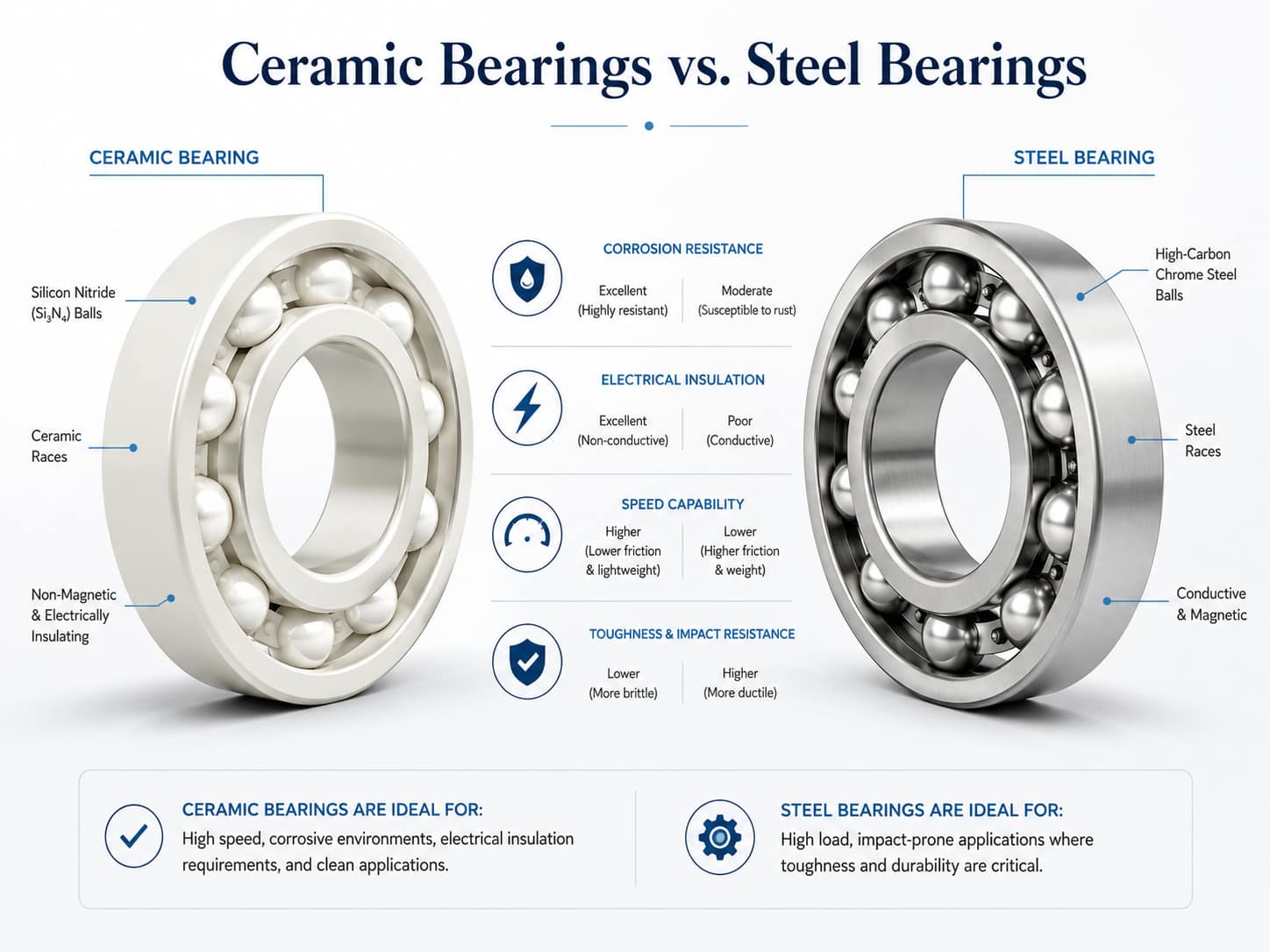
Quick Selection Guide
Choose Steel Bearings When:
- High load and impact resistance are important
- Cost and availability matter
- The environment is dry and well lubricated
- Standard replacement is required
Choose Hybrid Ceramic Bearings When:
- High speed is important
- Bearing current damage is a risk
- Lower rolling-element mass is useful
- Steel rings are still acceptable
Choose Full Ceramic Bearings When:
- Corrosion is the main failure mode
- Electrical insulation or non-magnetic behavior is required
- Lubrication is limited or contamination must be reduced
- Chemical, marine, vacuum, or clean environments are involved
Start with the Failure Mechanism
The right bearing choice starts with the reason a bearing is failing or underperforming. Material name alone is not enough.
Symptomrust, rough raceways, early noise
Possible directionfull ceramic bearing or stainless steel bearing depending on environment
Symptompitting, fluting, rising vibration
Possible directionhybrid ceramic bearing or insulated steel bearing
Symptomheat, cage stress, unstable rotation
Possible directionhybrid ceramic bearing with suitable preload and lubrication
Symptomwear, heat, lubricant breakdown
Possible directionfull ceramic or special lubrication design after load review
Symptomclearance shift, grease oxidation, seal degradation
Possible directiontemperature-rated bearing system, not material alone
Symptombrinelling, cracked components, edge loading
Possible directionsteel bearing is usually safer and more forgiving
1. What Is a Steel Bearing?
Most standard rolling bearings use high-carbon chromium bearing steel for their inner rings, outer rings and rolling elements. Common material designations include:
- AISI 52100
- SAE 52100
- 100Cr6
- SUJ2
- GCr15
Although the naming systems differ by country and standard, these grades belong to the same general family of high-carbon chromium bearing steels. After controlled heat treatment, precision grinding and superfinishing, bearing steel provides a useful balance of:
- High hardness
- Rolling-contact fatigue resistance
- Wear resistance
- Dimensional stability
- Toughness
- Cost-effective mass production
A typical steel bearing may include:
- Steel inner and outer rings
- Steel balls or rollers
- A steel, brass or polymer cage
- Grease or oil lubrication
- Optional shields or contact seals
Steel bearings are available in a very wide range of sizes, internal clearances, precision grades and sealing arrangements. This makes them the most practical choice for general industrial equipment.
2. What Is a Ceramic Bearing?
Ceramic bearings are made with engineering ceramics rather than conventional metal alone. The ceramics used in bearings are high-performance sintered materials, not ordinary consumer ceramics. There are two main categories.
2.1 Hybrid Ceramic Bearings
Hybrid ceramic bearings normally use:
- Steel inner and outer rings
- Silicon nitride ceramic balls or rollers
Silicon nitride, written as Si₃N₄, is the most common rolling-element material in hybrid bearings. This construction combines the toughness and established load-carrying capability of steel rings with several useful characteristics of ceramic rolling elements, including:
- Lower density than steel
- Electrical insulation
- High hardness
- Good wear resistance
- Reduced centrifugal loading at high speed
- Good performance under demanding lubrication conditions
Hybrid ceramic bearings are widely used in high-speed spindles, electric motors, generators, compressors and precision rotating equipment.
2.2 Full Ceramic Bearings
In full ceramic bearings, both the rings and rolling elements are manufactured from ceramic materials. Common materials include:
- Zirconia, or ZrO₂
- Silicon nitride, or Si₃N₄
- Silicon carbide, or SiC
Full ceramic bearings may use PTFE, PEEK or another polymer for the cage. Some designs are full-complement bearings and do not use a conventional cage. Their main advantages may include:
- Corrosion resistance
- Electrical insulation
- Non-magnetic construction
- Compatibility with certain chemicals
- Suitability for vacuum or clean environments
- Operation with water or process-fluid lubrication in selected applications
However, the performance of a full ceramic bearing depends strongly on the ceramic material, bearing geometry, cage, seals and mounting conditions. For a focused material comparison, see zirconia vs silicon nitride ceramic bearings.
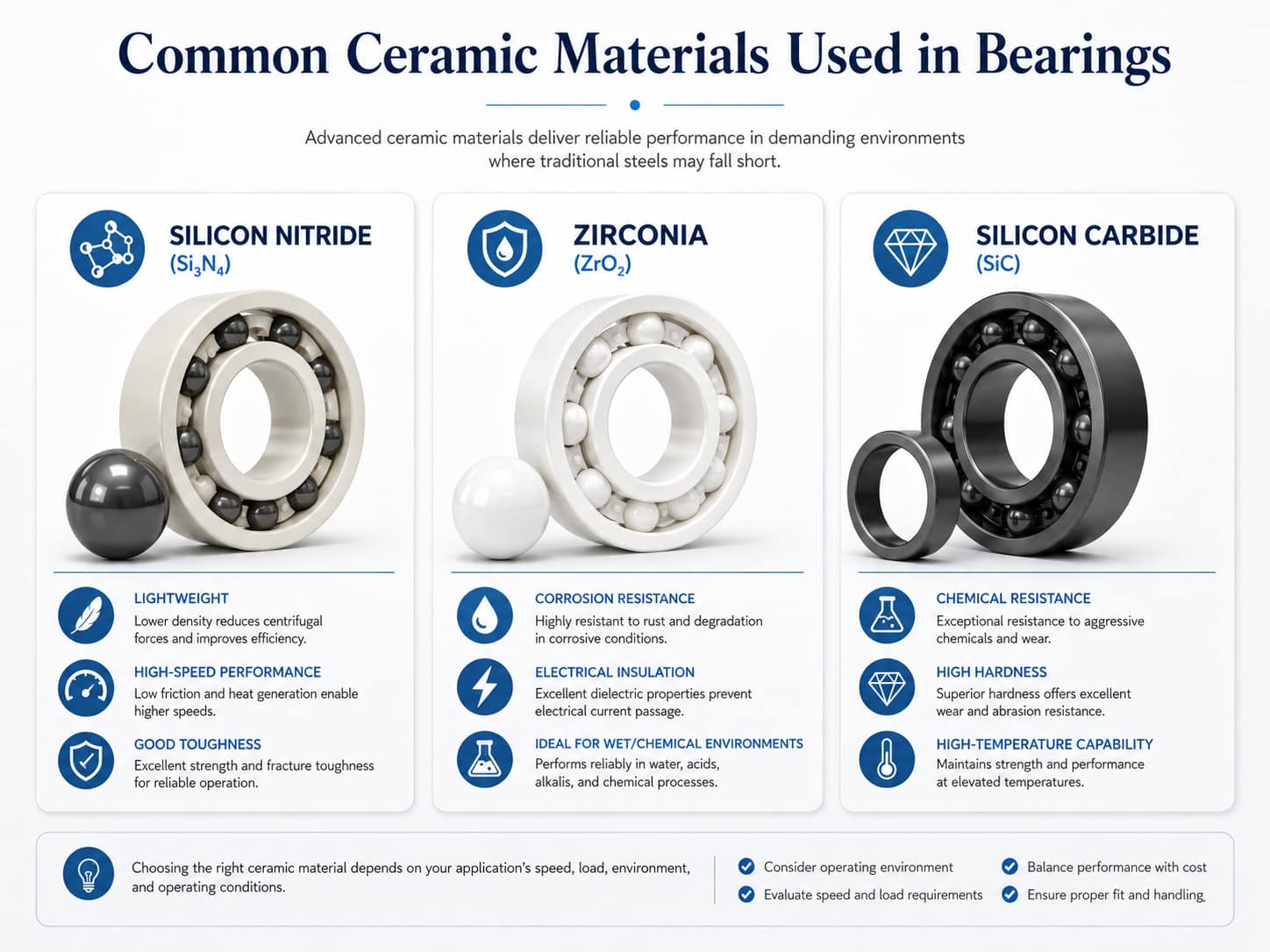
3. Common Ceramic Materials Used in Bearings
Engineering notes
- Silicon nitride is commonly used where low rolling-element mass helps at high speed.
- Zirconia is often selected for wet or corrosive full ceramic applications.
- Silicon carbide is considered for aggressive chemical or high-temperature conditions.
Silicon Nitride
Silicon nitride is widely used for ceramic rolling elements, particularly in hybrid bearings. Its main characteristics include:
- Low density compared with bearing steel
- High hardness
- Good strength
- Better fracture toughness than many other technical ceramics
- Good resistance to thermal shock
- Electrical insulation
- Good wear resistance
Because of its relatively low mass, silicon nitride is especially valuable in high-speed applications. Lower rolling-element mass reduces centrifugal force and can help lower heat generation at high rotational speeds.
Zirconia
Zirconia is commonly used in full ceramic bearings intended for corrosive, wet or electrically sensitive environments. Its typical characteristics include:
- Good corrosion resistance in many aqueous environments
- Higher fracture toughness than many traditional ceramics
- Electrical insulation
- Low thermal conductivity
- A thermal expansion rate relatively close to that of steel
- Higher density than silicon nitride
Zirconia bearings are frequently considered for chemical equipment, food-processing machinery, water-treatment systems, marine equipment and laboratory devices.
Silicon Carbide
Silicon carbide provides:
- Very high hardness
- Low density
- High temperature capability
- Excellent wear resistance
- Strong chemical resistance in many aggressive environments
- Low thermal expansion
It may be used in particularly demanding chemical or high-temperature applications. However, material compatibility should always be verified against the actual fluid, concentration and operating temperature.
4. Ceramic Bearings vs. Steel Bearings: Comparison Table
| Comparison factor | Steel bearings | Hybrid ceramic bearings | Full ceramic bearings |
|---|---|---|---|
| Ring material | Bearing steel or stainless steel | Usually bearing steel | Zirconia, silicon nitride or silicon carbide |
| Rolling elements | Steel balls or rollers | Usually silicon nitride | Ceramic balls or rollers |
| Toughness | Generally high | Steel rings retain good toughness | Lower tolerance to impact than steel |
| Shock resistance | Usually best for shock-loaded machinery | Better than full ceramic designs in many cases | Requires careful control of impact and mounting |
| High-speed potential | Good for general and many high-speed applications | Often preferred for very high speed | Depends on material and bearing design |
| Electrical conductivity | Conductive unless specially insulated | Ceramic rolling elements interrupt the current path | Ceramic components are electrically insulating |
| Corrosion resistance | Standard bearing steel can rust | Steel rings remain vulnerable to corrosion | Usually best where metallic corrosion must be avoided |
| Magnetic behavior | Standard bearing steel is magnetic | Steel rings usually remain magnetic | Can be made with non-magnetic components |
| Lubrication | Normally requires suitable lubrication | Normally still requires lubrication | Some designs can use water, process fluid or special dry-lubrication systems |
| Temperature performance | Depends on steel treatment, lubricant, cage and seals | Can perform well under demanding thermal conditions | Ceramic material may tolerate high temperature, but the complete bearing remains the limiting system |
| Cost | Usually lowest | Higher than all-steel bearings | Usually highest |
| Availability | Very broad | Broad in selected industrial series | More specialized |
| Typical applications | General machinery, gearboxes, pumps, conveyors | Motors, generators, spindles and compressors | Chemical, vacuum, marine and non-magnetic equipment |
5. High-Speed Performance
One of the main reasons for selecting hybrid ceramic bearings is the lower density of silicon nitride rolling elements. At high rotational speed, rolling elements are subjected to centrifugal force. Because silicon nitride balls are considerably lighter than steel balls of the same size, they can produce:
- Lower centrifugal loading
- Reduced ball-to-raceway loading at high speed
- Lower inertial forces
- Faster acceleration and deceleration
- Lower heat generation in a properly designed system
- Improved high-speed stability
This makes hybrid ceramic bearings especially suitable for:
- CNC machine-tool spindles
- High-speed electric motors
- Turbo compressors
- Dental turbines
- Precision grinding spindles
- High-speed generators
- Electric drivetrains
However, the rolling-element material alone does not determine the maximum bearing speed. The actual speed capability also depends on:
- Bearing internal geometry
- Cage material and design
- Lubricant type and quantity
- Preload
- Internal clearance
- Sealing arrangement
- Shaft and housing accuracy
- Cooling
- Applied load
A properly engineered hybrid bearing may offer greater speed capability than a comparable all-steel bearing, but a universal percentage improvement should not be stated without manufacturer-specific data.
6. Electrical Insulation and Bearing-Current Protection
Engineering notes
- Hybrid ceramic rolling elements interrupt the direct conductive path through the rolling contacts.
- This is useful in VFD motors, generators, EV drivetrains and high-speed motorized spindles.
- Insulated steel bearings may still be more economical in some large motor applications.
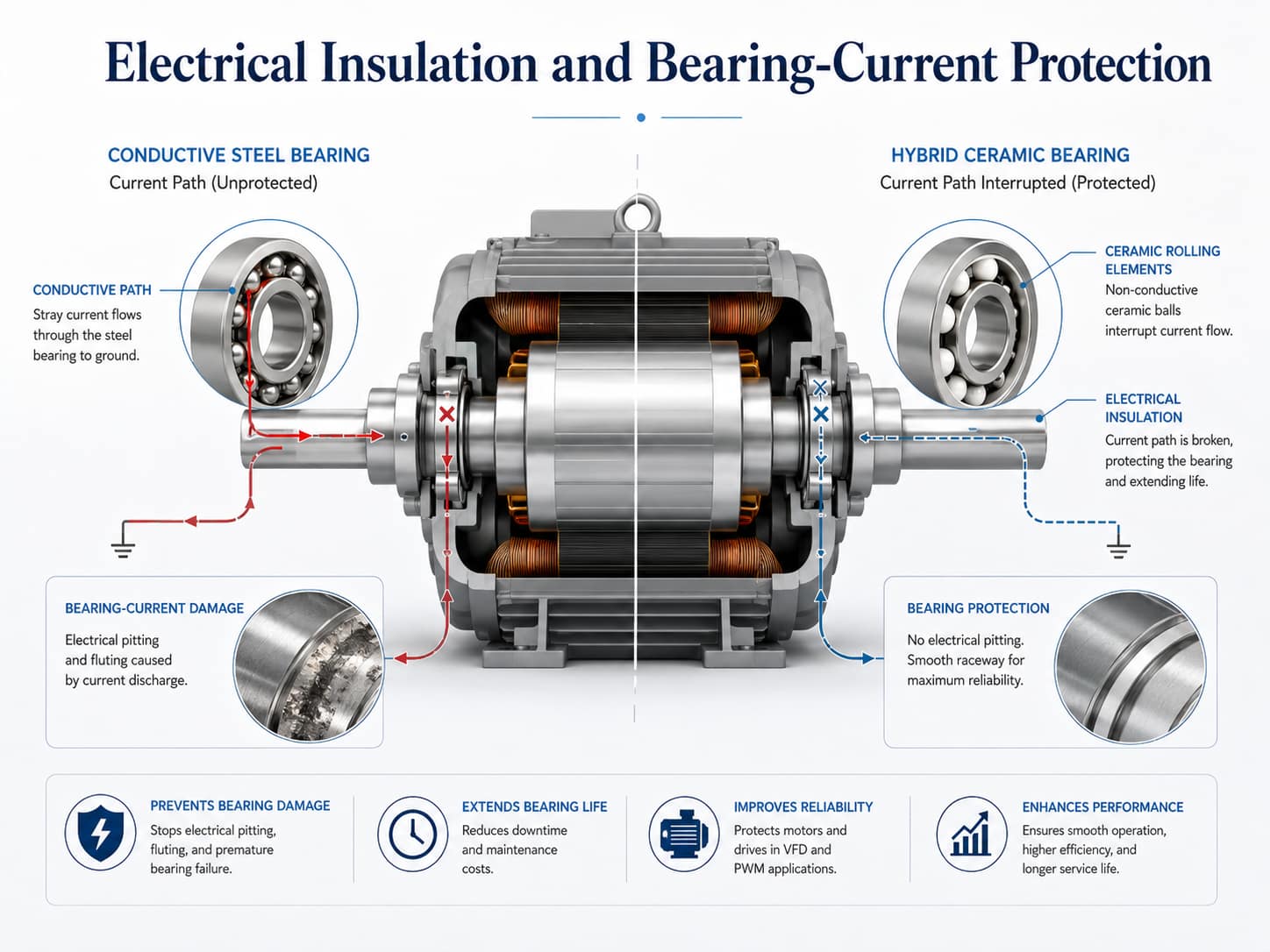
Steel is electrically conductive. In electric motors and generators, shaft voltage may cause current to pass through the bearing. This is especially relevant in equipment powered by variable-frequency drives. When electrical current passes through the rolling contacts, it may cause:
- Microscopic electrical pits
- Fluting or washboard-like raceway damage
- Lubricant degradation
- Increased noise
- Increased vibration
- Premature bearing failure
Hybrid ceramic bearings use electrically insulating ceramic rolling elements between the steel rings. This interrupts the direct conductive path through the rolling contacts and can help protect the bearing from current-related damage. Typical applications include:
- Variable-frequency motors
- Servo motors
- Electric-vehicle drive motors
- Railway traction motors
- Wind-turbine generators
- Industrial generators
- High-speed motorized spindles
Full ceramic bearings also provide electrical isolation through their ceramic rings and rolling elements. However, whether the complete bearing assembly is electrically insulated depends on all components, including cages, shields, seals and adjacent mounting parts.
Hybrid Bearings vs. Insulated Steel Bearings
An alternative solution is a steel bearing with an electrically insulating coating on one ring. Both technologies can reduce bearing-current damage, but they are not identical. Hybrid ceramic bearings also provide:
- Lower rolling-element mass
- High-speed benefits
- Resistance to electrical current through the rolling contacts
Insulated steel bearings may be more economical in some large-motor applications. The correct choice depends on voltage, current frequency, bearing size, motor design and required speed.
Corrosion Resistance: When Full Ceramic Bearings Make Sense
Standard high-carbon chromium bearing steel is not inherently corrosion resistant. Water, seawater, cleaning chemicals, acidic or alkaline solutions and chemical vapors can rust raceways, disrupt lubrication and shorten service life.
Steel Bearing in Wet / Chemical Environment
- rust risk
- lubricant breakdown
- raceway damage
- shorter service life
Full Ceramic Bearing in Corrosive Environment
- no conventional steel rings
- better resistance to many aqueous media
- useful for marine, chemical, food, and laboratory systems
- compatibility still needs checking

8. Load Capacity, Toughness and Impact Resistance
Steel bearings are generally more forgiving under shock, misalignment and installation error. Bearing steel combines high hardness with a degree of toughness that allows it to tolerate:
- Heavy radial loads
- Heavy axial loads
- Repeated shock
- Shaft deflection
- Housing deformation
- Misalignment
- Start-stop loading
Ceramics behave differently from steel. They have high hardness and high compressive strength, but they do not undergo the same degree of plastic deformation before fracture. This makes ceramic components more sensitive to:
- Sharp impact
- Edge loading
- Improper fits
- Hammer installation
- Surface defects
- Severe misalignment
- Concentrated mounting stress
This does not mean ceramic bearings are inherently weak. Properly designed ceramic bearings can carry substantial loads. However, their load rating must be evaluated using the specific bearing geometry, ceramic grade and operating conditions. For machines exposed to heavy impact or uncertain alignment, a steel bearing is often the safer and more economical choice.
9. Friction and Heat Generation
Ceramic rolling elements can be manufactured with high hardness, excellent roundness and a smooth surface finish. In high-speed hybrid bearings, their lower mass can reduce inertial and centrifugal effects. This may contribute to:
- Lower operating temperature
- Reduced high-speed friction
- More stable spindle behavior
- Faster acceleration response
- Lower lubricant stress
Nevertheless, total bearing friction is affected by much more than rolling-element material. Other important factors include:
- Bearing preload
- Internal clearance
- Lubricant viscosity
- Lubricant quantity
- Contact angle
- Cage design
- Seal contact
- Speed
- Applied load
In a sealed bearing, contact-seal drag may account for a large proportion of total friction. Replacing steel balls with ceramic balls will not automatically overcome poor lubrication, excessive preload or high seal friction.
10. Lubrication Requirements
A common misconception is that ceramic bearings never require lubrication. That is not correct.
Steel Bearings
Most steel bearings require grease or oil to:
- Separate rolling-contact surfaces
- Reduce friction and wear
- Carry away heat
- Protect against corrosion
- Lubricate the cage
- Remove or suspend contaminants
Hybrid Ceramic Bearings
Hybrid bearings also normally require lubrication. They may provide improved performance under thin-film or low-viscosity lubrication because of the characteristics of the ceramic rolling elements, but they are not automatically lubrication-free.
Full Ceramic Bearings
Some full ceramic bearings can operate with:
- Water lubrication
- Process-fluid lubrication
- Solid lubricants
- Special dry-running arrangements
- Very limited conventional grease
This may be valuable in food, chemical, vacuum or clean-process equipment. However, suitability for dry running depends on:
- Load
- Speed
- Cage material
- Bearing clearance
- Temperature
- Duty cycle
- Required service life
- Surrounding atmosphere
A full ceramic bearing used at high speed or under heavy load may still require carefully selected lubrication.
11. Temperature Performance
Engineering ceramics generally retain hardness at temperatures above the practical limits of conventional bearing steel. However, the maximum operating temperature of a bearing is never determined by the ceramic material alone. The full bearing system includes:
- Rings
- Rolling elements
- Cage
- Seals
- Lubricant
- Shaft
- Housing
These components may have very different temperature limits. For example:
- A polymer cage may soften before the ceramic components are affected.
- Rubber seals may degrade at elevated temperatures.
- Standard grease may oxidize or lose viscosity.
- Steel shafts and ceramic rings may expand at different rates.
- Internal clearance may decrease as temperatures change.
Standard steel bearings may require heat-stabilized materials when used continuously at elevated temperatures. Special high-temperature steel bearings are also available, so it is inaccurate to define one fixed temperature limit for all steel bearings. Likewise, a ceramic bearing should not be described as suitable for unlimited high-temperature operation. Always use the manufacturer’s temperature rating for the complete bearing configuration.
12. Thermal Expansion and Bearing Fits
Engineering notes
- Thermal expansion changes shaft fits, housing fits, preload and internal clearance.
- Silicon nitride expands much less than steel; zirconia is closer to steel.
- A same-size ceramic bearing is not always a direct drop-in replacement.
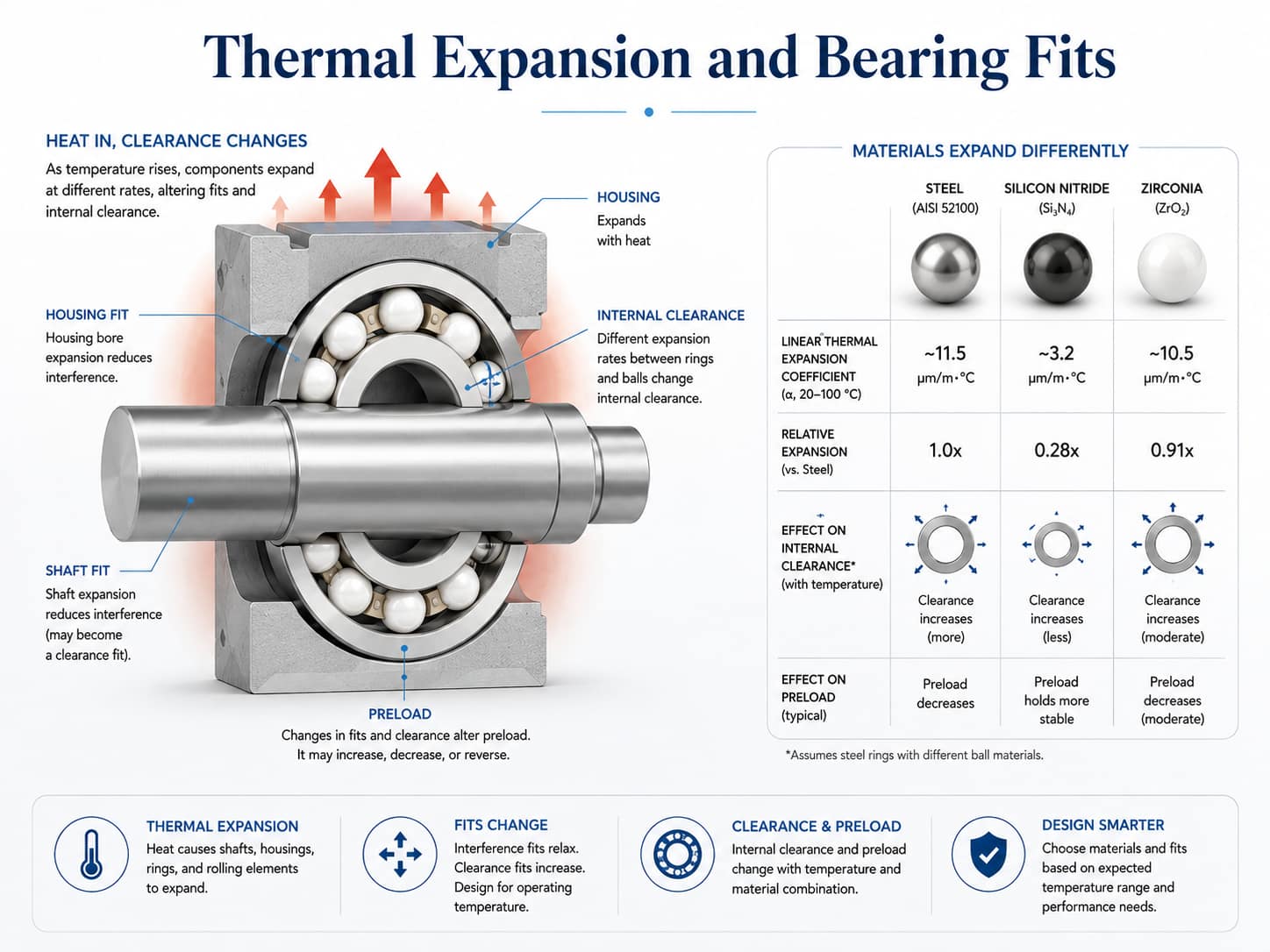
Steel, silicon nitride and zirconia have different thermal-expansion characteristics. This matters because temperature changes can alter:
- Shaft fits
- Housing fits
- Internal clearance
- Preload
- Contact stress
- Risk of ring creep
- Risk of bearing seizure
Silicon nitride generally expands much less than steel. Zirconia has a thermal-expansion rate closer to that of steel. These differences can be useful in certain designs, but they may also create fit problems when a bearing operates over a wide temperature range. A ceramic bearing with the same nominal dimensions as a steel bearing is not always a direct drop-in replacement. Shaft and housing fits, operating clearance and thermal expansion should be reviewed before substitution.
13. Magnetic Properties
Most standard bearing steels are magnetic. This can be unsuitable for:
- Magnetic measuring instruments
- MRI-related equipment
- Semiconductor inspection systems
- Electron-beam equipment
- Sensitive laboratory devices
- Certain vacuum systems
A full ceramic bearing can be configured as a non-magnetic bearing when the rings, rolling elements, cage and auxiliary components are all non-magnetic. A hybrid ceramic bearing is not normally fully non-magnetic because its inner and outer rings are still made from steel. For applications with strict magnetic requirements, engineers must also check:
- Cage material
- Shields
- Seal reinforcement
- Snap rings
- Fasteners
- Lubricant additives
- Adjacent shaft and housing materials
14. Noise and Vibration
Hybrid ceramic bearings are often used in precision equipment because their low rolling-element mass can improve dynamic behavior at high speed. Potential benefits include:
- Reduced rolling-element inertia
- Stable high-speed rotation
- Rapid response to speed changes
- Lower centrifugal effects
- Improved spindle performance
However, ceramic rolling elements do not automatically make a bearing quieter. Noise and vibration depend on:
- Raceway waviness
- Ball grade
- Bearing precision class
- Lubricant
- Cage behavior
- Internal clearance
- Preload
- Shaft and housing accuracy
- Contamination
- Installation alignment
A precision steel bearing may run more quietly than a poorly manufactured or incorrectly installed ceramic bearing.
15. Service Life
Ceramic bearings do not always last longer than steel bearings. Their service-life advantage is greatest when the dominant failure mechanism is directly addressed by the ceramic material. Hybrid or full ceramic bearings may provide longer service life when the main problem is:
- Electrical-current damage
- Corrosion
- High rolling-element centrifugal load
- Low-viscosity lubrication
- Lubricant-film breakdown
- Magnetic interference
- Contamination from conventional grease
Steel bearings may remain preferable when the main challenges are:
- Heavy impact
- Severe shaft deflection
- Poor housing alignment
- Highly contaminated grease
- Abrasive particles
- Installation damage
- Low replacement cost requirements
The correct question is not simply, “Which bearing lasts longer?” A better question is: What is the primary failure mechanism in this application, and which bearing design is best able to control it?
16. Cost and Availability
Steel bearings usually have the lowest purchase cost and the broadest availability. They offer:
- Extensive standardized sizes
- Multiple precision grades
- Multiple clearance options
- Wide seal and cage selection
- Shorter lead times
- Easier replacement
- Mature global supply
Hybrid ceramic bearings cost more because ceramic rolling elements require specialized powder preparation, sintering, inspection, grinding and finishing. Full ceramic bearings are generally the most expensive, particularly when they involve:
- Large dimensions
- Tight tolerances
- Special cages
- Non-standard clearance
- High-purity ceramic grades
- Small production quantities
- Custom geometry
However, purchase price is only part of the economic calculation. Total lifecycle cost may include:
- Downtime
- Bearing replacement labor
- Lubrication maintenance
- Product contamination
- Motor repair
- Corrosion damage
- Energy consumption
- Production loss
A higher-priced ceramic bearing may be economical when it prevents repeated failures in a critical machine.
17. When to Choose Steel Bearings
Engineering notes
- Steel bearings are generally more forgiving under shock, misalignment and mounting error.
- They are usually the best starting point for standard industrial equipment.
- Use ceramic designs when a specific failure mechanism justifies the change.
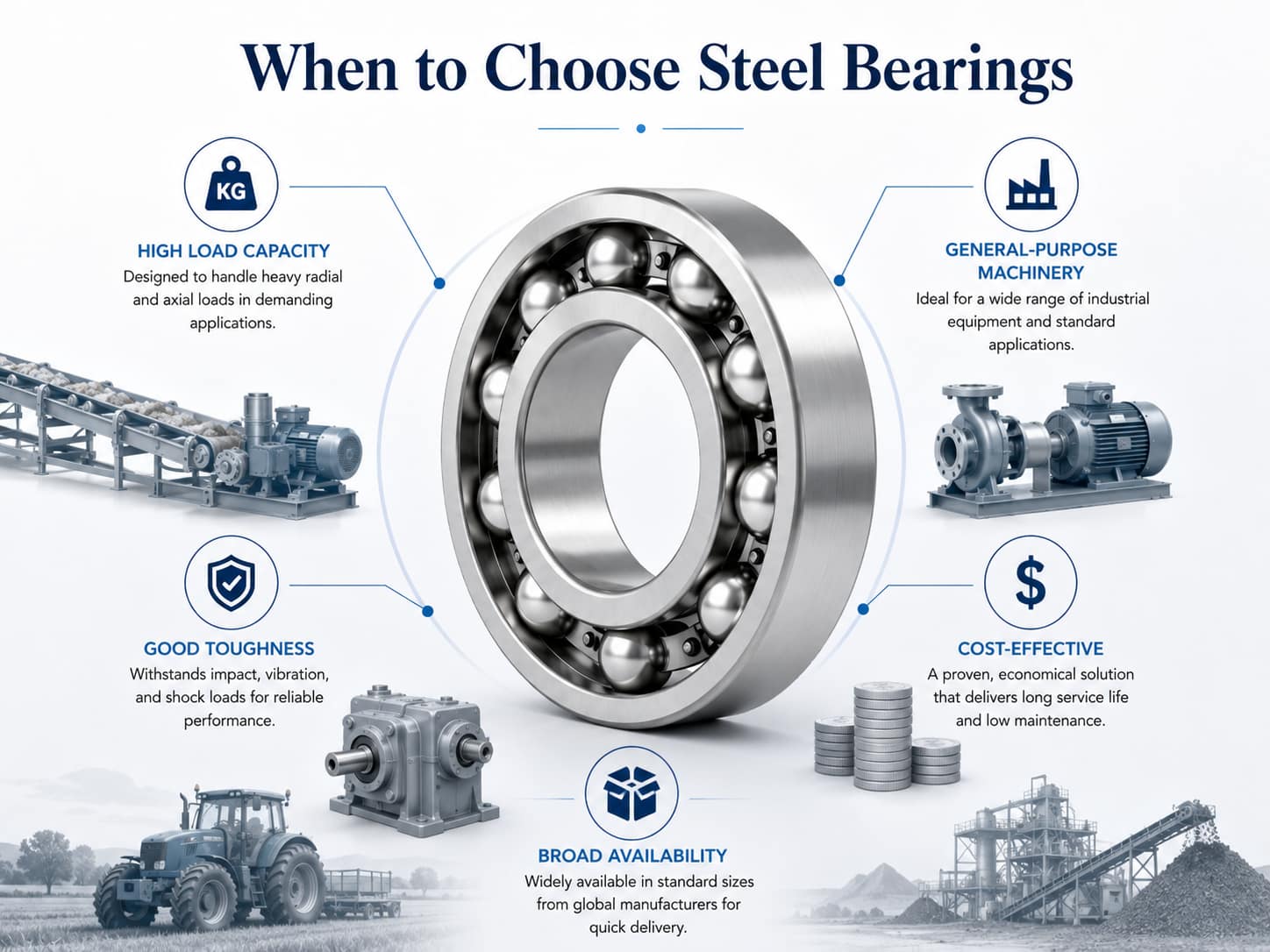
Steel bearings are usually the best starting point for:
- General industrial machinery
- Conveyors
- Gearboxes
- Agricultural equipment
- Construction machinery
- Standard pumps
- Fans and blowers
- Heavy-load equipment
- Shock-loaded systems
- Applications with conventional lubrication
- Cost-sensitive standard replacements
Choose steel bearings when corrosion, electrical current, non-magnetic operation and restricted lubrication are not major concerns.
18. When to Choose Hybrid Ceramic Bearings
Hybrid ceramic bearings are often suitable for:
- High-speed machine-tool spindles
- High-frequency electric motors
- Variable-frequency drive motors
- Electric-vehicle drive units
- Railway traction motors
- Wind-turbine generators
- Compressors
- Turbo equipment
- High-speed pumps
- Precision rotating systems
They are especially valuable when both high-speed capability and electrical insulation are required.
19. When to Choose Full Ceramic Bearings
Full ceramic bearings may be appropriate for:
- Chemical pumps
- Electroplating equipment
- Seawater machinery
- Underwater equipment
- Semiconductor processing
- Vacuum systems
- Food-processing equipment
- Pharmaceutical machinery
- Laboratory instruments
- Non-magnetic equipment
- Electrically isolated rotating assemblies
- Systems using water or process-fluid lubrication
Full ceramic bearings require particularly careful attention to impact, fit, alignment and cage selection. For standard sizes and available configurations, see the zirconia full ceramic bearing range.
20. When Ceramic Bearings May Not Be the Best Choice
Ceramic bearings should not be treated as a universal premium upgrade. Full ceramic bearings may be unsuitable where there is:
- Repeated heavy shock loading
- Poor shaft alignment
- Significant shaft bending
- Housing deformation
- Edge loading
- Uncontrolled press fitting
- Hammer installation
- Heavy abrasive contamination
- Unverified thermal expansion
- Incorrect internal clearance
- Excessive preload
In these conditions, a high-quality steel bearing, stainless-steel bearing, case-hardened bearing or electrically insulated steel bearing may offer better reliability at a lower total cost.
21. Common Misconceptions
Myth 1: All ceramic bearings are the same
Fact: Zirconia, silicon nitride and silicon carbide have different densities, toughness levels, thermal-expansion behavior and chemical resistance.
Myth 2: Ceramic bearings do not need lubrication
Fact: Most hybrid ceramic bearings still require lubrication. Only selected full ceramic designs can operate with water, process fluid, solid lubrication or controlled dry-running conditions.
Myth 3: Ceramic bearings always carry more load
Fact: High material hardness does not automatically result in a higher bearing load rating. Capacity depends on geometry, contact stress, ring material, rolling-element material and bearing design.
Myth 4: Hybrid ceramic bearings are completely non-magnetic
Fact: Hybrid bearings normally retain steel rings and are therefore not fully non-magnetic.
Myth 5: Ceramic bearings always last longer
Fact: They last longer only when their material advantages address the actual cause of failure.
Myth 6: Ceramic bearings can directly replace steel bearings
Fact: Nominal dimensions may match, but fits, clearance, preload, thermal expansion, lubrication and load ratings must still be checked.
22. Bearing Selection Checklist
Before choosing between steel, hybrid ceramic and full ceramic bearings, confirm the following.
Load
- Radial load
- Axial load
- Combined load
- Static load
- Shock frequency
- Load variation
Speed
- Continuous rotational speed
- Maximum speed
- Acceleration rate
- Start-stop frequency
- Required operating duration
Environment
- Water or seawater
- Acids or alkalis
- Solvents
- Humidity
- Vacuum
- Dust
- Magnetic fields
- Electrical current
- High or low temperature
Lubrication
- Grease or oil
- Lubricant viscosity
- Relubrication interval
- Risk of product contamination
- Process-fluid lubrication
- Dry-running requirement
Installation
- Shaft tolerance
- Housing tolerance
- Alignment
- Internal clearance
- Preload
- Shaft deflection
- Mounting method
- Thermal expansion
Cost
- Initial bearing price
- Installation cost
- Maintenance cost
- Downtime
- Replacement frequency
- Equipment damage
- Energy consumption
23. Detailed Selection Matrix
Simple Bearing Selection Flow
Yes: consider full ceramic or stainless options.
Yes: consider hybrid ceramic or insulated bearing.
Yes: consider hybrid ceramic bearing.
Yes: steel bearing is usually safer.
Yes: evaluate full ceramic or special lubrication design.
Send model, load, speed, environment, and quantity for review.
Typical Application Scenarios
Steel bearings are often the baseline for pumps, conveyors, gearboxes and standard equipment.
Electric motors and generatorsHybrid ceramic or insulated bearings can help when shaft current and fluting are concerns.
CNC spindles and high-speed equipmentHybrid ceramic bearings are commonly evaluated for speed, heat and dynamic stability.
Chemical pumpsFull ceramic bearings may help when corrosion is the primary failure mode.
Marine and seawater equipmentMaterial, cage, seal and surrounding hardware compatibility must be checked.
Food and clean-process equipmentFull ceramic or application-specific designs can reduce corrosion and contamination risks.
Laboratory and non-magnetic equipmentFull ceramic construction can support non-magnetic requirements when auxiliary parts also comply.
Vacuum or special environmentsBearing selection should include lubricant, cage, clearance and temperature limits.
| Operating requirement | Recommended starting point |
|---|---|
| General industrial machinery | Steel bearing |
| Heavy load or repeated shock | Steel bearing |
| Standard low-cost replacement | Steel bearing |
| Very high rotational speed | Hybrid ceramic bearing |
| Motor bearing-current protection | Hybrid ceramic or insulated steel bearing |
| High-speed electric drivetrain | Hybrid ceramic bearing |
| Strong corrosion exposure | Full ceramic bearing |
| Seawater operation | Full ceramic or specially engineered corrosion-resistant bearing |
| Completely non-magnetic construction | Full ceramic bearing with non-magnetic auxiliary components |
| Vacuum or clean processing | Full ceramic or application-specific hybrid bearing |
| Process-fluid lubrication | Application-specific full ceramic bearing |
| Poor alignment or uncertain mounting | Steel bearing is generally more forgiving |
Conclusion
Ceramic bearings and steel bearings are designed for different operating priorities. Steel bearings remain the most practical solution for most machinery because they combine high load capacity, toughness, availability and competitive cost. They are well suited to conventional operating temperatures, standard lubrication systems and applications without severe corrosion or electrical-current problems. Hybrid ceramic bearings combine steel rings with ceramic rolling elements. They are particularly valuable in high-speed spindles, electric motors, generators, compressors and electric drivetrains. Their lower rolling-element mass and electrical insulation can provide clear advantages in demanding high-speed and electrically sensitive systems. Full ceramic bearings are more specialized. They can provide corrosion resistance, electrical insulation and non-magnetic operation in chemical, marine, vacuum, semiconductor and clean-processing environments. However, they require careful control of impact, alignment, thermal expansion, bearing fits and mounting stress. The correct bearing should therefore be selected by matching its material and construction to the application’s load, speed, temperature, operating medium, electrical conditions, lubrication and installation accuracy—not by assuming that ceramic is always better than steel.
Frequently Asked Questions
Are ceramic bearings better than steel bearings?
Not in every application. Ceramic bearings offer specific advantages in high-speed, electrically sensitive, corrosive, vacuum or non-magnetic environments. Steel bearings are usually more economical and more tolerant of shock, misalignment and general industrial use.
What is the difference between hybrid and full ceramic bearings?
Hybrid ceramic bearings normally use steel rings with ceramic rolling elements. Full ceramic bearings use ceramic rings and ceramic rolling elements.
Do ceramic bearings require lubrication?
Most hybrid ceramic bearings still require lubrication. Some full ceramic bearings can operate with water, process fluid, solid lubrication or controlled dry-running conditions.
Can ceramic bearings handle heavy loads?
They can carry significant loads when properly designed, but steel bearings are generally more tolerant of shock, misalignment and mounting error. Load ratings must be checked for the specific bearing.
Are ceramic bearings suitable for high-speed applications?
Hybrid ceramic bearings are widely used in high-speed equipment because silicon nitride rolling elements have lower mass than steel rolling elements. Actual speed limits still depend on lubrication, preload, cage design, load and cooling.
Can ceramic bearings prevent electrical damage in motors?
Hybrid ceramic bearings can interrupt the current path through the rolling contacts and help prevent electrical pitting and fluting. They are commonly used in variable-frequency motors and electric drivetrains.
Can full ceramic bearings operate in seawater?
Certain full ceramic bearings are suitable for seawater, but the ceramic grade, cage, seals and surrounding components must all be compatible with the actual environment.
Are hybrid ceramic bearings completely non-magnetic?
No. Their ceramic rolling elements may be non-magnetic, but the steel rings usually remain magnetic.
Can a ceramic bearing directly replace a steel bearing?
Not always. Dimensions may be identical, but load rating, fits, internal clearance, preload, lubrication and thermal expansion should be checked before replacement.
Which is better: zirconia or silicon nitride?
Neither is universally better. Zirconia is often selected for corrosion resistance and general full ceramic bearing applications. Silicon nitride is usually preferred for lightweight, high-speed rolling elements and hybrid bearings.