Can Zirconia Ceramic Bearings Run Without Lubrication?
Some zirconia ceramic bearings can operate without conventional grease or oil, but dry running is not automatically suitable for every ceramic-bearing application.
Whether a bearing can run successfully without conventional lubrication depends on speed, load, cage design, operating temperature, surrounding medium, duty cycle and required service life.
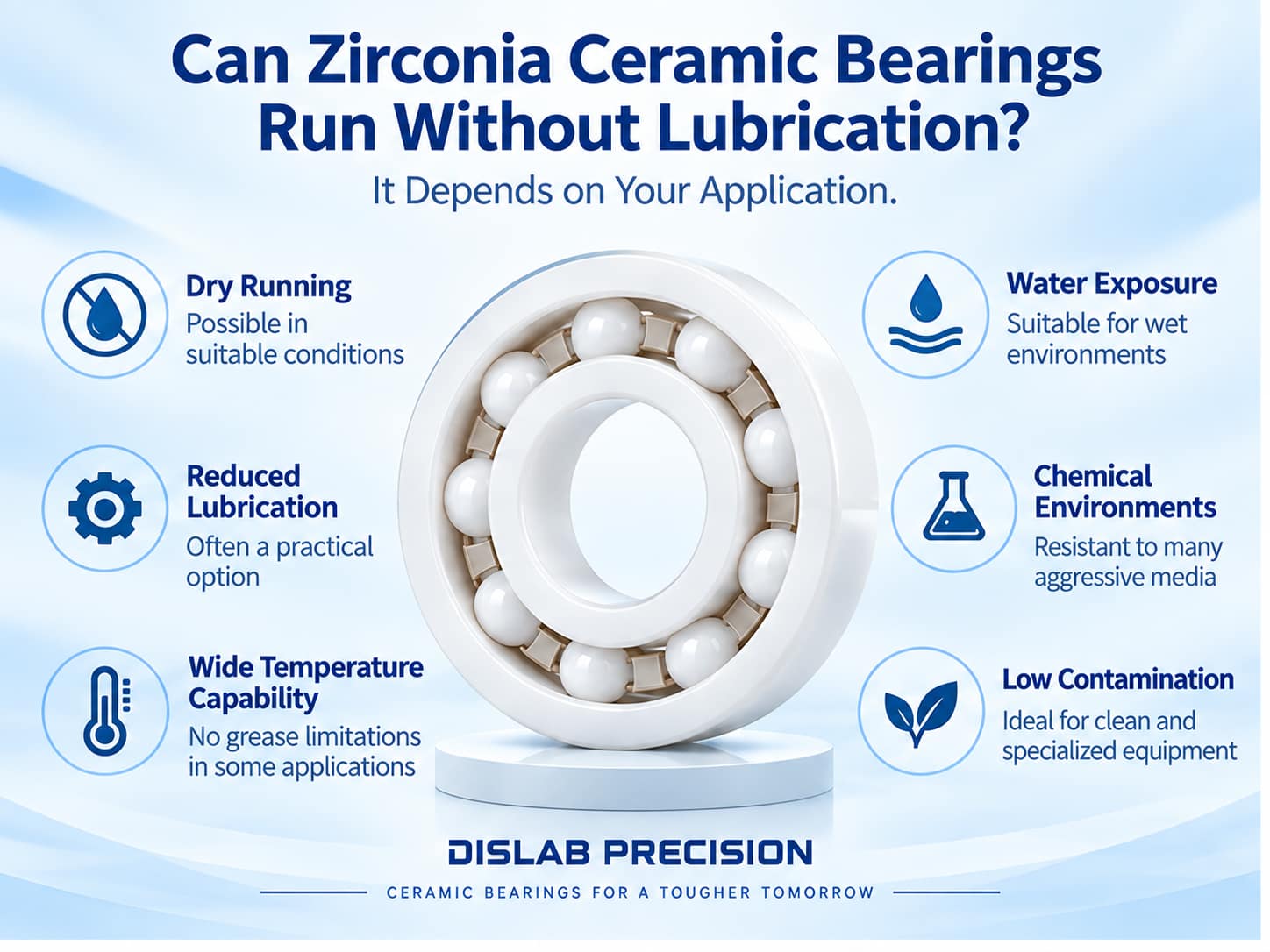
What Does “Without Lubrication” Actually Mean?
The phrase “without lubrication” is often used too broadly. In practice, several different operating conditions may be involved.
Dry Running
The bearing operates without conventional grease or oil.
Reduced Lubrication
The bearing uses less lubricant than a conventional steel-bearing application.
Process-Fluid Operation
Water or another surrounding fluid becomes part of the operating condition.
Intermittent Operation
Limited running time, low speed or low load may make no-grease operation more realistic.
These conditions should not be treated as equivalent.
Why Are Ceramic Bearings Considered for Dry Running?
Zirconia ceramic bearings are often considered for reduced-lubrication or dry-running applications because ZrO₂ provides corrosion resistance, electrical insulation and non-magnetic behavior while avoiding conventional steel rust.
This can be useful where grease is difficult to retain or where lubricant contamination is undesirable.
Typical application areas may include:
- clean equipment;
- water-exposed systems;
- chemical-processing equipment;
- laboratory mechanisms;
- washdown equipment;
- specialized food or pharmaceutical machinery.
For a broader introduction to the material itself, see
What Are Zirconia Ceramic Bearings?
Does Zirconia Mean Self-Lubricating?
No.
Zirconia should not be described as automatically self-lubricating.
A ZrO₂ bearing may be able to operate without conventional grease under suitable conditions, but friction, heat generation and contact stress still exist.
The more accurate engineering statement is:
Can Full Ceramic Bearings Run Dry?
In some applications, yes.
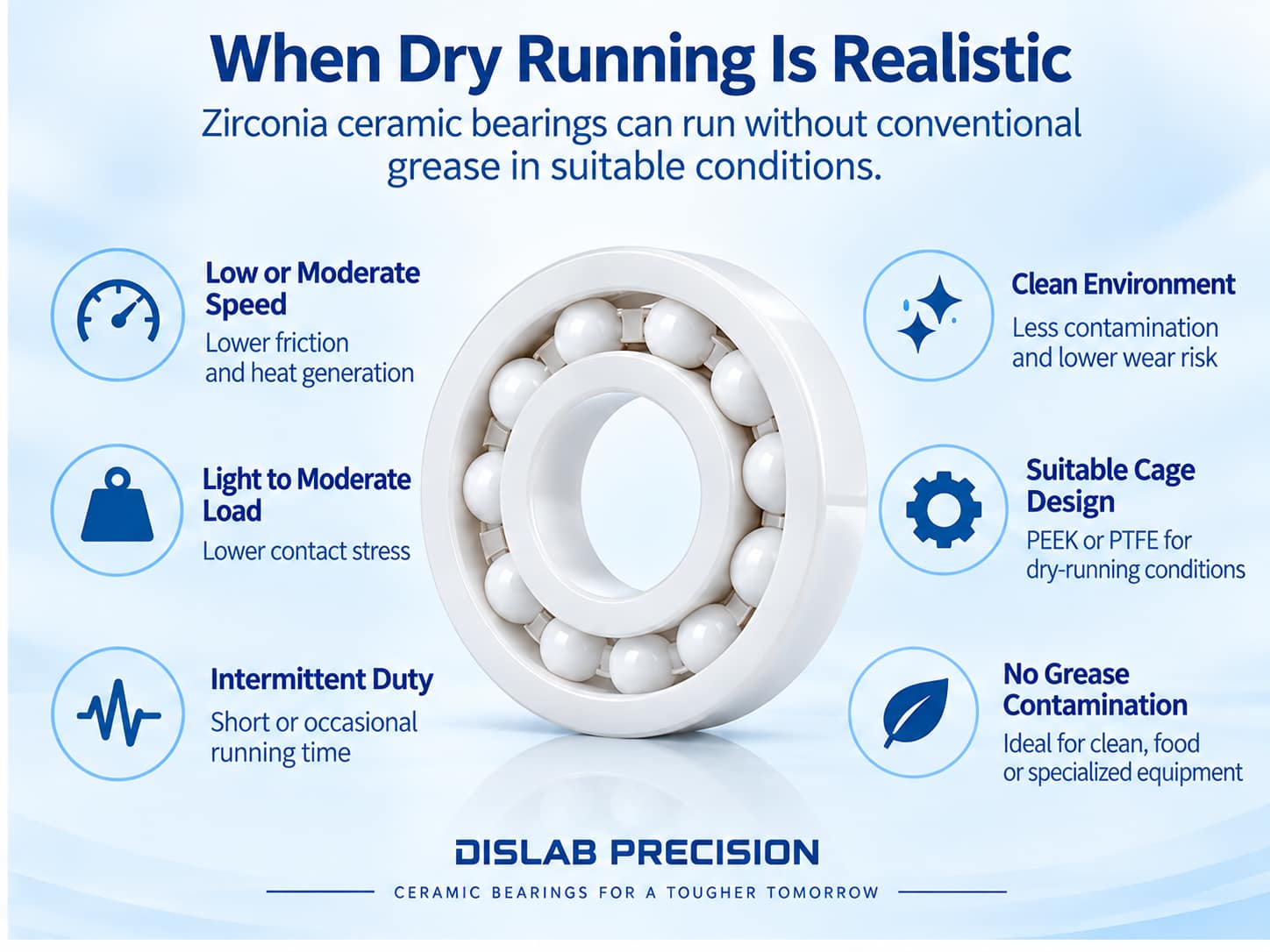
Dry-running operation becomes more realistic when:
- speed is relatively low or moderate;
- load is light or moderate;
- temperature is controlled;
- contamination is limited;
- duty cycle is intermittent or moderate;
- the cage design is suitable.
When Dry Running Is More Realistic
The most favorable starting point for dry-running ceramic bearings is generally a relatively mild mechanical operating condition.
Examples include:
- low or moderate RPM;
- light to moderate load;
- short running periods;
- intermittent motion;
- clean environments;
- applications where grease contamination should be avoided.
When Lubrication Is Still Recommended
Lubrication is still often beneficial or necessary when the bearing operates under more demanding mechanical conditions.
This includes:
- higher RPM;
- heavier loads;
- continuous duty;
- long service-life requirements;
- significant frictional heating;
- shock or vibration.
Lubrication may improve wear behavior, heat control, operating smoothness, noise and service life.
Dry Running vs Reduced Lubrication
In many industrial applications, reduced lubrication is more realistic than completely dry operation.
A zirconia bearing may operate successfully with:
- very light lubrication;
- minimal grease;
- intermittent lubrication;
- water or process-fluid exposure;
- no conventional grease in limited-duty conditions.
This is why the question “Can ceramic bearings run without grease?” should usually be replaced by:
How Do Speed and Load Affect Lubrication Need?
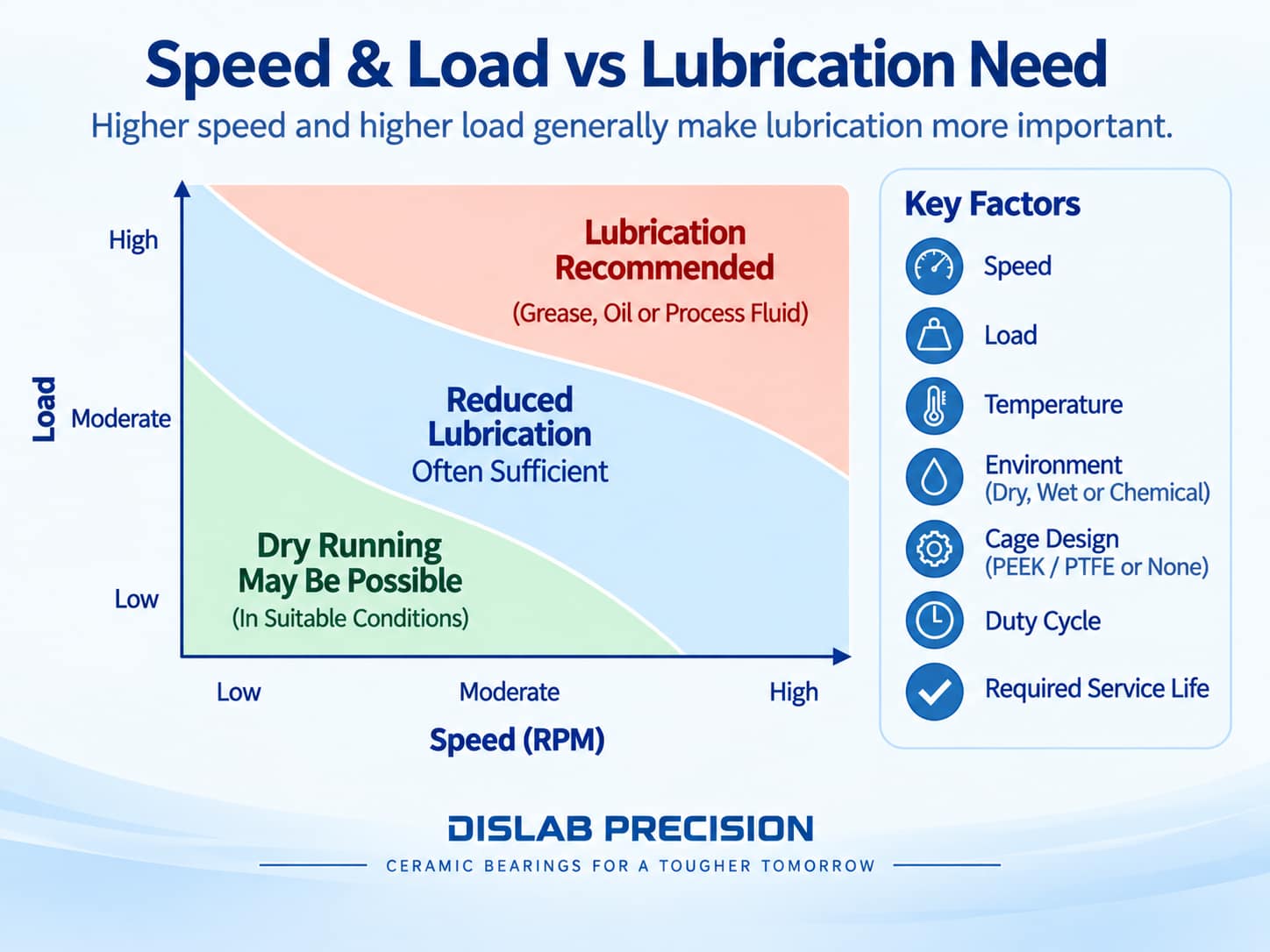
Speed and load are two of the most important practical variables.
| Operating Condition | General Lubrication Direction |
|---|---|
| Low speed + low load | Dry running may be possible in suitable conditions |
| Moderate speed + moderate load | Reduced lubrication may be a practical option |
| High speed | Lubrication becomes increasingly important |
| Heavy load | Lubrication becomes increasingly important |
| High speed + heavy load | Conventional lubrication is usually the safer starting point |
These are directional guidelines rather than universal operating limits.
What Happens If a Bearing Runs Dry at Too High a Speed?
As RPM rises, dry running becomes less forgiving.
Higher speed can increase:
- friction;
- contact heat;
- cage stress;
- rolling-element interaction;
- wear risk.
A bearing that operates successfully without grease at low speed may require lubrication at higher RPM.
What Role Does the Cage Play?
The cage is an important part of the dry-running decision.
A caged bearing keeps the balls separated and helps guide them, which can become increasingly valuable as speed rises.
However, the cage itself must tolerate dry-running friction, temperature and the surrounding environment.
Two common choices are PEEK and PTFE.
For a detailed cage comparison, see
PTFE vs PEEK Cage for Full Ceramic Bearings.
Is Full Complement Better for Dry Running?
Not automatically.
A full-complement bearing removes the conventional cage, which can be helpful when cage temperature or chemical compatibility is the limiting factor.
However, removing the cage also removes controlled ball separation.
Adjacent rolling elements can interact directly, making speed and friction important considerations.
For the full configuration comparison, see
Full-Complement vs Caged Ceramic Bearings: How to Choose.
Do Ceramic Bearings Need Grease at High Speed?
In many higher-speed applications, some form of lubrication remains beneficial or necessary.
Higher speed increases heat generation and makes stable rolling-element behavior more important.
Ceramic material alone does not remove these mechanical effects.
Can Zirconia Bearings Run in Water Instead of Grease?
In some applications, the surrounding water or process fluid becomes part of the operating condition.
This can occur in:
- submerged mechanisms;
- water-treatment systems;
- washdown equipment;
- selected pumps;
- marine or wet-environment machinery.
This is better described as water-exposed or process-fluid operation rather than simply “dry running.”
For more detail, see
Ceramic Bearings for Water, Seawater and Wet Environments.
Can Zirconia Bearings Run in Chemical Environments Without Grease?
In some applications, yes.
Conventional grease may be unsuitable because it can wash out, react with process chemicals, contaminate the product or degrade.
This can make dry-running, reduced-lubrication or process-fluid operation attractive.
For broader guidance, see
Ceramic Bearings for Corrosive and Chemical Environments.
What About Temperature?
Temperature affects dry-running performance in two ways.
Friction Generates Heat
Without lubrication, frictional heating may become more significant.
The Environment May Already Be Hot
Elevated ambient or process temperature reduces the available thermal margin.
Temperature can also affect:
- cage materials;
- internal clearance;
- wear;
- service life;
- shaft and housing fits.
What About Bearing Life?
A bearing may be physically capable of running dry without providing the longest possible service life.
This distinction matters.
A short-duty mechanism has very different requirements from a continuously rotating machine expected to operate for thousands of hours.
The relevant question is therefore:
Typical Applications for Reduced or No Lubrication
Potential applications include:
- clean equipment;
- food and pharmaceutical machinery;
- laboratory equipment;
- water-handling systems;
- washdown equipment;
- chemical-processing machinery;
- low-speed instruments;
- selected submerged systems.
How to Decide If Lubrication Is Needed
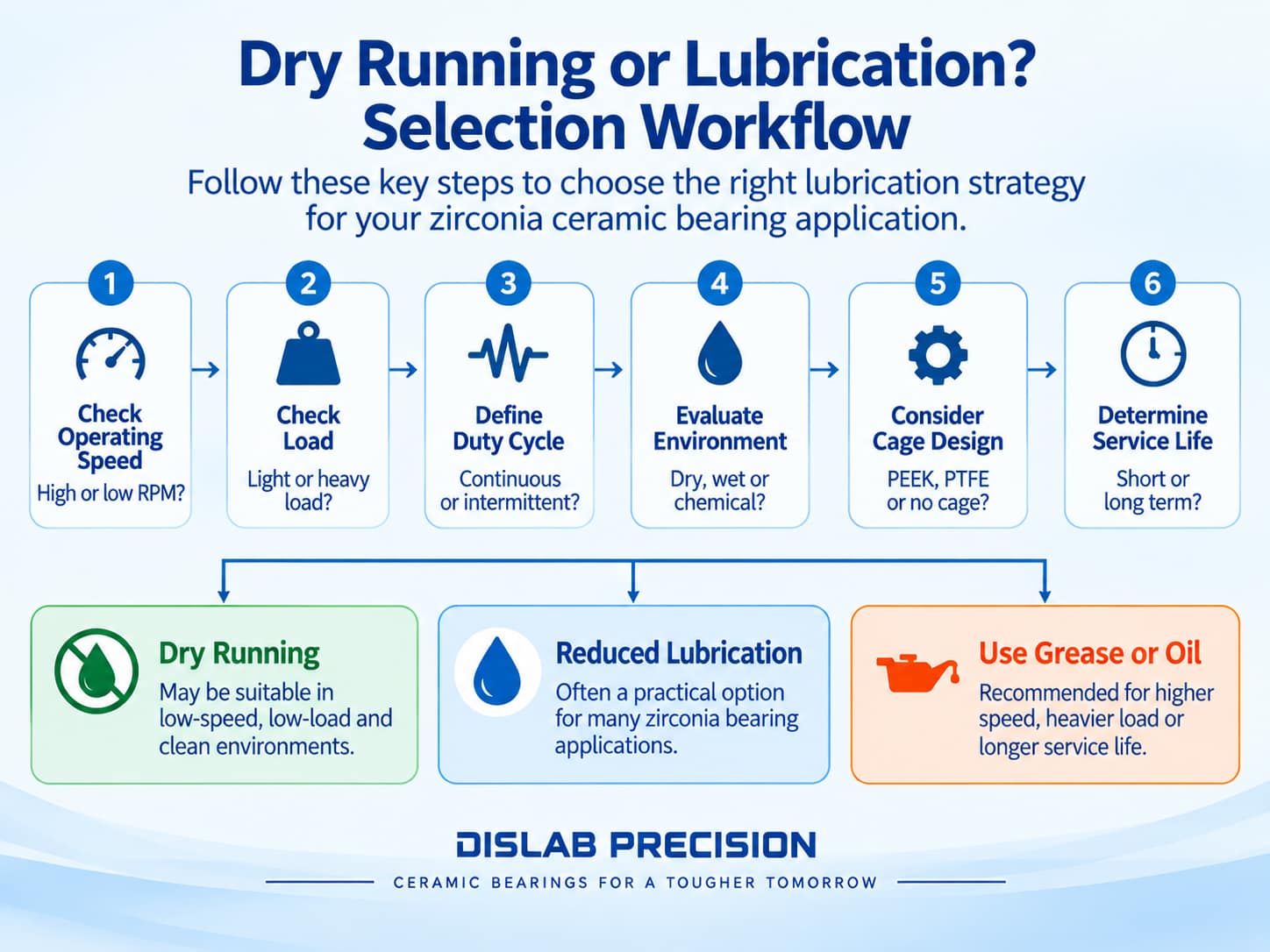
Higher RPM generally increases the value of lubrication.
Heavier load increases contact stress and makes dry running less forgiving.
Continuous operation is more demanding than short or intermittent motion.
Is the bearing running dry, in water or in a chemical/process fluid?
Evaluate PEEK, PTFE or full-complement construction.
Short-life and long-life applications may require different lubrication strategies.
Choose between dry running, reduced lubrication or conventional grease/oil based on the complete operating condition.
Common Selection Mistakes
Assuming Ceramic Means No Lubrication Is Ever Needed
This is too broad. Ceramic material does not eliminate friction, heat or contact stress.
Treating Dry Running and Water Operation as the Same
A bearing operating in water is different from a bearing running completely dry in air.
Ignoring Speed
Higher RPM is one of the most important reasons lubrication becomes more important.
Ignoring Load
Lightly loaded and heavily loaded bearings behave very differently without lubrication.
Ignoring the Cage
The cage can strongly influence dry-running behavior and allowable speed.
Assuming Full Complement Is Always Better
Removing the cage solves one limitation while removing ball separation.
Frequently Asked Questions
Can ceramic bearings run without lubrication?
Some ceramic bearings can operate without conventional lubrication under suitable speed, load, temperature and duty-cycle conditions.
Do zirconia bearings need grease?
Sometimes yes and sometimes no. The correct answer depends on speed, load, cage design, environment and required service life.
Are ceramic bearings self-lubricating?
Not automatically. Ceramic bearings may allow reduced-lubrication or dry-running operation in selected applications, but ceramic material itself does not eliminate lubrication requirements.
Can full ceramic bearings run dry?
Yes, in some applications—especially at relatively low or moderate speed and load. The complete operating condition still needs to be evaluated.
Is full complement better for dry running?
Not automatically. It removes the cage but also removes controlled ball separation, so speed and friction remain important.
Can ceramic bearings run in water without grease?
In some applications, yes. This should usually be described as water-exposed or process-fluid operation rather than purely dry running.
When is lubrication still recommended?
Lubrication becomes increasingly important at higher speed, heavier load, longer duty cycles and where maximum service life is required.
Need Help Choosing a Lubrication Strategy?
Provide the bearing model or dimensions, RPM, load, operating temperature, environment, duty cycle, cage preference and required quantity.
DISLAB Precision can help evaluate whether a ZrO₂ full ceramic bearing should run dry, use reduced lubrication or use a conventional lubrication strategy.
Technical information on this page is intended as a general selection guide. Final lubrication strategy and operating limits should be confirmed for the specific bearing size and application.