Are Ceramic Bearings Electrically Insulating and Non-Magnetic?
Full ceramic bearings can provide an unusual combination of electrical insulation, non-magnetic behavior and corrosion resistance. But full ceramic and hybrid ceramic bearings should not be treated as the same solution.
The correct choice depends on whether the application needs electrical isolation, low magnetic interference, corrosion resistance—or several of these properties at the same time.
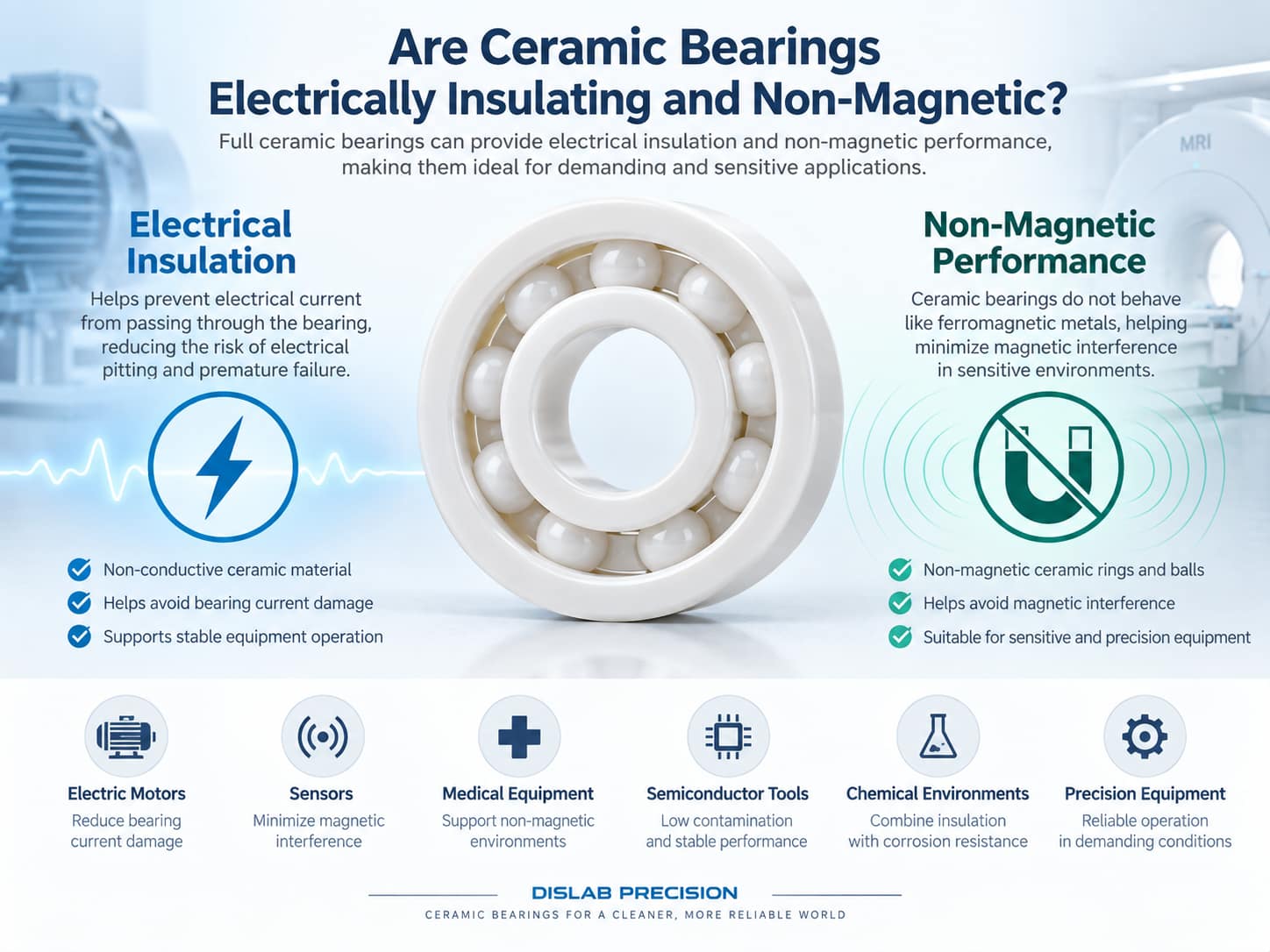
What Does Electrically Insulating Mean in a Bearing?
An electrically insulating bearing interrupts or strongly restricts the electrical current path through the rolling contacts.
This can matter because current passing through a conventional steel bearing can contribute to:
- electrical pitting;
- micro-cratering of raceways;
- fluting;
- lubricant degradation;
- premature bearing failure.
Electrical insulation is therefore particularly important in some motors, generators, inverter-driven equipment and electrically sensitive machinery.
What Does Non-Magnetic Mean?
A non-magnetic bearing uses materials that do not behave like conventional ferromagnetic bearing steels.
This can be important where magnetic fields may affect:
- sensors;
- measurement accuracy;
- medical equipment;
- scientific instruments;
- semiconductor equipment;
- magnetic particle contamination.
However, the bearing must be considered together with the shaft, housing, fasteners and other nearby components.
Full Ceramic vs Hybrid Ceramic Bearings
| Feature | Full Ceramic Bearing | Hybrid Ceramic Bearing |
|---|---|---|
| Rings | Ceramic | Steel |
| Rolling elements | Ceramic | Usually Si₃N₄ ceramic |
| Electrical insulation | Excellent when insulating-grade ceramic components are used | Excellent across the rolling-contact path because ceramic rolling elements interrupt current flow |
| Non-magnetic bearing construction | Possible with suitable ceramic and non-metallic components | No—the steel rings remain part of the bearing |
| Typical reason to choose | Electrical isolation + corrosion resistance + non-magnetic requirement | Electrical insulation + high-speed / conventional steel-ring performance |
How Full Ceramic Bearings Provide Electrical Insulation
In a full ceramic bearing, both rings and rolling elements are ceramic rather than bearing steel.
Standard insulating-grade ZrO₂ and Si₃N₄ bearing materials provide very high electrical resistance compared with steel.
This can make full ceramic bearings attractive when the design requires electrical isolation together with other ceramic properties.
Are Zirconia Bearings Electrically Insulating?
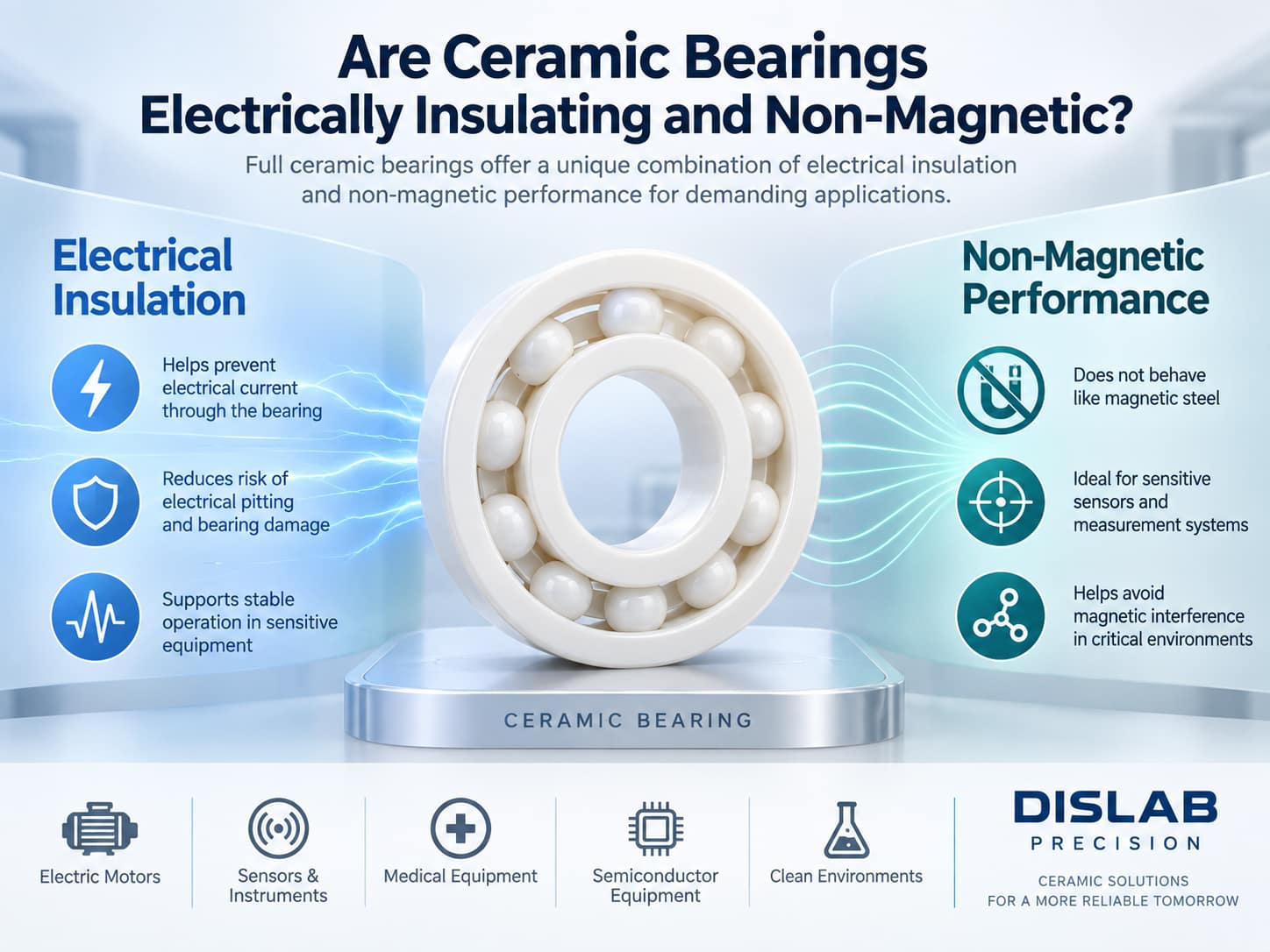
Standard ZrO₂ full ceramic bearings used for conventional insulating applications are non-conductive compared with metallic bearing materials.
This makes zirconia attractive where the application combines:
- electrical insulation;
- corrosion resistance;
- water resistance;
- non-magnetic requirements;
- clean or chemically demanding conditions.
For broader zirconia material guidance, see
What Are Zirconia Ceramic Bearings?.
Are Zirconia Bearings Non-Magnetic?
Full ceramic zirconia bearings are commonly selected for applications where magnetic interference should be minimized.
With appropriate non-metallic cage and component choices, they can provide a bearing construction without the conventional magnetic steel rings and balls found in standard bearings.
This can be important in sensitive instrumentation, medical systems and other magnetic-field-sensitive equipment.
What About Silicon Nitride?
Si₃N₄ ceramic is also electrically insulating and non-magnetic.
Silicon nitride is particularly important in hybrid bearings because ceramic rolling elements can interrupt electrical current paths while retaining steel rings.
Compared with zirconia, Si₃N₄ also provides lower density and lower thermal expansion, which can make it attractive for higher-speed applications.
For the material comparison, see
Zirconia vs Silicon Nitride Ceramic Bearings.
Can Hybrid Ceramic Bearings Prevent Bearing-Current Damage?
Yes.
This is one of the established uses of Si₃N₄ hybrid bearings in electric motors and generators.
The ceramic rolling elements act as an insulating barrier between the inner and outer steel rings and can significantly reduce damaging electrical-current passage through the rolling contacts.
That makes hybrid bearings a strong option when the main requirement is electrical insulation rather than fully non-magnetic construction.
Does the Cage Matter?
Yes, especially when several environmental requirements need to be met at the same time.
Common full ceramic bearing cage materials include PEEK and PTFE.
PEEK Cage
Provides strong mechanical cage performance together with electrical insulation and good chemical resistance.
PTFE Cage
Provides very low friction, broad chemical resistance and non-metallic construction.
For cage selection, see
PTFE vs PEEK Cage for Full Ceramic Bearings.
What About Full-Complement Bearings?
A full-complement ceramic bearing removes the conventional cage entirely.
This can eliminate another potentially metallic component from the bearing and may be useful in some sensitive environments.
However, full complement usually sacrifices speed capability because the rolling elements are no longer separated by a cage.
For more detail, see
Full-Complement vs Caged Ceramic Bearings: How to Choose.
Electrical Insulation Does Not Mean the Whole Machine Is Isolated
Even when the bearing itself provides electrical isolation, other conductive paths may remain through:
- shafts;
- housings;
- couplings;
- grounding straps;
- lubricants or contamination;
- other machine components.
For electrical machinery, grounding, inverter design and system-level current paths should still be reviewed.
Non-Magnetic Bearing Does Not Mean Non-Magnetic Machine
The same principle applies to magnetic behavior.
A non-magnetic full ceramic bearing does not make the surrounding shaft or housing non-magnetic.
For highly sensitive applications, the complete assembly should be checked.
Additional Benefits of Full Ceramic Bearings
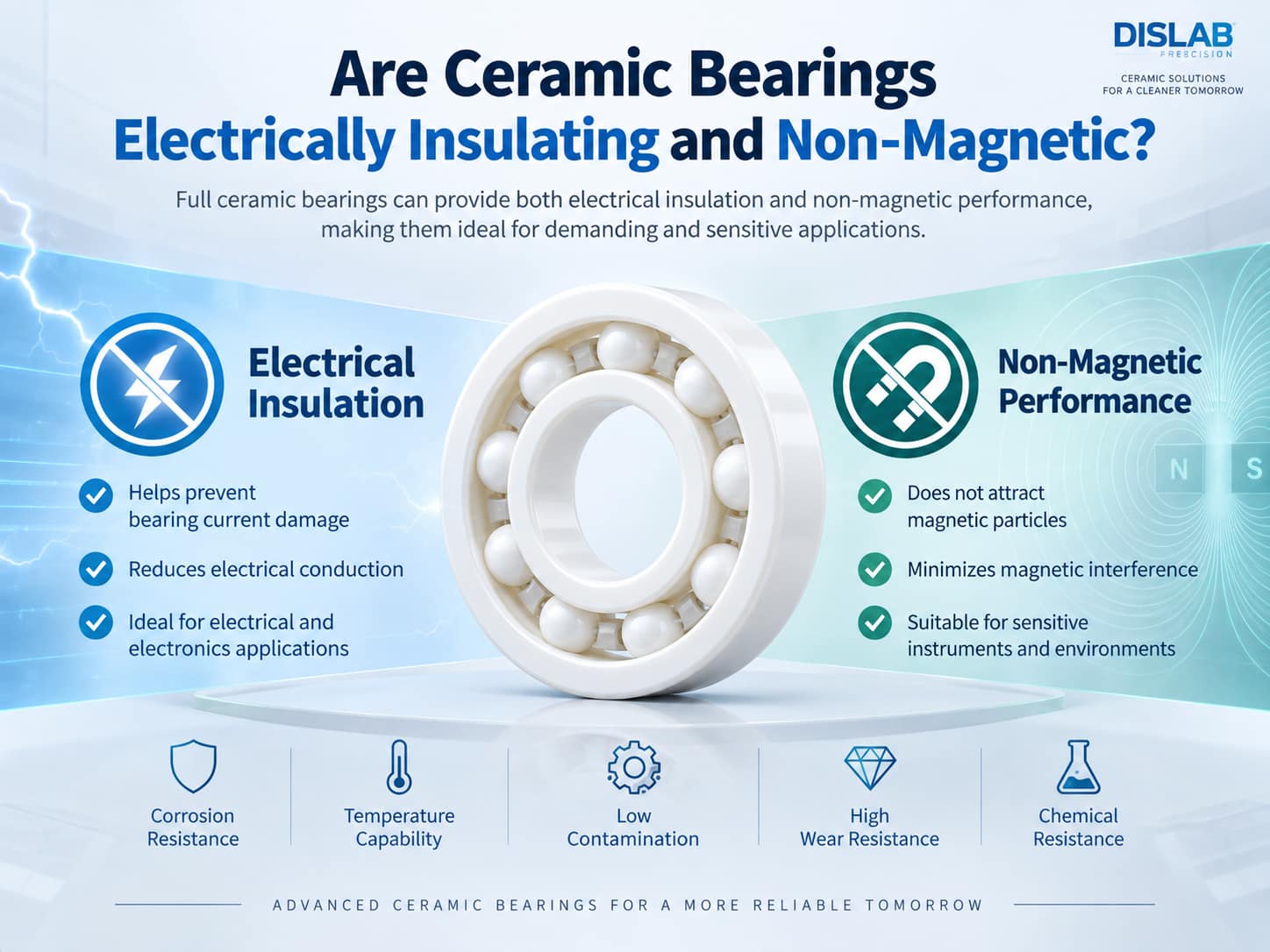
Electrical insulation and low magnetic interference may appear together with other requirements.
Full ceramic bearings can also provide:
- corrosion resistance;
- chemical resistance;
- water resistance;
- low contamination;
- special temperature capability;
- operation without conventional grease in selected applications.
This combination is often more important than any single property in isolation.
Where Do These Properties Matter?
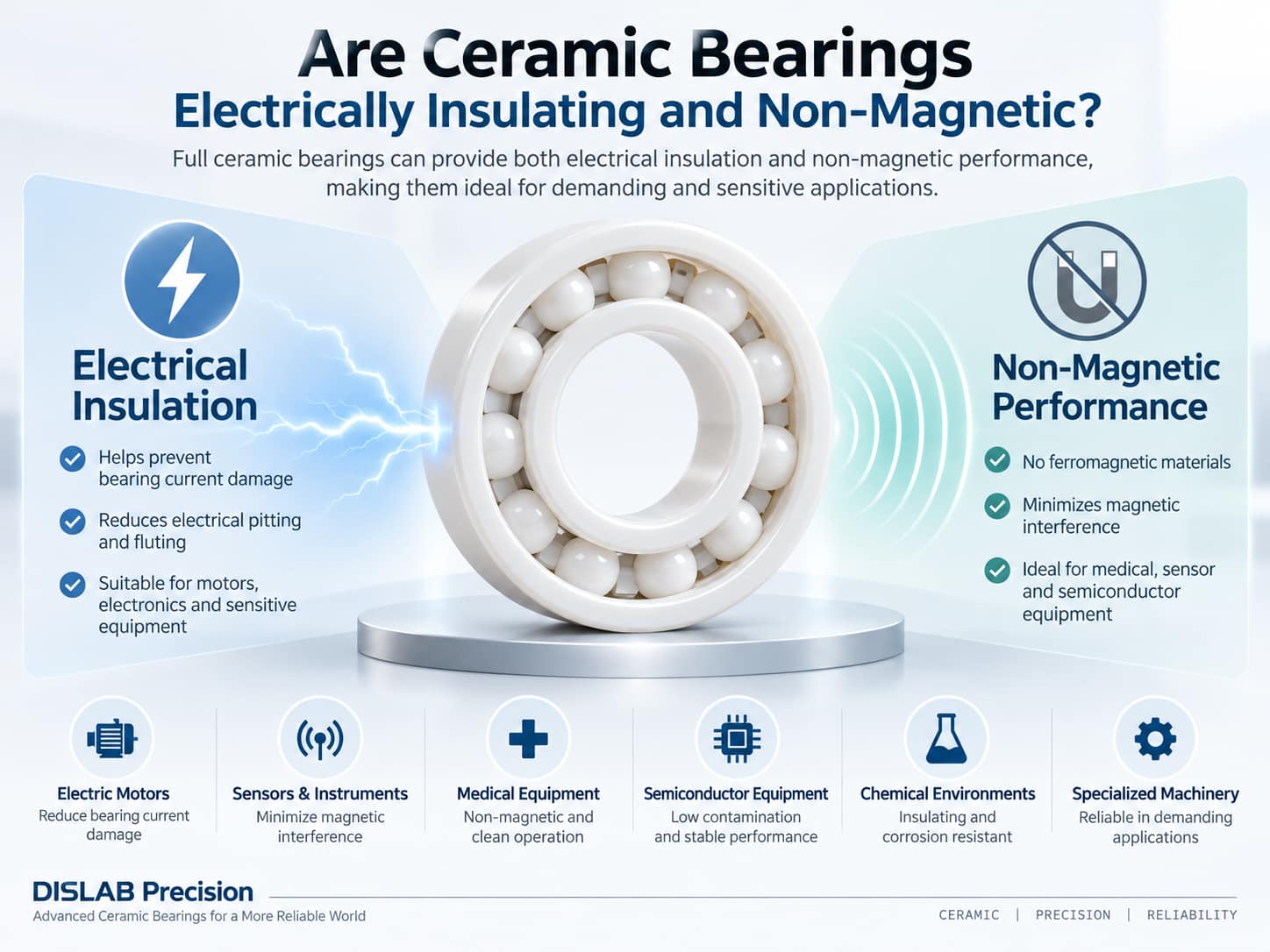
Electric Motors and Generators
Electrical insulation can help reduce damage associated with current passing through rolling contacts.
Sensors and Measuring Instruments
Low magnetic interference can be valuable when the bearing operates near sensitive measurement systems.
Medical Equipment
Non-magnetic bearing materials may be useful in specialized medical equipment where magnetic interference must be minimized. The complete system must still be evaluated for the specific medical environment.
Semiconductor Equipment
Electrical isolation, corrosion resistance and low contamination can all be valuable in precision semiconductor machinery.
Laboratory and Scientific Equipment
Non-magnetic and electrically insulating components can help reduce unwanted interactions with sensitive instruments.
Chemical and Wet Environments
Zirconia can combine insulation and non-magnetic behavior with strong corrosion resistance.
See
Ceramic Bearings for Corrosive and Chemical Environments
and
Ceramic Bearings for Water, Seawater and Wet Environments.
How to Choose Between Full Ceramic and Hybrid
Consider Full Ceramic When
- non-magnetic bearing construction is important;
- corrosion resistance is also required;
- wet or chemical exposure is present;
- electrical insulation is required;
- metal contamination should be minimized.
Consider Hybrid When
- electrical insulation is the main requirement;
- higher speed is important;
- steel-ring load capability is desired;
- the application is an electric motor or generator;
- full non-magnetic construction is not required.
Questions to Ask Before Selection
- Is electrical insulation required?
- Is non-magnetic bearing construction also required?
- Would a hybrid bearing meet the electrical requirement?
- Is corrosion resistance important?
- What are the RPM and load?
- What is the operating temperature?
- Is the environment dry, wet or chemical?
- Is PEEK, PTFE or full complement preferred?
- Do shaft and housing materials also need to be non-magnetic?
- Is a specific electrical resistivity requirement defined?
Common Selection Mistakes
Assuming Hybrid Bearings Are Not Electrically Insulating
Si₃N₄ rolling elements can provide highly effective electrical isolation between steel rings.
Assuming Electrical Insulation Means Non-Magnetic
These are different properties. A hybrid bearing can be electrically insulating while still containing steel rings.
Assuming Every Zirconia Grade Has the Same Electrical Resistivity
Special conductive and static-dissipative zirconia formulations exist.
Ignoring the Complete Assembly
The bearing may be non-magnetic or insulating while surrounding components are not.
Selecting From Electrical Properties Alone
Load, RPM, temperature, corrosion and configuration still matter.
Frequently Asked Questions
Are ceramic bearings electrically insulating?
Full ceramic bearings made from insulating-grade ceramics can provide excellent electrical insulation. Hybrid ceramic bearings with Si₃N₄ rolling elements can also provide strong electrical insulation across the rolling contacts.
Are ceramic bearings non-magnetic?
Full ceramic bearings made from suitable ceramic and non-metallic components can provide non-magnetic bearing construction. Hybrid bearings still contain steel rings.
Are zirconia bearings electrically insulating?
Standard insulating-grade ZrO₂ full ceramic bearings are non-conductive compared with steel, although specialized conductive or static-dissipative zirconia formulations also exist.
Are zirconia bearings non-magnetic?
Yes, full ceramic zirconia bearings are commonly selected for applications requiring non-magnetic bearing materials.
Are hybrid ceramic bearings electrically insulating?
Yes. Si₃N₄ ceramic rolling elements can interrupt electrical current paths between the inner and outer steel rings.
Are hybrid ceramic bearings non-magnetic?
Not as a complete bearing construction, because their inner and outer rings are normally steel.
Can ceramic bearings prevent electrical bearing damage?
They can help prevent current from passing through the rolling contact path, but the complete electrical system and grounding arrangement should still be evaluated.
Need an Electrically Insulating or Non-Magnetic Bearing?
Provide the bearing model or dimensions, RPM, load, operating temperature, environment, electrical insulation requirement, non-magnetic requirement and required quantity.
DISLAB Precision can help evaluate whether a ZrO₂ full ceramic bearing, Si₃N₄ full ceramic bearing or hybrid ceramic configuration best matches your application.
Technical information on this page is intended as a general engineering guide. Electrical insulation, magnetic behavior and bearing suitability should be confirmed against the actual material grade, bearing configuration and complete machine design.