What Are Zirconia Ceramic Bearings? Properties, Advantages and Limitations
Zirconia ceramic bearings are full ceramic bearings that use zirconium oxide, commonly written as ZrO₂, for the bearing rings and rolling elements.
They are designed for applications where conventional bearing steel may face problems such as corrosion, electrical conductivity, magnetic interference or incompatibility with the surrounding operating environment. See the guide to electrical insulation and non-magnetic performance.
But replacing steel with ceramic does not automatically make a bearing better. Zirconia has a very different combination of hardness, toughness, thermal expansion, electrical behavior and corrosion resistance compared with bearing steel and other engineering ceramics.
Those differences create useful advantages in the right application—but they also create limitations that engineers and buyers need to understand.

What Is Zirconia, or ZrO₂?
Zirconia is the common engineering name for zirconium dioxide, ZrO₂. It belongs to the family of advanced technical ceramics used in demanding mechanical, electrical and industrial applications.
Unlike ordinary ceramics, engineering zirconia is manufactured and processed to achieve controlled mechanical and physical properties.
One of zirconia’s most important characteristics is its combination of high strength and relatively high fracture toughness for a technical ceramic.
Ceramics are normally associated with hardness but also brittleness. Zirconia is different because stabilized zirconia compositions can resist crack propagation better than many traditional technical ceramics.
This does not make zirconia ductile like steel, but it helps explain why the material can be used for mechanically loaded components such as bearing rings and rolling elements.
How Is a Zirconia Ceramic Bearing Constructed?
A full zirconia ceramic bearing typically uses ZrO₂ for both the inner and outer rings and for the ceramic balls.
The internal configuration can vary. Some designs use a polymer cage to separate and guide the rolling elements. PTFE and PEEK are examples of engineering polymers that may be used depending on temperature, speed and application requirements. For a detailed comparison, see PTFE vs PEEK ceramic bearing cages.
Other designs use a full-complement or cage-less arrangement. Seals or shields may also be available in certain configurations, although their materials can influence the operating limits of the complete bearing.
For commercial sizes and available configurations, see the
DISLAB Precision Zirconia Full Ceramic Bearing range.
Key Properties of Zirconia Ceramic Bearings
Understanding ZrO₂ bearings starts with the properties that distinguish zirconia from conventional bearing steel.
| Property | Engineering Significance |
|---|---|
| Corrosion resistance | Useful where conventional steel rust or chemical attack is a concern. |
| Electrical insulation | Useful where electrical current through metallic bearing components is undesirable. |
| Non-magnetic behavior | Suitable for selected magnetically sensitive equipment and instruments. |
| High hardness | Supports wear resistance at rolling and raceway surfaces. |
| High toughness for a ceramic | Provides better resistance to crack propagation than many conventional technical ceramics. |
| Relatively low thermal conductivity | Transfers heat differently from metallic bearing materials. |
| Thermal expansion closer to steel than Si₃N₄ | Can be useful when evaluating fits with metallic shafts and housings. |
| Higher density than Si₃N₄ | Less attractive where minimum rotating mass is the primary design objective. |
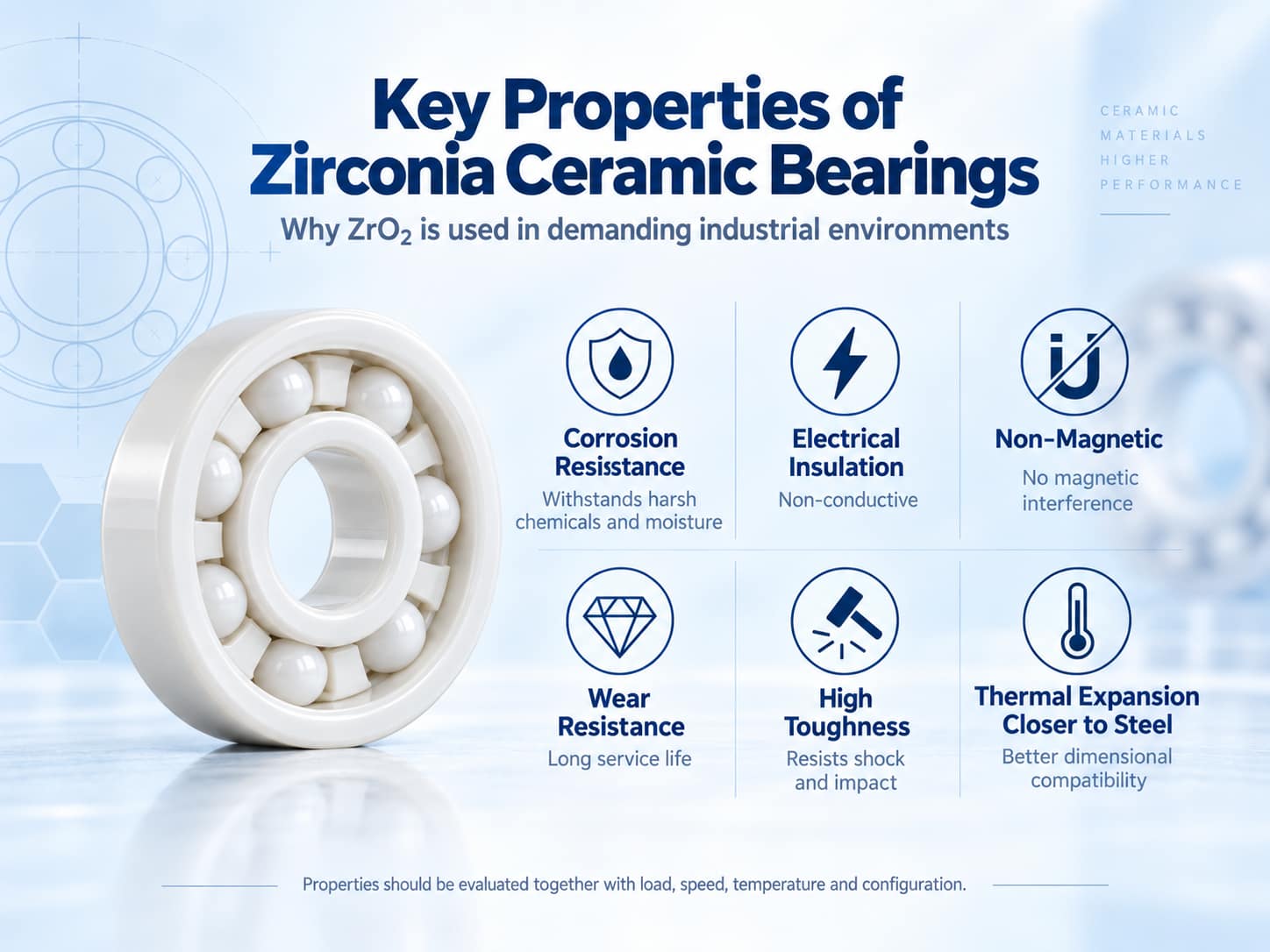
1. Corrosion Resistance
Corrosion resistance is one of the main reasons engineers consider zirconia bearings.
Conventional bearing steels can rust when exposed to moisture, salt, cleaning fluids or aggressive process environments. Even stainless steel has limitations depending on alloy grade, temperature and chemical exposure.
Zirconia eliminates conventional metallic rust from the primary rings and rolling elements because these components are ceramic.
This makes full ceramic ZrO₂ bearings interesting for equipment exposed to moisture, washdown, water, salt and selected corrosive and chemical environments.
2. Electrical Insulation
Zirconia is an electrically insulating ceramic.
This can make a full ceramic bearing useful where electrical current passing through conventional metallic bearing components would be undesirable.
Potential applications may include:
- electrically sensitive equipment;
- measuring instruments;
- selected motor systems;
- semiconductor equipment;
- laboratory machinery.
Buyers should distinguish between a full ceramic bearing and a hybrid ceramic bearing.
A hybrid bearing normally uses ceramic rolling elements with metallic rings. When electrical isolation is critical, evaluate the complete bearing construction rather than assuming that every product described as a ceramic bearing behaves the same way.
3. Non-Magnetic Performance
Zirconia itself is non-magnetic, making full ceramic bearings attractive for selected applications where conventional ferromagnetic bearing materials are undesirable.
Possible uses may include sensitive instruments, measurement systems and specialized electrical equipment.
However, the complete construction still matters. Metallic seals, retainers or surrounding components can change the magnetic behavior of the complete assembly.
4. Hardness, Wear Resistance and Toughness
Zirconia combines high hardness with unusually good toughness for an engineering ceramic.
Hardness contributes to wear resistance at the rolling contacts, while toughness helps resist crack propagation.
This combination is one reason zirconia can be used for mechanically loaded components such as bearing rings and balls.
However, zirconia should not be treated as if it behaves exactly like bearing steel.
Steel is ductile. Zirconia remains a ceramic.
Ceramic bearing rings therefore require appropriate handling and installation. Severe impact, excessive interference, poor alignment or improper mounting methods can damage the bearing. Review zirconia ceramic bearing installation before mounting.
5. Thermal Expansion
Zirconia has a relatively high coefficient of thermal expansion compared with ceramics such as silicon nitride.
Its thermal expansion is closer to that of many metallic engineering materials than Si₃N₄.
This can sometimes be beneficial when zirconia bearings are installed on steel shafts or in metallic housings, but it does not remove the need for fit calculations.
As temperature changes, the shaft, housing, inner ring and outer ring can expand at different rates.
This may change:
- internal clearance;
- interference fit;
- ring stress;
- running behavior.
6. Temperature Capability
Ceramic materials are often associated with high-temperature performance, but bearing temperature limits are frequently misunderstood.
A complete bearing may include a cage, seals, lubricant or other materials that reach their operating limits before the ceramic rings or balls do.
For example, PTFE-caged and PEEK-caged bearings do not necessarily share the same temperature limits.
A full-complement bearing creates another set of operating considerations.
Load and speed may also need to be reduced as operating temperature increases. For a detailed evaluation, review the complete-bearing temperature limits.
Can Zirconia Ceramic Bearings Run Without Lubrication?
In selected applications, a full ceramic bearing can operate without conventional oil or grease.
This can be valuable where lubricant contamination is undesirable or where conventional lubricants are difficult to use.
However, describing zirconia bearings simply as “self-lubricating” can be misleading.
Dry-running suitability depends on:
- bearing size;
- load;
- speed;
- internal construction;
- cage material;
- temperature;
- surrounding medium;
- required operating life.
Dry operation should therefore be treated as an engineering condition rather than assumed from the ceramic material alone. For the relevant application factors, review when dry running is appropriate.
Zirconia Bearings in Water and Wet Environments
Wet environments are an important application area for zirconia full ceramic bearings.
Because ceramic rings and rolling elements do not rust like conventional bearing steel, ZrO₂ bearings may be considered for:
- water-related machinery;
- washdown systems;
- pumps;
- marine equipment;
- humid processing environments.
But the word “water” covers many different conditions.
Cold fresh water, salt water, chemically treated water, hot water and steam are not equivalent operating environments.
Temperature, dissolved chemicals, contamination and exposure duration should all be considered before final bearing selection.
Main Advantages and Limitations

Main Advantages
- excellent corrosion resistance;
- electrical insulation;
- non-magnetic ceramic construction;
- good wear resistance;
- high toughness for a ceramic;
- suitable for selected lubricant-free applications;
- available in common deep-groove bearing formats.
Main Limitations
- ceramic rings remain sensitive to severe impact;
- higher density than Si₃N₄;
- temperature limits depend on the complete configuration;
- chemical compatibility must be application-specific;
- usually higher cost than standard steel bearings.
Where Are Zirconia Ceramic Bearings Used?
Zirconia bearings are most relevant where the operating environment creates a real reason to move away from conventional metallic bearings.
Typical application areas can include:
- chemical and process equipment;
- water-related machinery;
- marine systems;
- food-processing equipment;
- laboratory devices;
- electrically sensitive machinery;
- specialized industrial equipment.
The application name alone is not enough to select a bearing.
Two machines in the same industry may require completely different materials if their temperature, speed, chemical exposure or loading conditions differ.
Zirconia vs Steel Bearings
Zirconia and steel bearings solve different engineering problems.
Steel remains the standard choice for most conventional machinery because it offers an effective combination of toughness, load capacity, availability, speed capability and cost.
Zirconia becomes more attractive when corrosion resistance, electrical insulation, magnetic behavior or environmental compatibility become important design constraints.
A zirconia bearing should therefore not be considered a universal upgrade from steel.
For a broader comparison between steel, hybrid ceramic and full ceramic designs, read
Ceramic Bearings vs Steel Bearings.
Zirconia vs Silicon Nitride Bearings
ZrO₂ and Si₃N₄ are both widely used technical ceramics, but they should not be treated as interchangeable.
Zirconia is relatively dense and has thermal expansion closer to steel. It is especially attractive for many corrosion-resistant, wet and general industrial full ceramic applications.
Silicon nitride has significantly lower density and lower thermal expansion and is often favored where high-speed potential, reduced rotating mass and thermal stability are important.
Neither material is universally better.
For a detailed engineering comparison, read
Zirconia vs Silicon Nitride Ceramic Bearings: ZrO₂ vs Si₃N₄.
When Is Zirconia the Better Choice?
Zirconia deserves serious consideration when corrosion resistance, electrical insulation or non-magnetic behavior is central to the application and operating speed does not strongly favor a lower-density ceramic.
It can also be a practical material when a buyer needs a familiar deep-groove bearing format but conventional bearing steel is incompatible with the environment.
Before selection, confirm the operating medium, temperature, speed, load, shaft and housing materials, lubrication condition and mounting method.
When Might Another Bearing Material Be Better?
Steel may be preferable where the operating environment is clean and lubricated, cost is a major priority, shock loading is severe and there is no requirement for electrical insulation or corrosion resistance.
A hybrid ceramic bearing may be suitable where lower rolling-element mass or electrical-current control is needed while retaining metallic rings.
Silicon nitride may be preferable where high speed, minimum rotating mass and low thermal expansion are major priorities.
Engineering-plastic bearings may be a practical choice for light-duty, cost-sensitive or corrosion-resistant applications, but their rigidity, dimensional stability, load capability and temperature range may be more limited than those of a properly selected zirconia ceramic bearing.
The objective is not to select the most exotic material. The objective is to select the bearing system that best matches the real operating condition.
How to Select a Zirconia Ceramic Bearing
Before requesting a quotation or engineering recommendation, collect the basic operating data. Use the zirconia ceramic bearing specification guide to organize the required details.
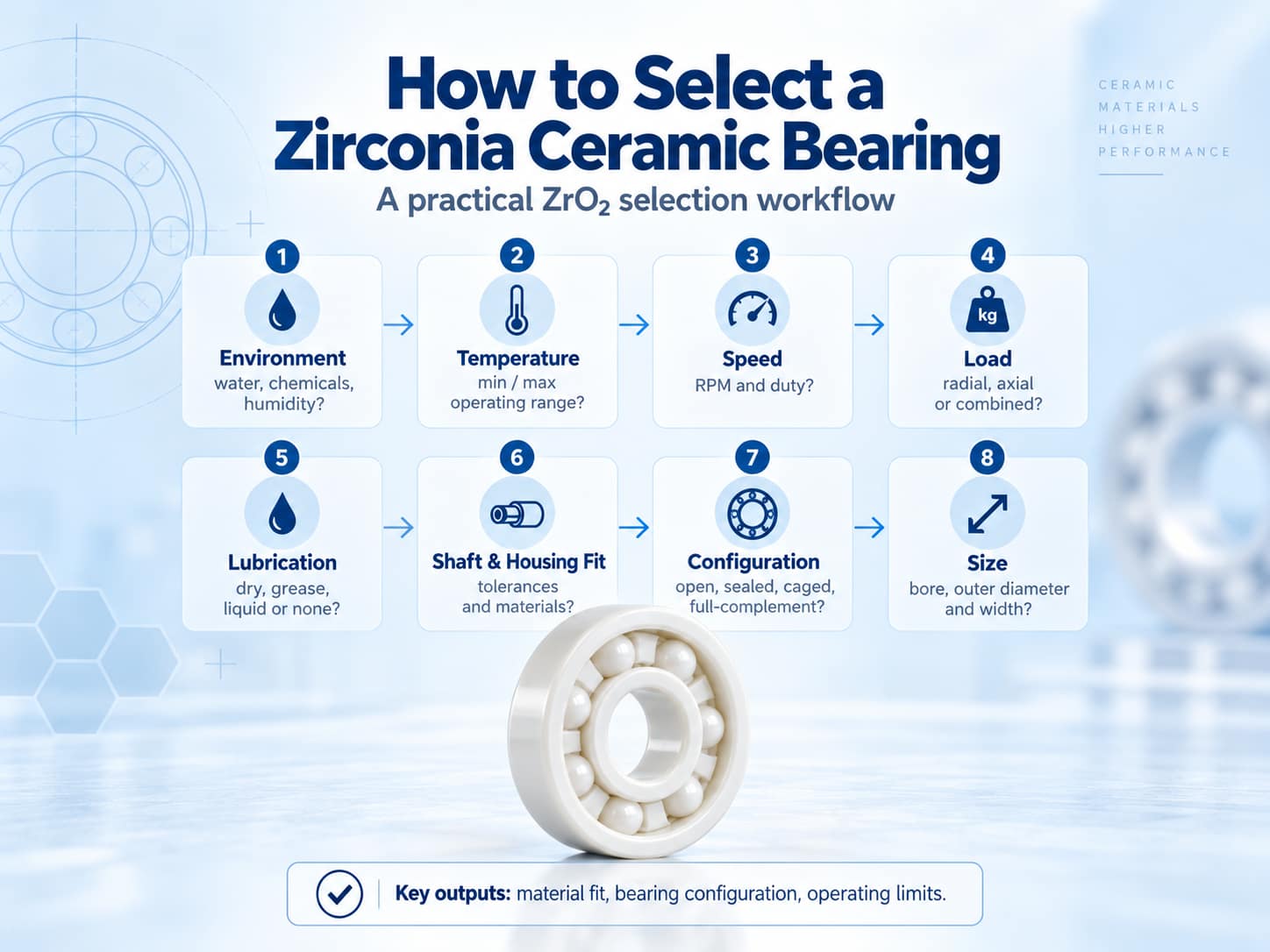
Identify water, salt, humidity, chemicals, contamination or other process media.
Provide continuous operating temperature and short-term peak temperature.
Provide normal and maximum RPM together with duty cycle where relevant.
Identify radial, axial and any shock or impact loading.
Confirm whether the bearing will use grease, oil, process fluid or dry-running conditions.
Provide materials, tolerances and installation details where known.
Choose between open, sealed, caged or full-complement designs as required.
Provide the bearing number or bore × outside diameter × width.
| Selection Item | Information to Provide |
|---|---|
| Bearing size | Bearing number or bore × OD × width |
| Speed | Normal and maximum RPM |
| Load | Radial, axial and shock load where applicable |
| Temperature | Continuous and peak temperature |
| Environment | Water, salt, humidity, vacuum or contamination |
| Chemical exposure | Chemical name, concentration and temperature |
| Lubrication | Grease, oil, dry operation or process fluid |
| Shaft / housing | Material and fit where known |
| Configuration | Open, sealed, caged or full-complement |
| Quantity | Prototype, maintenance quantity or production volume |
For standard dimensions and sourcing information, visit the
DISLAB Precision Zirconia Ceramic Bearing product page.
Frequently Asked Questions
What are zirconia ceramic bearings made from?
Full zirconia ceramic bearings use ZrO₂ ceramic for the inner ring, outer ring and rolling elements. Depending on the configuration, the bearing may also include a polymer cage, seals or other auxiliary components.
Are zirconia bearings completely rust proof?
The ceramic rings and balls do not rust in the same way as conventional bearing steel. Chemical compatibility should still be checked for the actual medium, concentration and temperature, and any non-ceramic components must also be considered.
Are zirconia ceramic bearings electrically insulating?
Zirconia is an electrically insulating ceramic. A full ceramic construction can therefore be useful in electrically sensitive applications. The complete assembly should still be reviewed where seals, cages or other components are involved.
Are zirconia bearings magnetic?
ZrO₂ ceramic itself is non-magnetic. If the application requires a completely non-magnetic bearing assembly, verify cage, seal and auxiliary materials as well.
Can zirconia bearings run in water?
They can be suitable for many water and wet-environment applications because ceramic rings and rolling elements do not suffer conventional steel rust. Water chemistry, temperature and operating conditions should still be specified.
Can zirconia ceramic bearings run dry?
Some configurations can operate without conventional grease or oil under suitable conditions. Dry-running capability depends on speed, load, cage design, temperature and required service life.
Are zirconia bearings better than steel bearings?
Not universally. Zirconia provides important advantages where corrosion resistance, electrical insulation or non-magnetic behavior is required. Steel remains the practical choice for many conventional, well-lubricated machines.
Which is better: zirconia or silicon nitride?
It depends on the application. Zirconia is often attractive for corrosion-resistant and general industrial full ceramic applications. Silicon nitride generally offers stronger advantages where low density, high-speed potential and low thermal expansion are priorities.
Need a Zirconia Ceramic Bearing for Your Application?
Selecting a ceramic bearing starts with the operating conditions—not only the bearing number.
Send DISLAB Precision your bearing model or dimensions together with operating speed, load, temperature, surrounding medium, lubrication conditions and required quantity.
We can help determine whether a ZrO₂ full ceramic bearing is appropriate and identify a suitable standard or application-specific configuration.
Technical information on this page is intended as a general selection guide. Final bearing material, configuration and operating limits should be confirmed against the actual application conditions.