PTFE vs PEEK Cage for Full Ceramic Bearings: How to Choose
The cage is easy to overlook when selecting a full ceramic bearing. Buyers often focus first on whether the rings and balls should be zirconia (ZrO₂) or silicon nitride (Si₃N₄), while the cage is treated as a secondary detail.
In practice, the cage can strongly influence bearing performance. Two common non-metallic cage materials are PTFE and PEEK.
In general, PEEK offers higher mechanical strength and dimensional stability, while PTFE is particularly attractive for very low friction and broad chemical resistance.
Neither is universally better. The correct choice depends on speed, load, temperature, chemical exposure, lubrication and required service life.

What Does the Cage Do in a Ceramic Bearing?
The cage, also called a retainer or separator, keeps the rolling elements spaced around the bearing.
Its functions can include:
- separating the balls;
- guiding the rolling elements;
- reducing direct ball-to-ball contact;
- maintaining ball spacing around the raceway;
- supporting smoother operation at speed.
The cage does not normally carry the main external bearing load. That load is transmitted through the rolling elements and raceways.
However, the cage is still exposed to centrifugal forces, vibration, ball contact, friction and thermal effects. This means the cage material can become an important operating limitation even when the ceramic rings and balls themselves could withstand more demanding conditions.
Why Use a Polymer Cage in a Full Ceramic Bearing?
A full ceramic bearing uses ceramic rings and ceramic rolling elements, but every component does not need to be ceramic.
Engineering polymer cages can provide:
- low mass;
- low friction;
- corrosion resistance;
- electrical insulation;
- compatibility with ceramic rolling elements;
- practical manufacturing options.
Two materials frequently considered are PTFE and PEEK.
What Is a PTFE Bearing Cage?
PTFE stands for polytetrafluoroethylene.
It is a fluoropolymer known for very low friction, electrical insulation and broad chemical resistance.
A PTFE cage may be considered when the application emphasizes:
- very low friction;
- aggressive chemical exposure;
- corrosion resistance;
- electrical insulation;
- special operating environments;
- moderate cage mechanical demand.
PTFE is relatively soft compared with PEEK. Its lower strength and greater tendency to deform under sustained mechanical stress mean that it should not automatically be selected only because of its excellent friction or chemical characteristics.
What Is a PEEK Bearing Cage?
PEEK stands for polyether ether ketone.
It is a high-performance engineering thermoplastic used where conventional plastics may lack sufficient strength, stiffness or dimensional stability.
For bearing cages, PEEK can provide a useful combination of:
- higher mechanical strength;
- higher stiffness;
- good dimensional stability;
- low density;
- good wear resistance;
- good chemical resistance;
- relatively low friction;
- strong elevated-temperature mechanical performance.
This balance is why PEEK is often a practical general-purpose cage material for demanding full ceramic bearing applications.
PTFE vs PEEK Cage: Key Differences
| Selection Factor | PTFE Cage | PEEK Cage |
|---|---|---|
| Mechanical strength | Lower | Higher |
| Stiffness | Lower / more compliant | Higher |
| Dimensional stability under load | More limited | Better |
| Friction | Extremely low | Low |
| Wear durability | Application dependent | Generally stronger mechanically |
| Chemical resistance | Excellent across a very broad range | Very good, but chemical-specific |
| Electrical insulation | Excellent | Excellent |
| High-speed cage suitability | More limited by mechanical properties | Generally better |
| Resistance to centrifugal loading | Lower | Better |
| General industrial cage choice | More specialized | Often preferred |
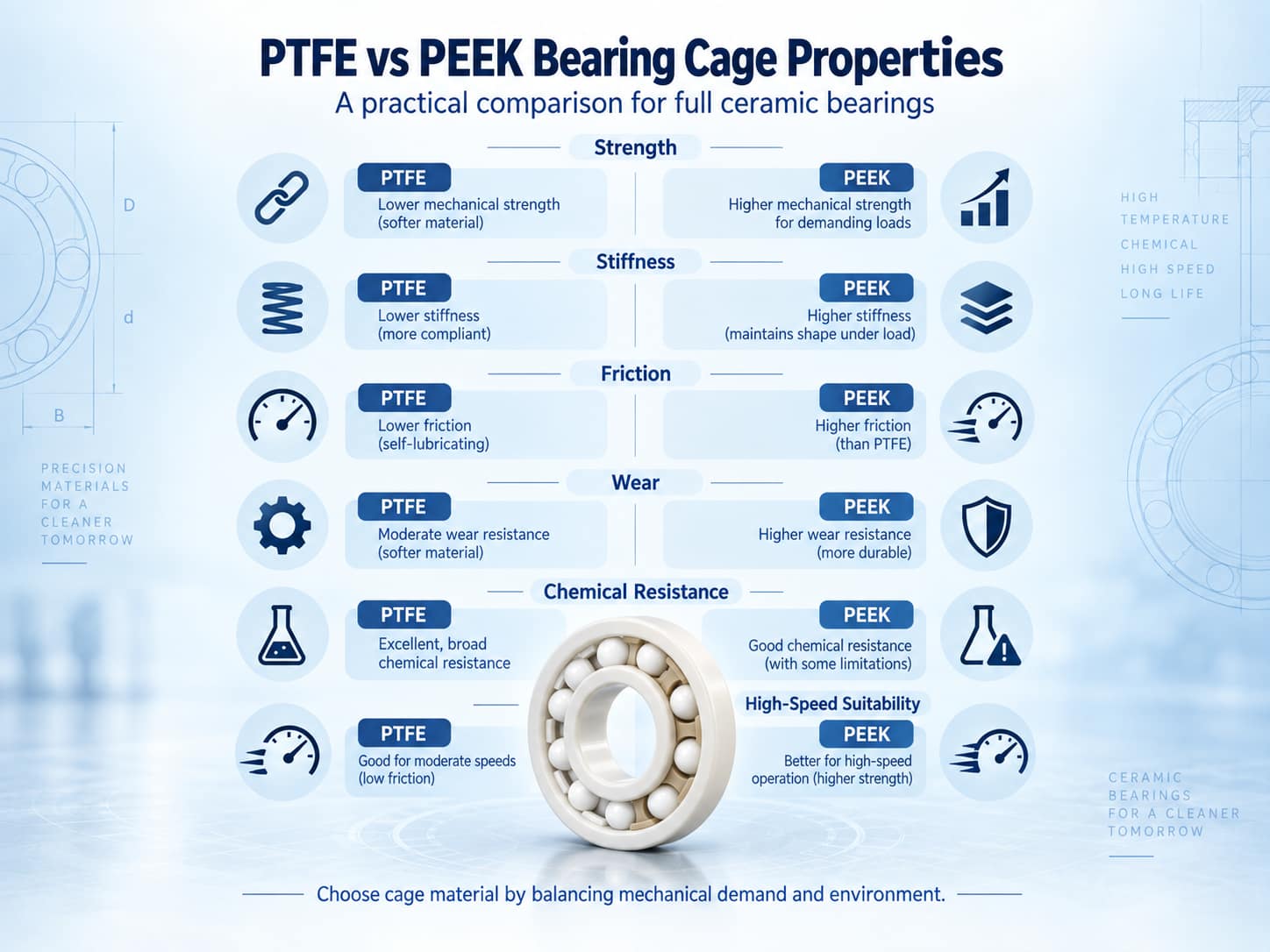
Mechanical Strength: Why PEEK Often Has the Advantage
Mechanical strength is one of the most important differences between PTFE and PEEK.
A bearing cage must maintain its geometry while guiding the balls. At higher rotational speed, centrifugal forces increase. Vibration and transient loading can also create repeated contact between the rolling elements and cage.
PEEK is significantly stronger and stiffer than PTFE, so it generally maintains its shape more effectively under demanding mechanical conditions.
PEEK therefore deserves particular consideration when the application involves:
- higher rotational speed;
- stronger centrifugal forces;
- continuous industrial operation;
- vibration;
- greater mechanical cage stress;
- longer service-life expectations.
Friction: Where PTFE Is Particularly Strong
PTFE is well known for its extremely low coefficient of friction.
That can reduce sliding resistance between the cage and other bearing components and may be useful where lubrication is limited or contamination from grease or oil is undesirable.
However, low friction alone does not determine cage performance.
A cage must also maintain correct rolling-element spacing and dimensional stability.
For this reason, the lowest-friction cage material is not automatically the best choice for a higher-speed or mechanically demanding bearing.
Wear and Service Life
Wear behavior depends on more than the polymer name.
Important variables include:
- bearing speed;
- ceramic ball material;
- cage geometry;
- temperature;
- lubrication;
- contamination;
- load;
- duty cycle.
PTFE benefits from low friction, but its relatively soft structure can be less durable in some mechanically demanding conditions.
PEEK generally provides better resistance to mechanical deformation and is often favored where cage durability is an important requirement.
Temperature: PTFE or PEEK?
Temperature comparisons between PTFE and PEEK are frequently oversimplified.
Both are high-performance polymers, but the useful temperature range of a finished bearing depends on more than the polymer’s raw material temperature rating. Review the complete-bearing temperature limits when evaluating the cage as part of the full assembly.
Factors include:
- cage geometry;
- mechanical load on the cage;
- bearing speed;
- duration of exposure;
- seal materials;
- lubrication;
- thermal expansion;
- surrounding medium.
PEEK is particularly useful where elevated temperature must be combined with mechanical strength.
PTFE can also operate across demanding temperature ranges and may offer advantages in certain unusual environments.
Chemical Resistance
Both materials provide strong chemical resistance, but PTFE has an especially broad reputation for chemical inertness.
This can make PTFE attractive in unusually aggressive chemical environments.
PEEK also resists many industrial chemicals and is widely used in demanding processing equipment, but compatibility still depends on:
- chemical type;
- concentration;
- operating temperature;
- exposure duration.
The same application-specific review should be performed for PTFE.
Which Cage Is Better for Corrosive Environments?
The cage is only one part of the bearing.
A zirconia full ceramic bearing may provide excellent corrosion resistance through its rings and balls, but the cage must also be compatible with the surrounding medium.
In many industrial environments, PEEK provides a useful combination of environmental resistance and mechanical strength.
In highly aggressive chemical service, PTFE may deserve closer consideration because of its exceptionally broad chemical resistance.
Which Cage Is Better for High Speed?
For higher-speed applications, PEEK is generally the stronger candidate.
As rotational speed increases, the cage must resist stronger centrifugal forces while maintaining correct ball spacing.
PEEK’s higher strength and stiffness typically make it better suited to this role than PTFE.
However, maximum bearing speed still depends on the complete design, including ceramic material, bearing size, internal clearance, load, accuracy and lubrication.
Which Cage Is Better for Dry Running?
There is no universal answer.
PTFE’s low friction can be valuable where conventional lubrication is limited.
PEEK can also perform effectively under poor lubrication conditions while providing greater mechanical strength.
Dry-running suitability therefore depends on:
- speed;
- load;
- duty cycle;
- temperature;
- cage geometry;
- required service life.
Which Cage Is Better for Electrical Insulation?
Both PTFE and PEEK are electrically insulating polymers.
In a full ceramic bearing using ceramic rings and balls, either cage can support an electrically non-conductive bearing construction.
The complete assembly must still be evaluated if metallic seals, shields, shafts, housings or other components are involved.
When Should You Choose PTFE or PEEK?
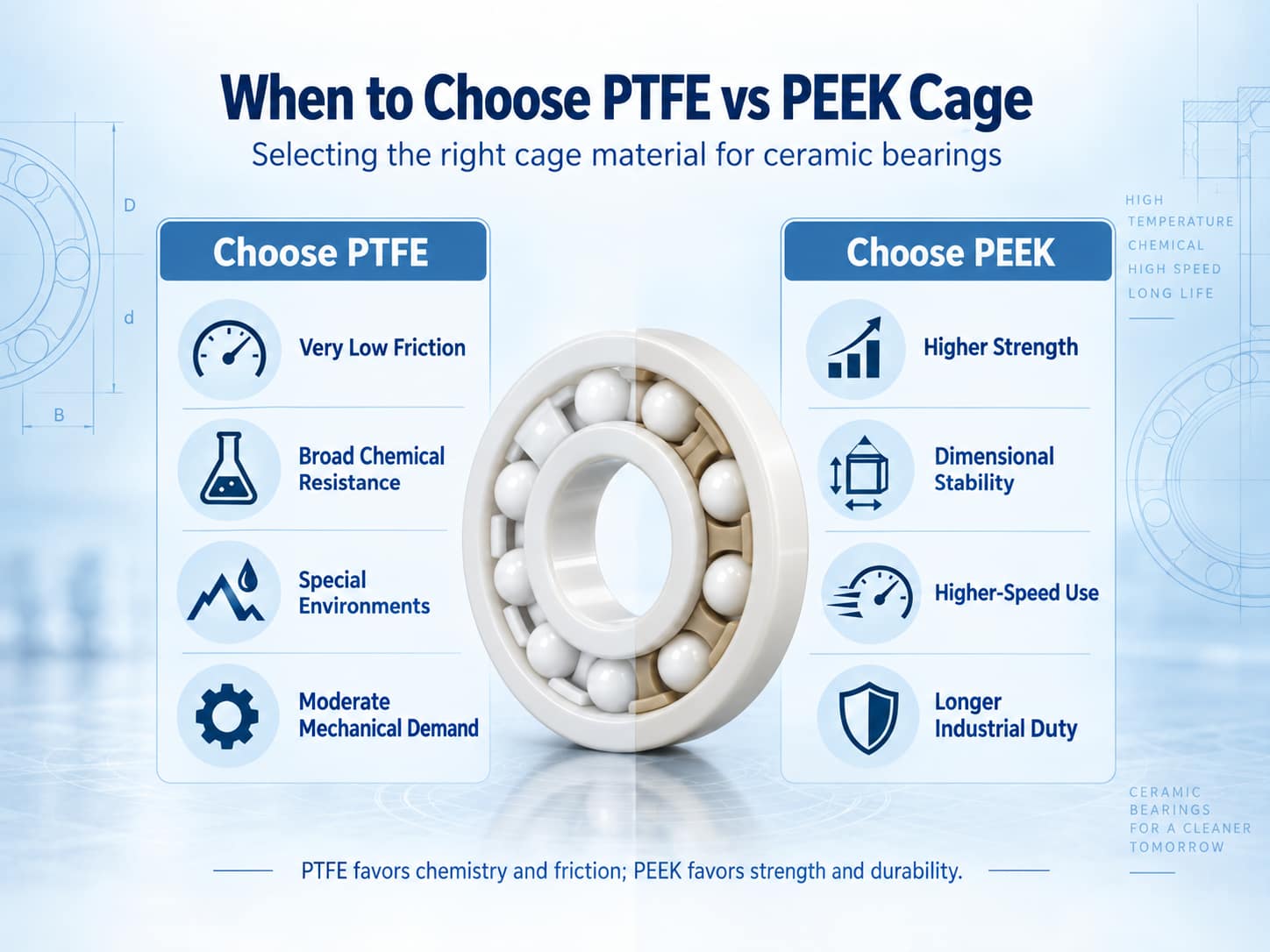
Choose PTFE When You Prioritize
- very low friction;
- broad chemical resistance;
- special corrosive environments;
- electrical insulation;
- moderate cage mechanical demand;
- specific unusual environmental requirements.
Choose PEEK When You Prioritize
- higher cage strength;
- better dimensional stability;
- higher-speed operation;
- better resistance to centrifugal loading;
- continuous industrial duty;
- a balance of strength, wear and chemical resistance.
What About Full-Complement Ceramic Bearings?
PTFE and PEEK are not the only configuration choices.
A full ceramic bearing may also use a full-complement design with no conventional cage.
For a detailed configuration comparison, see full-complement and caged ceramic bearings.
Removing the cage can eliminate a polymer-related temperature or chemical limitation and allows more rolling elements to occupy the raceway.
However, adjacent rolling elements may contact each other because there is no cage separating them.
PTFE vs PEEK vs Full Complement
| Configuration | Best Considered When |
|---|---|
| PTFE cage | Very low friction or specialized chemical/environmental compatibility is important. |
| PEEK cage | Mechanical strength, dimensional stability, higher speed and industrial durability are priorities. |
| Full complement | Removing the polymer cage solves a temperature, chemical or configuration constraint and lower speed is acceptable. |
Does Cage Choice Change the Ceramic Material Decision?
Yes—but cage material and ceramic material should remain separate engineering decisions.
First determine whether the bearing itself should use zirconia, silicon nitride or another material.
Then evaluate the cage.
For example, an application may favor ZrO₂ because corrosion resistance is the primary concern but still require PEEK rather than PTFE because the bearing operates at higher speed.
Another application may favor Si₃N₄ rings and balls but require full complement because a polymer cage would not suit the operating environment.
For the main ceramic material comparison, see
Zirconia vs Silicon Nitride Ceramic Bearings: ZrO₂ vs Si₃N₄.
For an introduction to zirconia bearing material and construction, see
What Are Zirconia Ceramic Bearings?.
How to Select the Right Ceramic Bearing Cage
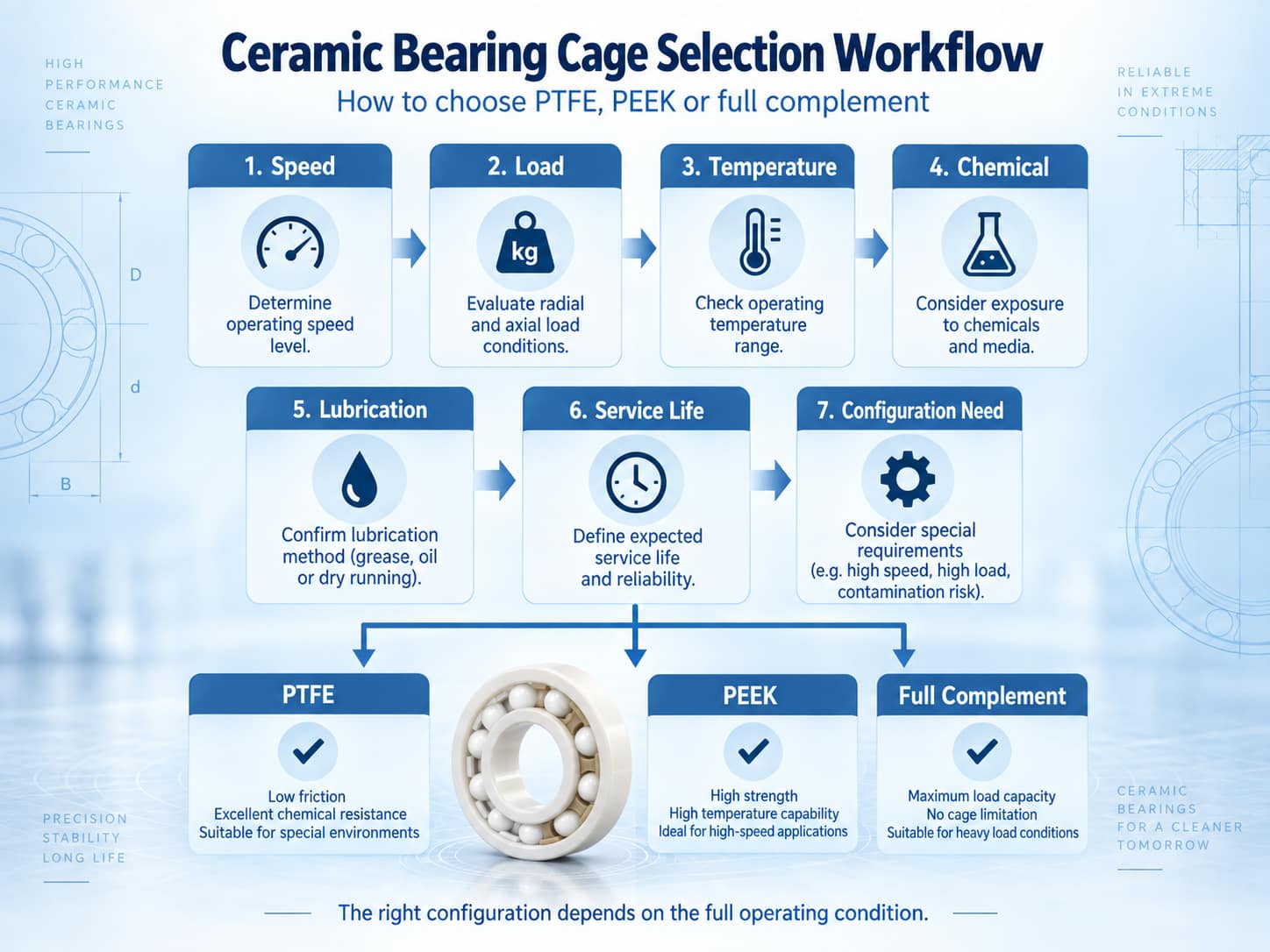
A practical cage-selection process can be organized around seven questions.
Higher rotational speed generally increases cage mechanical and centrifugal loading.
Consider normal radial and axial loading together with shock, vibration and acceleration.
Provide continuous operating temperature and short-term peak temperature.
Identify the actual chemical, concentration and operating temperature.
Confirm grease, oil, process fluid or dry-running operation.
Continuous production equipment places different cage demands on the bearing than intermittent laboratory use.
If cage material becomes the principal temperature or chemical limitation, evaluate whether full complement is suitable and whether its lower speed capability is acceptable.
Common Cage Selection Mistakes
Choosing PTFE Only Because It Has Lower Friction
Friction is only one requirement. Mechanical strength and dimensional stability may become more important as speed and duty increase.
Choosing PEEK Only Because It Is Stronger
An unusually aggressive chemical environment may justify a different cage material.
Using Polymer Datasheet Temperature as the Bearing Temperature Limit
The complete bearing configuration determines the real operating limit.
Assuming Full Complement Is Always Better
Removing the cage solves some constraints but usually reduces speed capability.
Ignoring the Operating Medium
Water, seawater, acid, solvent, vacuum and process chemicals represent very different operating environments.
Frequently Asked Questions
Is PEEK better than PTFE for ceramic bearing cages?
PEEK is generally stronger and more mechanically durable, so it is often preferred for demanding industrial ceramic bearing cages. PTFE can be advantageous where very low friction or specialized chemical compatibility is the main priority.
Which cage is better for high-speed ceramic bearings?
PEEK is generally the stronger option because of its higher mechanical strength and dimensional stability. Final speed capability still depends on the complete bearing design.
Which has lower friction, PTFE or PEEK?
PTFE is particularly well known for extremely low friction. Cage selection should also consider deformation, strength, wear, speed and temperature.
Which cage has better chemical resistance?
PTFE offers exceptionally broad chemical resistance. PEEK also provides very good chemical resistance, but compatibility should be checked against the actual chemical, concentration and operating temperature.
Which cage is better at high temperature?
This should not be decided from polymer temperature ratings alone. PEEK retains useful mechanical properties at elevated temperature, while PTFE has broad thermal capability. Bearing speed, load, geometry and environment determine the final operating limit.
Can full ceramic bearings operate without a cage?
Yes. A full-complement ceramic bearing has no conventional cage. This can remove cage-related limitations but generally reduces allowable speed.
Can PTFE and PEEK cages both be used in zirconia bearings?
Yes, depending on the bearing design and operating conditions. Full-complement configurations may also be considered.
Need Help Choosing PTFE, PEEK or Full Complement?
Cage material should be selected from the real operating condition—not only from the bearing number.
Provide the bearing model or dimensions, RPM, load, continuous and peak temperature, chemical or liquid exposure, lubrication conditions, duty cycle and required quantity.
DISLAB Precision can help evaluate whether a PTFE cage, PEEK cage or full-complement configuration is the more appropriate choice.
Technical information on this page is intended as a selection guide. Final cage material, bearing configuration and operating limits should be confirmed against the actual application conditions.