Zirconia Ceramic Bearing Temperature Limits Explained
When buyers ask for the temperature limit of a zirconia ceramic bearing, they often expect one simple number. In practice, there is no single universal operating-temperature limit.
The usable temperature of a ZrO₂ bearing depends on the complete bearing system: ceramic rings and balls, cage, lubrication, seals, speed, load, fit, thermal expansion and operating environment.
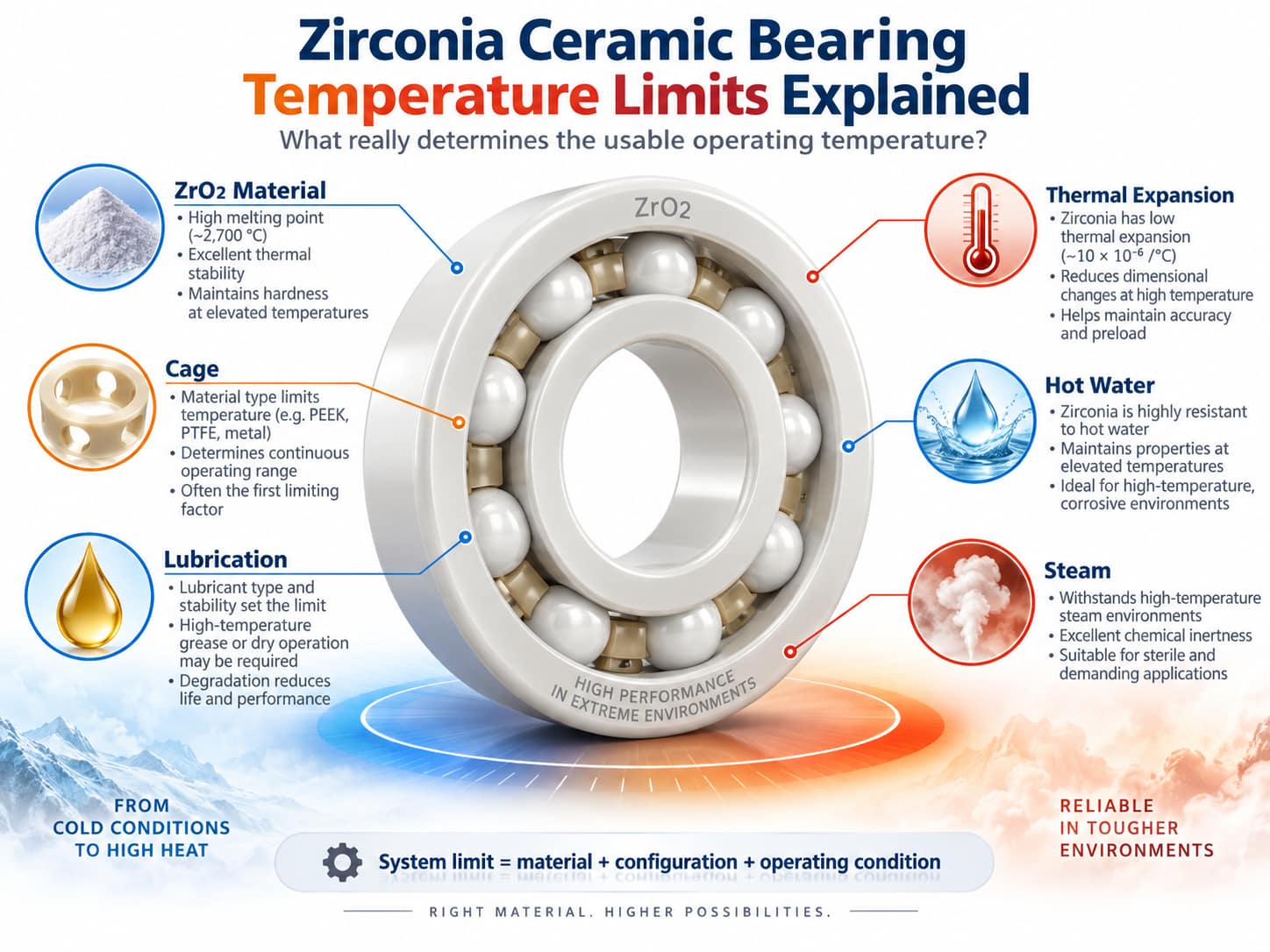
What Does “Temperature Limit” Actually Mean?
Material Capability
The temperature behavior of the zirconia rings and rolling elements themselves.
Configuration Limit
The practical limit created by cage material, lubrication, seals and other bearing components.
Operating Limit
The temperature at which the complete bearing can still operate reliably at the required speed and load.
Thermal Cycling
The ability of the bearing and assembly to tolerate repeated heating and cooling.
A ceramic material may tolerate an elevated static temperature while the assembled bearing reaches a practical limit much earlier.
Why Zirconia Is Used in Temperature-Demanding Applications
Zirconia combines high hardness and wear resistance with comparatively high fracture toughness for an engineering ceramic.
It can also provide:
- corrosion resistance;
- electrical insulation;
- non-magnetic behavior;
- smooth precision surfaces;
- useful mechanical performance in demanding industrial environments.
For a broader introduction to ZrO₂, see
What Are Zirconia Ceramic Bearings?.
Material Temperature vs Complete Bearing Temperature
This distinction is essential.
Even when zirconia rings and balls remain suitable, the complete bearing may be limited by:
- PEEK or PTFE cage behavior;
- lubricant degradation;
- seal material;
- clearance changes;
- shaft and housing expansion;
- speed-related heat generation.
What Really Sets the Temperature Limit?
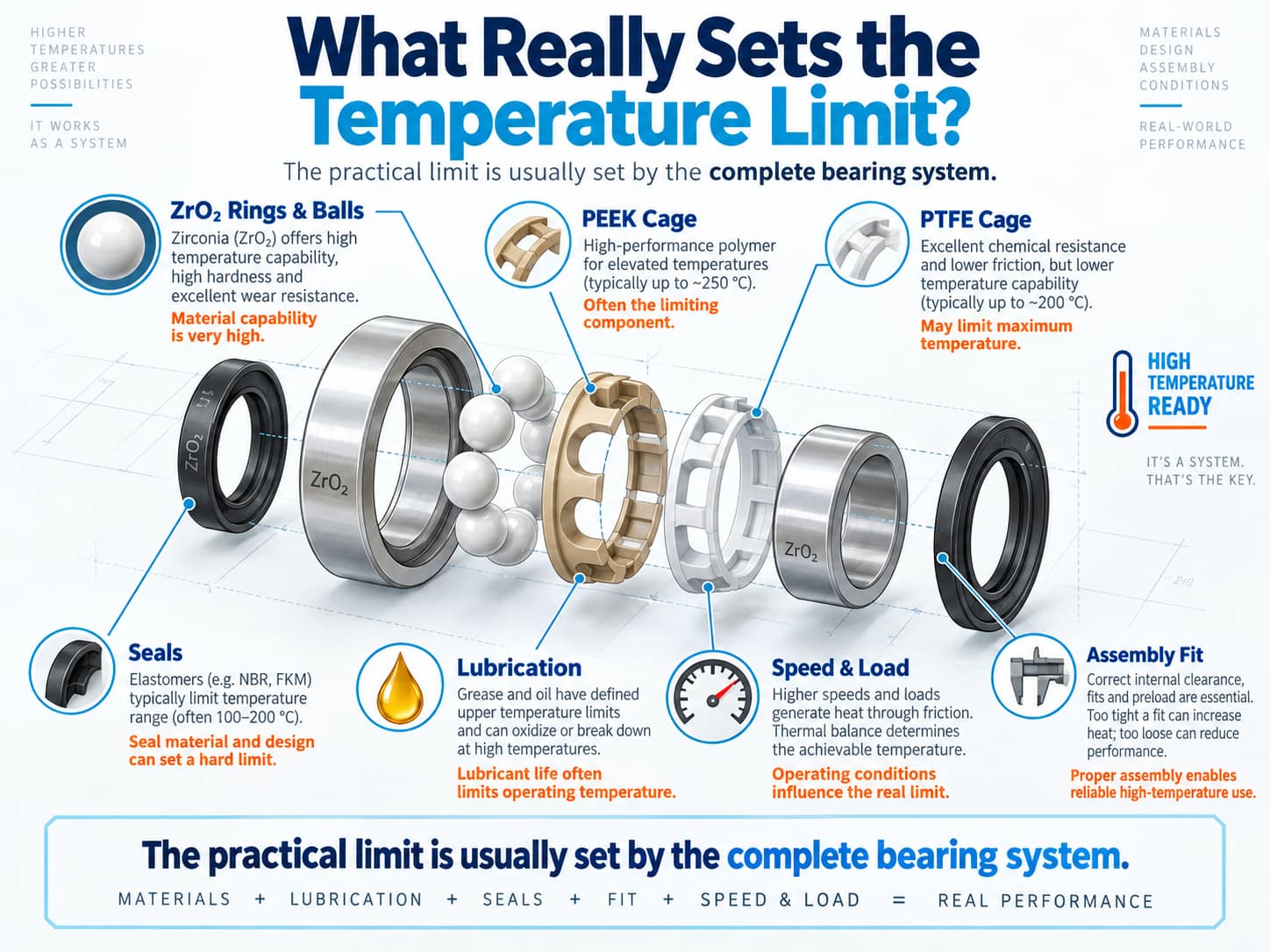
The practical operating limit is usually determined by the weakest temperature-sensitive part of the complete bearing system.
ZrO₂ Rings and Balls
The ceramic components often provide substantial temperature capability, but thermal expansion, thermal cycling and operating stresses still need to be considered.
Cage
If the bearing uses a polymer cage, the cage may become the first temperature-sensitive mechanical component.
Lubrication
Grease and oil can lose useful properties as temperature rises. In many real applications, lubrication becomes the practical limit before the ceramic material itself.
Seals
A sealed bearing introduces elastomer or polymer components that may have a lower temperature capability than the ceramic rings and balls.
Speed and Load
Higher RPM and heavier loading can generate additional heat and reduce the available temperature margin.
Assembly Fit
Thermal expansion of the bearing, shaft and housing can change internal clearance and fit.
PEEK Cage at Elevated Temperature
PEEK is commonly considered when a ceramic bearing requires a mechanically strong polymer cage.
Its advantages include:
- good mechanical strength;
- dimensional stability;
- wear resistance;
- good chemical resistance;
- useful performance at elevated temperature.
However, the continuous-service temperature published for bulk PEEK material should not be treated as the operating-temperature rating of a bearing cage.
The actual cage limit also depends on speed, load, geometry, clearance and operating duration.
PTFE Cage at Elevated Temperature
PTFE provides very low friction and broad chemical resistance.
It can tolerate elevated temperatures as a raw material, but it is mechanically softer and less rigid than PEEK.
This makes it especially important to evaluate the combination of:
- temperature;
- RPM;
- load;
- cage stress;
- chemical exposure.
For cage-material selection, see
PTFE vs PEEK Cage for Full Ceramic Bearings.
Can Full-Complement Bearings Handle More Heat?
Sometimes.
A full-complement bearing removes the conventional polymer cage.
If the cage is the first component reaching its practical temperature limit, removing it can extend the usable configuration range.
However, eliminating the cage also removes controlled ball separation.
This usually reduces suitable speed and changes friction behavior.
For the complete configuration trade-off, see
Full-Complement vs Caged Ceramic Bearings: How to Choose.
Lubrication Can Become the Real Temperature Limit
Even when ceramic components remain mechanically suitable, conventional grease or oil may become the limiting factor.
Elevated temperature can cause:
- lubricant oxidation;
- viscosity change;
- evaporation or loss;
- shorter grease life;
- increased maintenance requirements.
Depending on the application, the lubrication strategy may include:
- temperature-appropriate grease;
- reduced lubrication;
- process-fluid operation;
- dry running under suitable conditions.
For more detail, see
Can Zirconia Ceramic Bearings Run Without Lubrication?.
Dry Heat vs Hot Water vs Steam
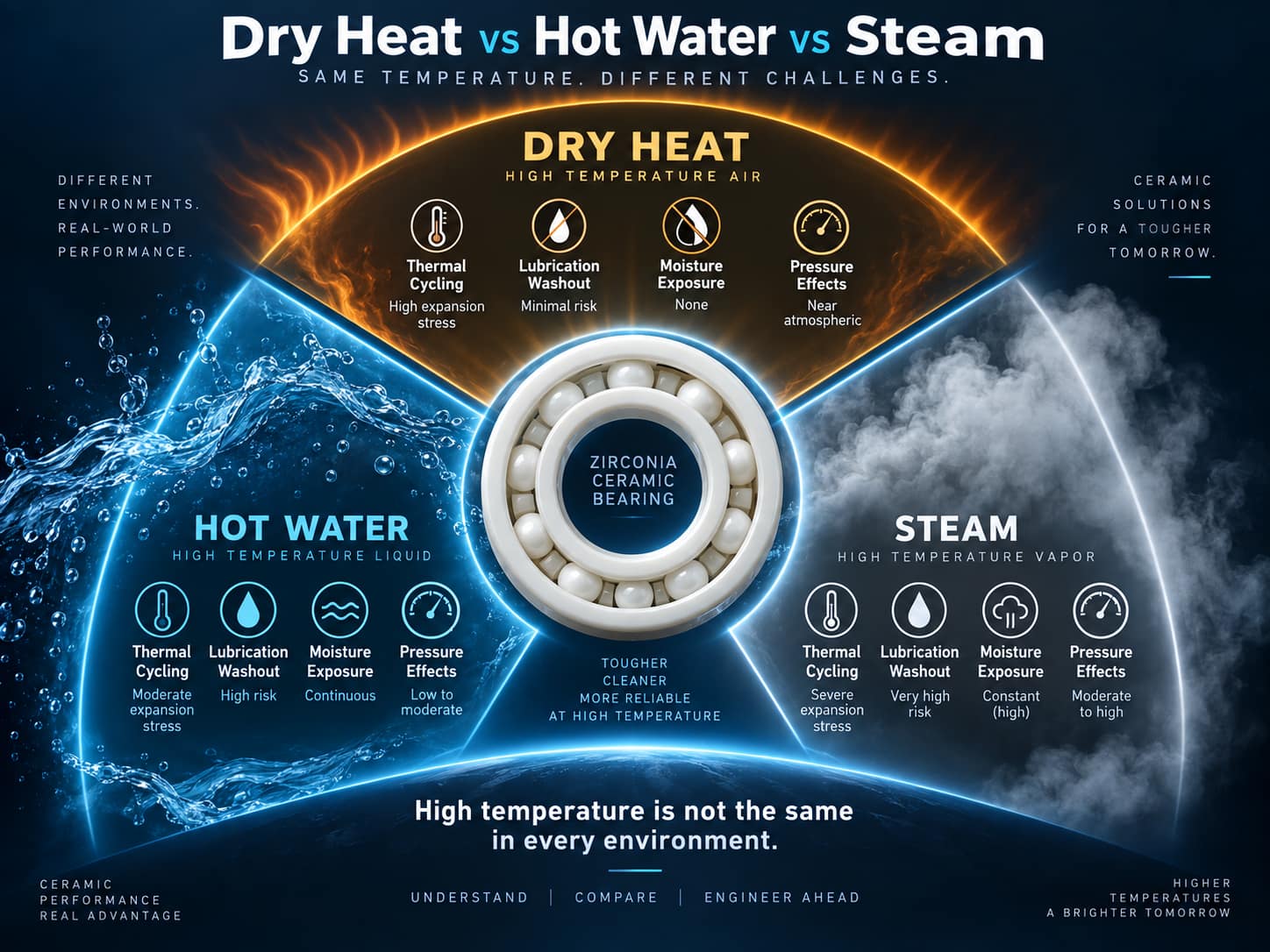
A bearing operating at an elevated temperature in dry air is not experiencing the same environment as a bearing in hot water or steam.
| Environment | Main Additional Concerns |
|---|---|
| Dry heat | Thermal expansion, cage behavior, lubricant life and frictional heat |
| Hot water | Temperature plus continuous moisture exposure, lubrication washout and cycling |
| Steam | Temperature plus moisture, pressure effects, repeated cycling and difficult lubrication conditions |
Hot Water and Steam Need Separate Evaluation
Hot-water and steam applications combine thermal and environmental effects.
Review:
- continuous temperature;
- peak temperature;
- exposure time;
- thermal cycling;
- water or steam pressure;
- cage material;
- lubrication;
- required bearing life.
For broader wet-environment guidance, see
Ceramic Bearings for Water, Seawater and Wet Environments.
Why Thermal Expansion Matters
Temperature changes bearing dimensions as well as shaft and housing dimensions.
This can affect:
- internal clearance;
- interference fits;
- preload;
- running torque;
- alignment;
- operating smoothness.
Because zirconia and surrounding metals do not necessarily expand identically, the complete assembly needs to be considered.
Why Thermal Shock Matters
Maximum temperature and rate of temperature change are two different engineering questions.
Rapid transitions can occur during:
- hot washdown;
- cold rinsing after hot operation;
- sterilization cycles;
- repeated heating and cooling;
- startup and shutdown cycles.
A bearing that performs well at a stable elevated temperature may still require additional review under severe thermal cycling.
Zirconia vs Silicon Nitride at Elevated Temperature
ZrO₂ and Si₃N₄ have different thermal characteristics.
Zirconia provides useful toughness, corrosion resistance and electrical insulation.
Silicon nitride has lower density and substantially lower thermal expansion, and it is often attractive where high speed and thermal-shock performance are major requirements.
For more detail, see
Zirconia vs Silicon Nitride Ceramic Bearings.
How to Think About Temperature in Three Layers
Layer 1: Ceramic Material
Can the zirconia rings and balls tolerate the temperature and environment?
Layer 2: Bearing Configuration
Can the cage, seals and lubrication tolerate the temperature?
Layer 3: Complete Assembly
Can the bearing, shaft and housing still maintain appropriate fit, clearance and operation?
Operating Condition
Can the full system perform at the required speed, load and duty cycle?
How to Evaluate a Zirconia Bearing Temperature Limit
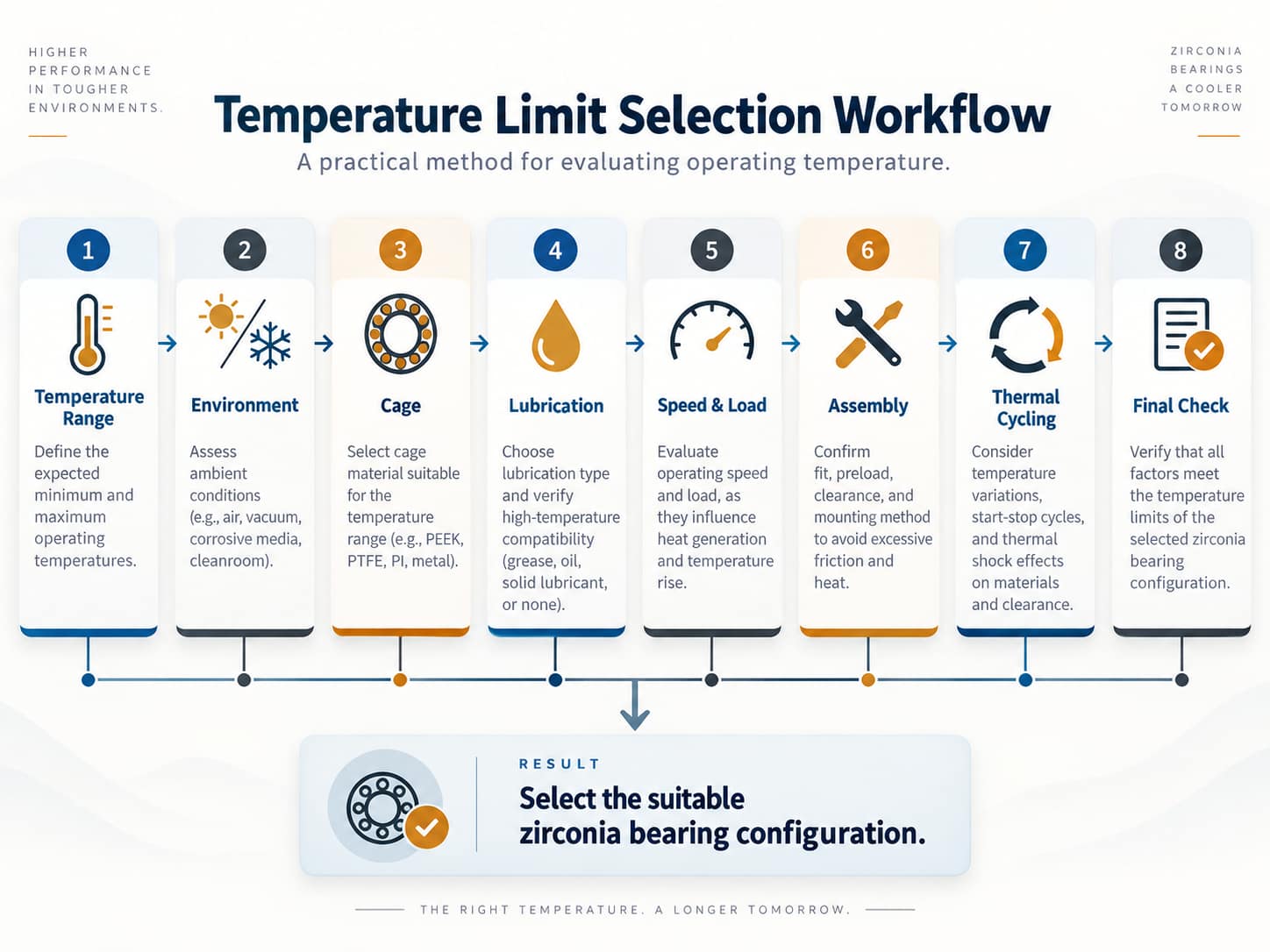
Identify normal operating temperature, peak temperature and short-term excursions.
Dry air, vacuum, hot water, steam, washdown or chemical process?
PEEK, PTFE or full complement?
Standard grease, high-temperature grease, reduced lubrication, process fluid or dry running?
Higher RPM and load can increase frictional heat.
Review shaft, housing, fit, clearance and preload.
Consider heating rate, cooling rate and repeated start-stop cycles.
Final suitability should be based on the actual bearing size and operating condition.
Common Selection Mistakes
Using the Zirconia Material Limit as the Bearing Limit
The complete bearing normally reaches practical limits before the ceramic material reaches its theoretical material limit.
Using a Polymer Datasheet Temperature as the Cage Rating
Bulk polymer values do not automatically equal real bearing-cage limits.
Ignoring Lubrication
Lubrication may become the first temperature-sensitive component.
Treating Hot Water or Steam Like Dry Heat
Moisture, pressure and cycling create additional design requirements.
Ignoring Thermal Expansion
Temperature can change internal clearance and assembly fit.
Ignoring Speed and Load
Operating friction generates additional temperature inside the bearing.
Frequently Asked Questions
What is the temperature limit of a zirconia ceramic bearing?
There is no single universal number. The practical limit depends on the ceramic material, cage, lubrication, seals, speed, load, assembly and operating environment.
Can zirconia bearings handle high temperature?
Yes, zirconia is suitable for many elevated-temperature applications, but the complete bearing may be limited by other components before the ZrO₂ rings and balls become the limiting factor.
Is the cage often the temperature-limiting component?
It can be. PEEK and PTFE both have useful elevated-temperature capability, but their mechanical behavior and application limits differ.
Is full complement better for high temperature?
It can be advantageous when the cage is the limiting factor, but removing the cage also reduces ball separation and usually reduces suitable speed.
Do zirconia bearings need special lubrication at high temperature?
They may. Lubrication strategy should be selected according to temperature, RPM, load, duty cycle and environment.
Are hot water and steam the same as high dry temperature?
No. Hot water and steam combine temperature with moisture exposure and may also involve pressure and repeated thermal cycling.
Is zirconia better than silicon nitride at high temperature?
Neither is universally better. Zirconia and silicon nitride have different thermal, mechanical and dynamic characteristics, so the choice depends on the application.
Need Help Evaluating Bearing Temperature?
Provide the bearing model or dimensions, normal and peak temperature, RPM, load, operating environment, lubrication condition, cage preference, shaft and housing materials and required quantity.
DISLAB Precision can help evaluate whether a ZrO₂ full ceramic bearing, a specific cage option or a full-complement configuration is suitable for your operating temperature.
Technical information on this page is intended as a general engineering selection guide. Final operating-temperature limits must be confirmed for the specific bearing size, configuration and application.