Zirconia (ZrO₂) Full Ceramic Deep-Groove Ball Bearings
Zirconia ceramic bearings use ZrO₂ ceramic rings and rolling elements to provide corrosion resistance, electrical insulation and non-magnetic performance in demanding industrial environments. Learn how to select ceramic bearings for corrosive environments. For wet applications, see ceramic bearings for water and seawater. For lubrication guidance, see ceramic bearings without lubrication. DISLAB Precision supplies full ceramic deep-groove configurations in a broad range of standard sizes. For a broader explanation of what zirconia ceramic bearings are, see the technical guide.
ZrO2 full ceramic deep groove ball bearings for corrosive, electrically insulated, non-magnetic and reduced-lubrication and application-specific dry-running environments where standard steel bearings are not suitable.
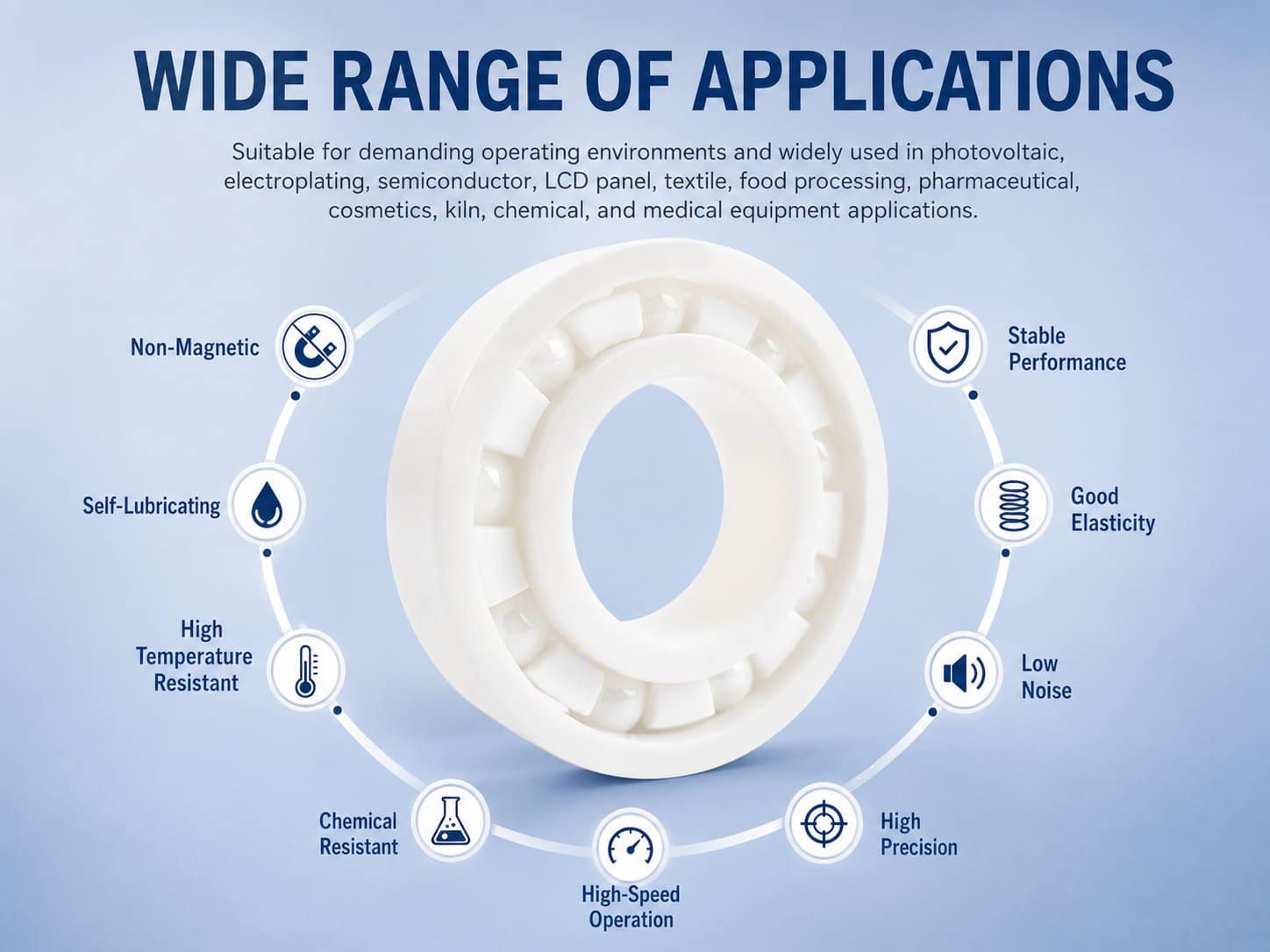
Full ceramic ZrO2 bearing for special operating environments.
Compact Technical Summary
A fast engineering view for RFQ screening before selecting bearing type, series, model and working environment.
Product Overview
Zirconia full ceramic deep groove ball bearings are designed for specialized industrial conditions where corrosion, water, chemicals, magnetism or lubricant contamination can reduce the service life of standard metal bearings.
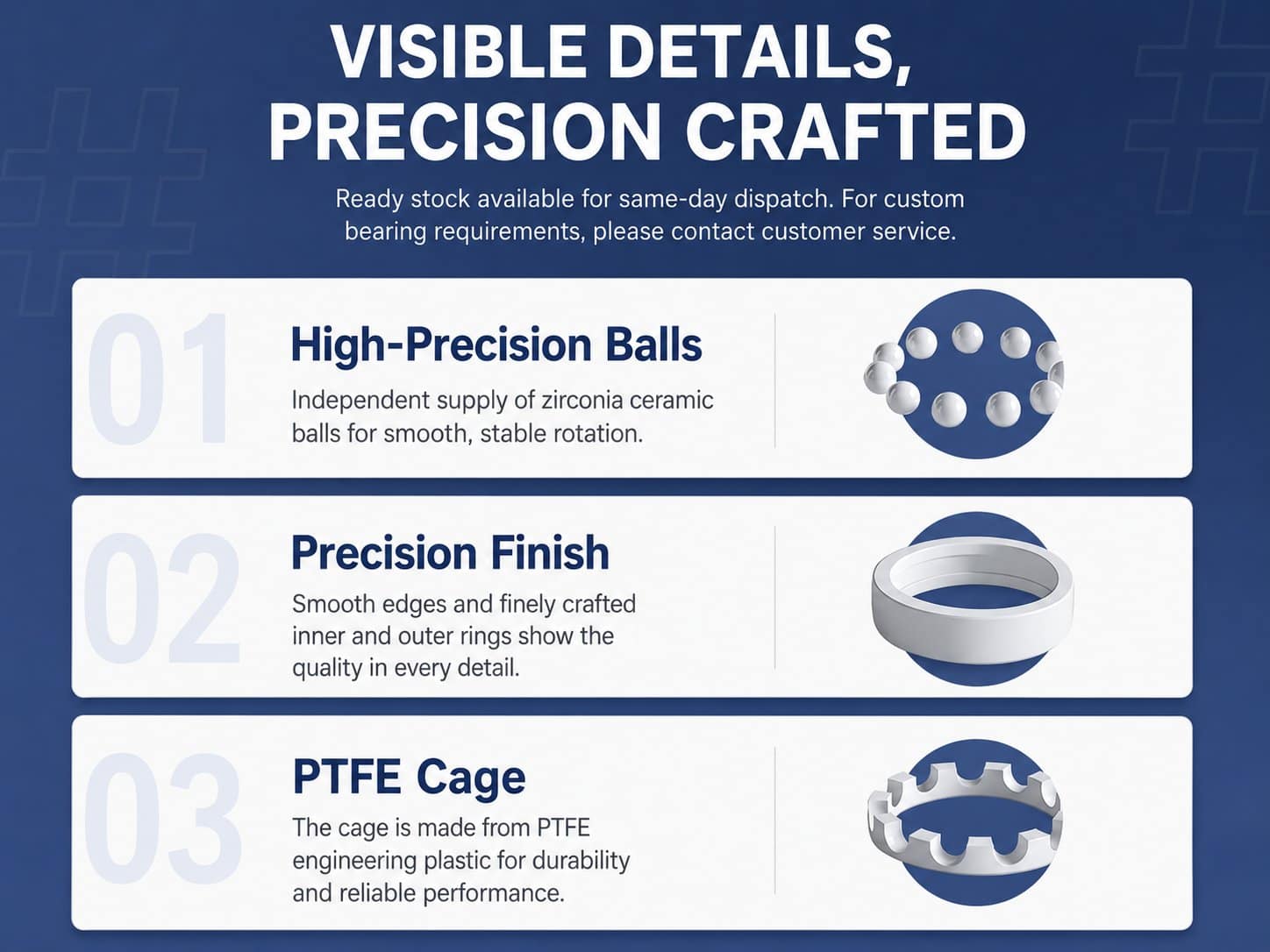
The zirconia full ceramic deep groove ball bearing features a precisely engineered structure where every component is optimized for harsh-environment performance. Each element is manufactured to tight tolerances, ensuring smooth operation and extended service life in demanding industrial applications.
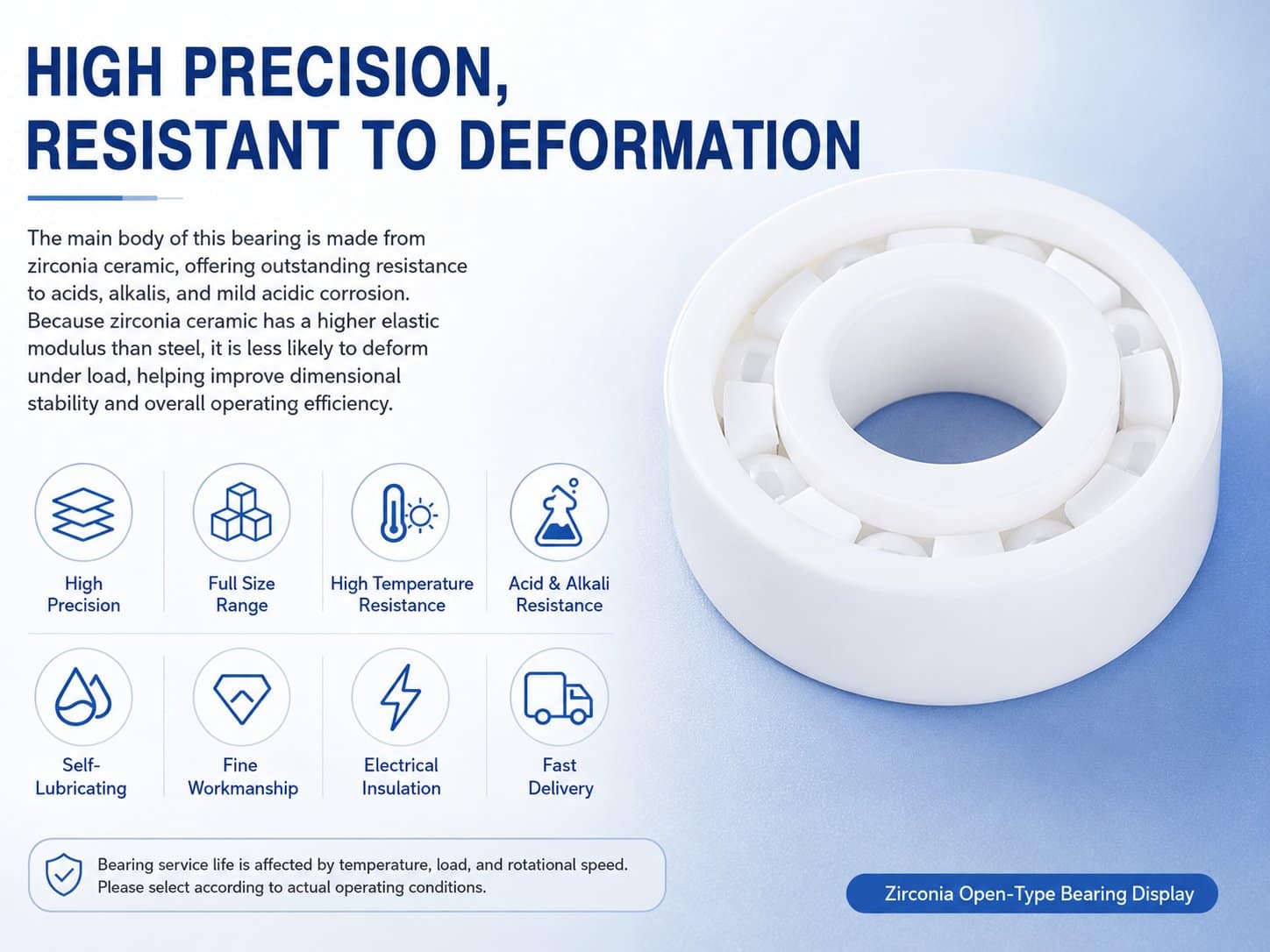
This product is engineered for precision and specialized environment applications. It is not intended as a low-cost replacement for standard steel bearings; it should be selected when corrosion resistance, electrical insulation, non-magnetic behavior or validated reduced-lubrication or dry-running capability is required. For a direct material comparison, see ZrO₂ vs Si₃N₄ ceramic bearings.
Key Performance Advantages
High Temperature Capability
PTFE, PEEK and cage-less versions support different temperature requirements.
Chemical Resistance
Zirconia resists many acids, alkalis, salts and industrial solvents.
Low Maintenance
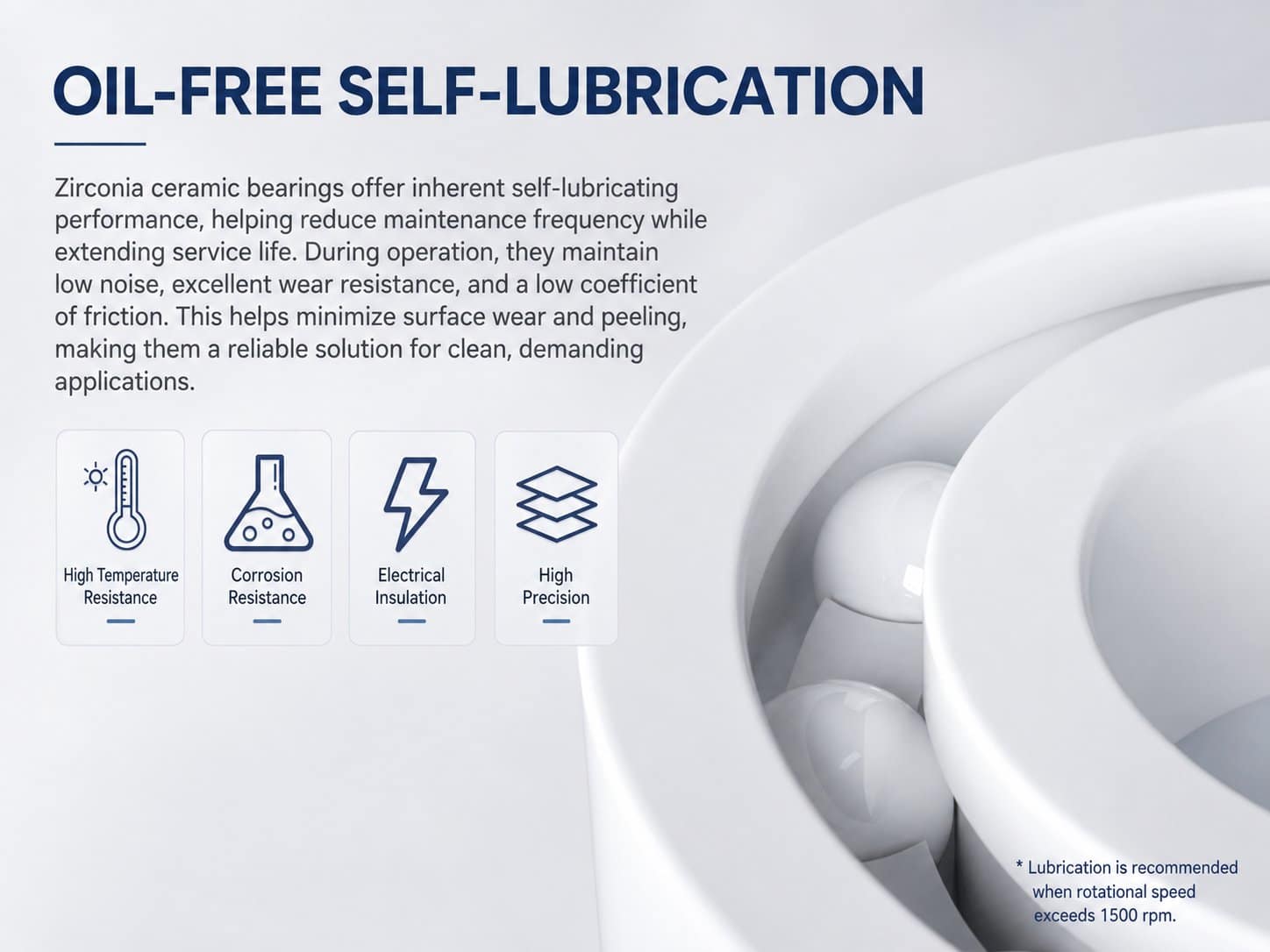
Ceramic rolling surfaces with PTFE or PEEK help reduce regular grease use.
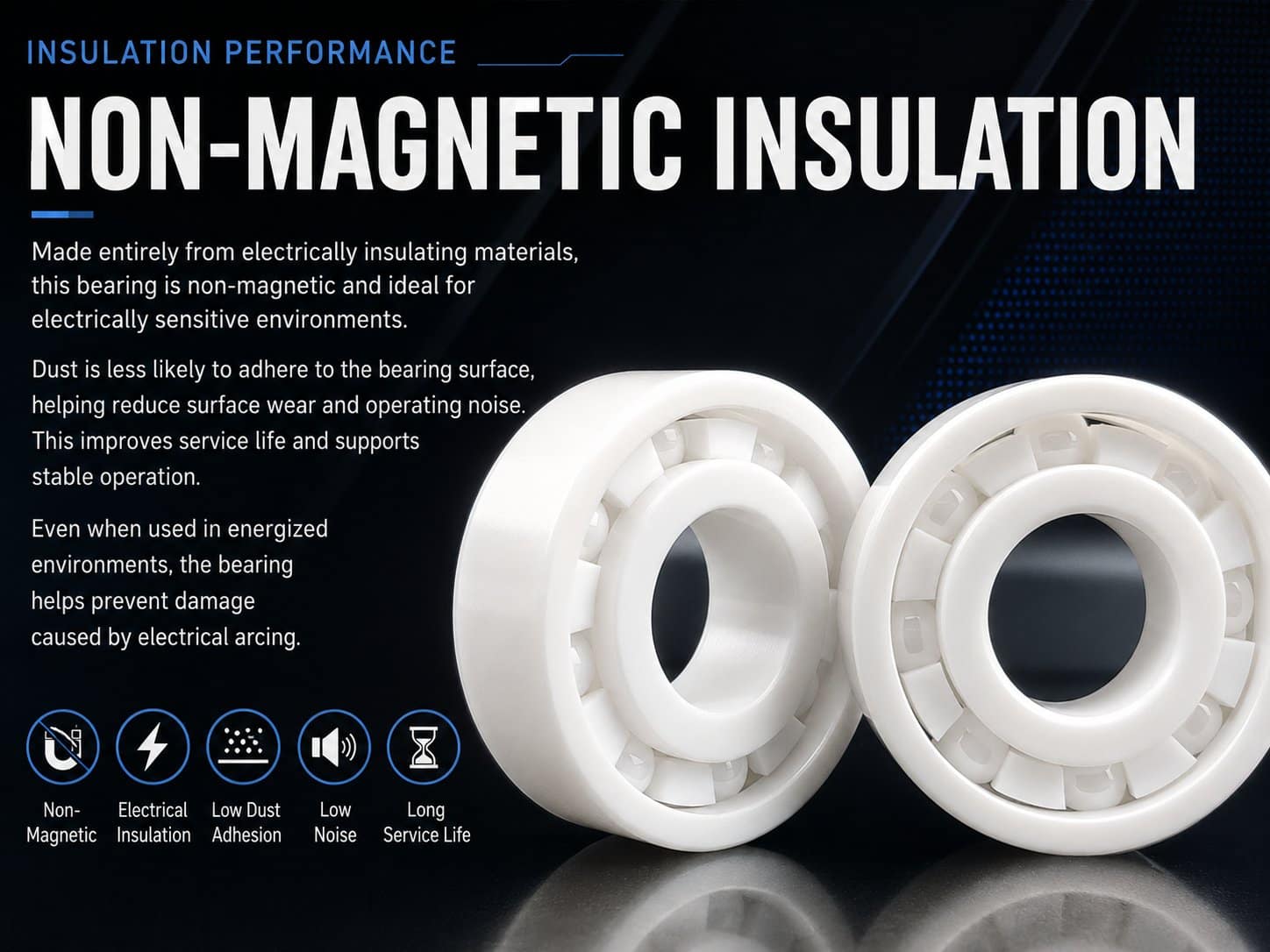
Electrical Insulation
Useful where conductive metal bearings may create unwanted electrical contact.
Non-Magnetic Performance
Suitable for precision electronic, testing and magnetically sensitive equipment.
High Rigidity
Maintains dimensional stability under appropriate load and thermal cycling.
Application Industries
Zirconia ceramic bearings are selected where moisture, chemicals, electrical insulation, non-magnetic behavior or clean operation are critical selection factors.
Industrial machinery
Special automation and machinery with limited lubrication access.
Food machinery
Clean production lines where lubricant contamination should be reduced.

Chemical equipment
Chemical processing, electroplating and washdown equipment.
Medical equipment
Laboratory, analytical and test instruments requiring clean rotation.
Semiconductor equipment
Electronic and photovoltaic systems sensitive to magnetic or conductive components.

High-temperature systems
Special applications where PTFE, PEEK or cage-less configurations must be validated.
Technical Performance and Application Comparison

- High temperature capability: PTFE cage version up to ~180°C, PEEK cage version up to ~240°C and cage-less versions for higher application-specific temperatures.
- Chemical resistance and low water absorption: suitable for chemical processing, marine, laboratory, food-grade and electroplating environments.
- Reduced-lubrication capability and low-maintenance design: zirconia full ceramic bearings may operate with reduced lubrication or under dry-running conditions in suitable applications, depending on speed, load, cage design and environment.
- Electrical insulation and non-magnetic performance: suitable for precision instruments, electronic systems and testing equipment.
vs metal bearings
Better corrosion resistance, electrical insulation, non-magnetic behavior and reduced-lubrication capability in suitable special environments.
vs standard plastic bearings
Higher rigidity, better dimensional stability and higher temperature capability under suitable load and speed conditions.
Product Structure & Configuration

Product Variants
Open Type (PTFE Cage)
Suitable for relatively clean environments requiring low friction operation and easy visual inspection.
Full Ball Type (Cage-less)
Designed for high load distribution and specific high-temperature or chemical immersion environments. Compare full-complement vs caged ceramic bearings when selecting for speed, load, temperature, lubrication and cage limitations.
Double Sealed Type
Designed for moisture, dust or chemical exposure where PTFE seals help protect the internal structure.
Advantages and Application Limits
✔ Advantages
Prevents corrosion failure in chemical and seawater environments, reduces magnetic interference, eliminates lubrication contamination in clean production lines, improves stability under thermal cycling and reduces maintenance frequency in critical equipment.
✖ Limitations
Not recommended for heavy shock loads, extremely high-speed mechanical systems without engineering validation, improper lubrication-free high-friction assemblies or general heavy-duty mechanical systems. Follow the zirconia ceramic bearing installation guide for handling, fit and mounting precautions.
- Proper selection based on load and operating conditions is required.
- Consult our technical team for application-specific guidance before using in harsh or high-speed assemblies.
Electrical insulation and non-magnetic properties for precision instruments, electronics and testing systems.
Reduced-lubrication capability may help reduce contamination risk in suitable clean-production and special industrial applications, depending on speed, load, cage design and environment.
Zirconia Ceramic Bearing Size Selection Table
Select a bearing type, series and model to confirm the inner diameter, outer diameter and width. To keep this section compact, the detailed size rows are not expanded by default. Choose a category, series, model, or use quick search to display matching specifications.
Select a zirconia ceramic bearing category
Detailed model dimensions will appear after you select a type, series, model, or enter a search keyword.
Dimension unit: mm. Width values such as 3/4 or 2.5/4 indicate optional width versions. Please confirm cage material, sealing structure, clearance, precision grade and quantity when sending your RFQ.
| Type | Series | Model | Inner Dia. | Outer Dia. | Width | RFQ |
|---|
Industrial Problems Solved
- Prevents corrosion failure in chemical and seawater environments.
- Reduces magnetic interference in precision electronic systems.
- Eliminates lubrication contamination in clean production lines.
- Improves stability under thermal cycling conditions.
- Extends service life in harsh chemical exposure environments.
- Reduces maintenance frequency in critical equipment.
Why Choose DISLAB Precision
DISLAB Precision is a global supplier of industrial precision components, including bearings, fasteners, spacers, and custom-engineered parts. With a manufacturing network of 300+ partners, we support both small-batch prototyping and large-scale industrial production.
Our engineering and sourcing team provides OEM/ODM customization, technical support, and application-based product selection assistance for global industrial customers. All products undergo strict inspection, including material verification, dimensional accuracy control, and surface quality checks prior to shipment.
From initial consultation through final delivery, DISLAB Precision is committed to providing reliable precision components that meet the requirements of modern industry.
Frequently Asked Questions (FAQ)
Q1: What is the maximum operating temperature?
Depends on configuration: PTFE cage (~180°C), PEEK cage (~240°C), cage-less versions suitable for higher application-specific temperatures.
Q2: Is it resistant to chemicals?
Yes, it is resistant to most acids, alkalis, and solvents, except strong oxidizing acids and high-concentration hydrogen peroxide.
Q3: Does it require lubrication?
In most applications, no lubrication is required due to low friction ceramic surfaces and PTFE/PEEK cage options.
Q4: Can it be used in seawater environments?
Yes, zirconia ceramic provides excellent resistance to seawater corrosion.
Q5: Is it suitable for heavy load applications?
It is intended for precision and special environment applications, not heavy shock load systems.
Q6: Can I customize structure and materials?
Yes, cage type, sealing type, and structural configuration can be customized to meet your specific requirements.
Related Precision Products
Explore real products that may support the same corrosion-resistant, precision or custom-engineered application.

Direct Contact Channels
- One-stop service: design, customization, production, and global delivery
- OEM/ODM solutions for industrial and export-oriented buyers