Full-Complement vs Caged Ceramic Bearings: How to Choose
When selecting a full ceramic bearing, choosing the ceramic material is only part of the decision. The rolling-element configuration also changes how the bearing behaves.
Two important designs are caged ceramic bearings and full-complement ceramic bearings.
A caged bearing uses a retainer to keep the balls separated and correctly spaced. A full-complement bearing removes the conventional cage and uses more rolling elements.

What Is a Bearing Cage?
The cage, also called the retainer or separator, keeps the rolling elements correctly spaced around the bearing.
The main external load is transmitted through the balls and raceways rather than directly through the cage, but the cage still performs several important functions.
- keeps the balls separated;
- maintains regular ball spacing;
- helps guide the rolling elements;
- reduces direct ball-to-ball interaction;
- supports smoother operation at higher rotational speed.
How the Two Designs Differ
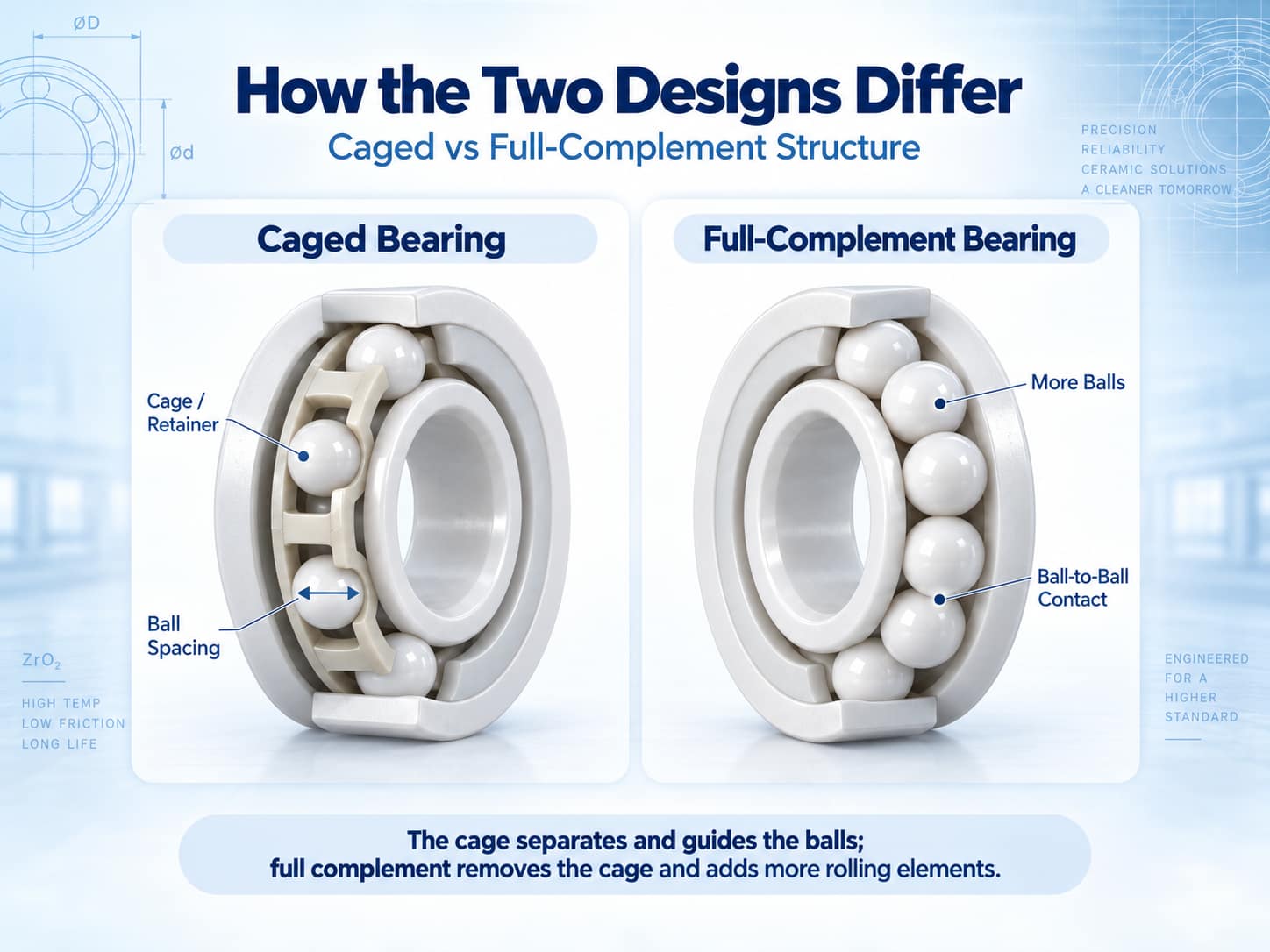
Caged Ceramic Bearing
The cage separates and guides the balls. Because each ball is kept apart from neighboring balls, direct ball-to-ball contact is reduced.
This generally supports higher-speed operation and more controlled rolling-element motion.
Full-Complement Ceramic Bearing
The conventional cage is removed, allowing additional balls to occupy more of the raceway circumference.
This can increase load capacity, but adjacent balls may interact directly during rotation.
What Is a Caged Ceramic Bearing?
A caged ceramic bearing combines ceramic rings and balls with a separate retainer.
Common polymer cage options for full ceramic bearings include:
- PEEK;
- PTFE.
The cage maintains controlled spacing between the balls and is particularly useful where continuous rotation or higher speed is important.
However, the cage also introduces another material into the bearing system.
Its temperature limit, chemical compatibility and mechanical strength must therefore be considered.
What Is a Full-Complement Ceramic Bearing?
A full-complement ceramic bearing uses no conventional cage.
Removing the retainer creates room for additional rolling elements.
This can be attractive where:
- greater load capacity is useful;
- operating speed is relatively low;
- the polymer cage becomes a temperature limitation;
- cage chemical compatibility is difficult.
The important trade-off is that the balls are no longer continuously separated by a cage.
Full Complement vs Caged: Key Differences
| Selection Factor | Caged Ceramic Bearing | Full-Complement Ceramic Bearing |
|---|---|---|
| Cage | Yes | No conventional cage |
| Number of balls | Fewer | More |
| Ball spacing | Controlled by cage | Adjacent balls may contact |
| Speed capability | Generally higher | Generally lower |
| Load capability | Good | Usually higher for comparable geometry |
| Cage temperature limit | Must be considered | Removed |
| Cage chemical compatibility | Must be checked | Not applicable |
| Typical priority | Speed and controlled operation | Load and cage elimination |
These differences are directional. Actual ratings depend on bearing size, geometry, ceramic material, internal clearance, lubrication and manufacturer-specific design.
Why Can Full-Complement Bearings Carry More Load?
A full-complement bearing contains more rolling elements.
The applied load can therefore be distributed across more ball-to-raceway contacts.
For otherwise comparable bearing geometry, this can increase load capacity.
Why Are Caged Bearings Better for Higher Speed?
The cage prevents neighboring balls from continuously contacting one another.
Without that separation, additional sliding and interaction can occur between rolling elements.
As RPM increases, this becomes increasingly important.
A caged design therefore generally provides advantages in:
- higher rotational speed;
- continuous operation;
- controlled ball spacing;
- lower ball-to-ball interaction;
- smoother dynamic behavior.
Speed vs Load Trade-Off
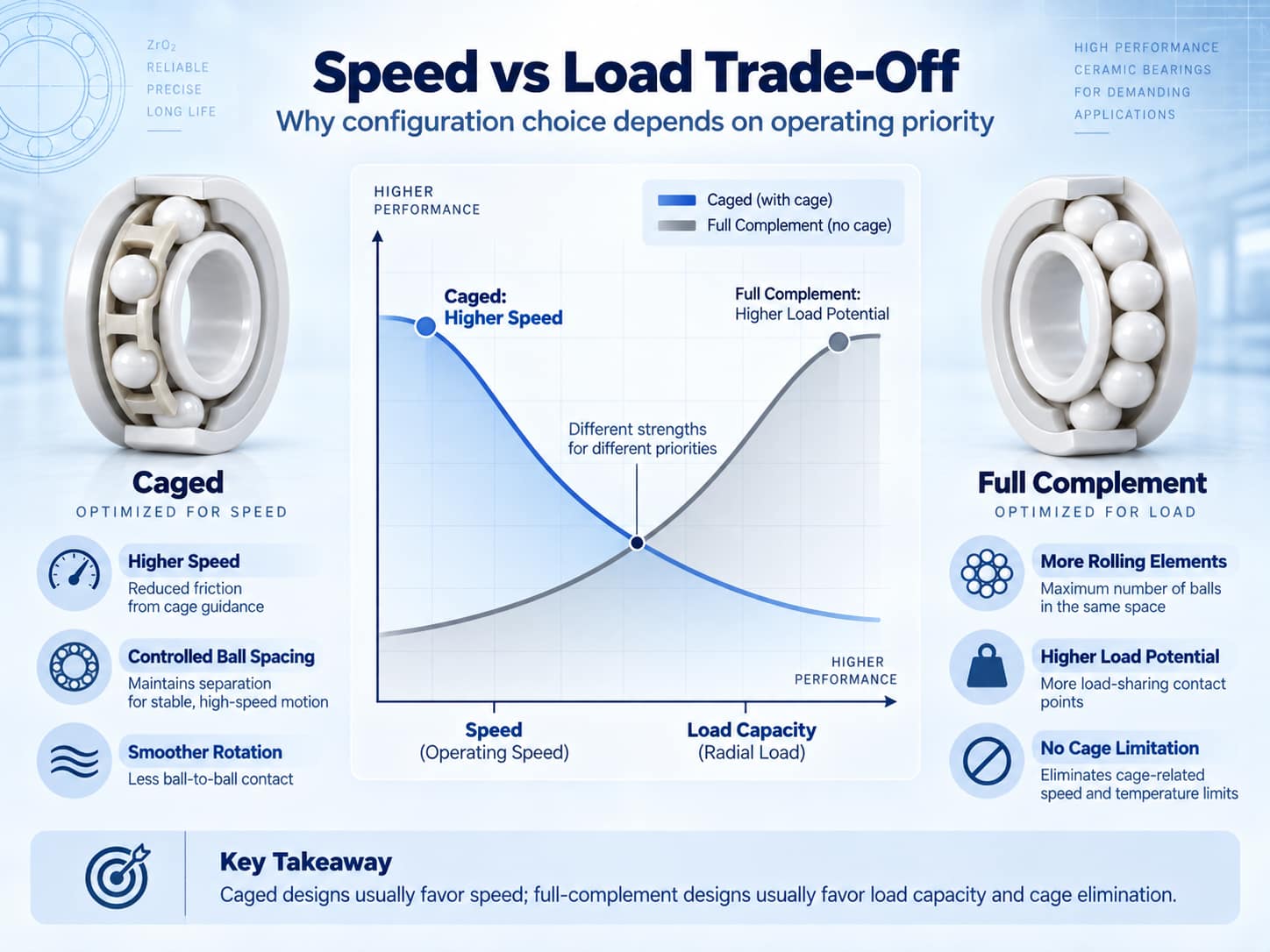
This is the central configuration trade-off.
A caged bearing generally prioritizes speed and controlled rolling-element guidance.
A full-complement design generally prioritizes more rolling elements and higher load potential at lower RPM.
This is why simply counting the balls does not tell you which bearing is better.
Full Complement and High Temperature
High temperature is an important reason to consider full complement. Review the temperature limits for zirconia ceramic bearings when evaluating the complete configuration.
In some applications, the ceramic rings and balls may tolerate conditions beyond the practical limit of a polymer cage.
Removing the cage removes that specific polymer limitation.
However, this does not mean unlimited temperature capability.
You still need to evaluate:
- ceramic material;
- bearing clearance;
- lubrication;
- shaft and housing expansion;
- load;
- RPM;
- seals and surrounding components.
Caged Bearings and Temperature
Caged full ceramic bearings can still operate successfully at elevated temperature when the cage material is appropriate.
PEEK is frequently selected when mechanical strength and durability are important.
PTFE offers different advantages, particularly low friction and broad chemical resistance.
For a detailed cage comparison, see
PTFE vs PEEK Cage for Full Ceramic Bearings.
Full Complement in Chemical Environments
Chemical compatibility is another reason engineers may consider removing the cage.
The ceramic rings and balls may resist an aggressive operating medium while the polymer cage becomes the limiting material.
A full-complement configuration removes that cage-related compatibility problem.
This can be useful where the application combines chemical exposure with relatively low rotational speed.
For broader environmental guidance, see
Ceramic Bearings for Corrosive and Chemical Environments.
Does a Chemical Environment Always Require Full Complement?
No.
If a compatible PEEK or PTFE cage exists, a caged configuration may provide the required chemical resistance while retaining better speed capability.
Chemical resistance alone should therefore not automatically lead to cage removal.
Full Complement in Water and Seawater
Water and seawater applications can also use full-complement configurations where appropriate.
Removing the polymer cage may simplify long-term compatibility, but many submerged applications can still use a suitable PEEK or PTFE cage.
For wet and marine applications, see
Ceramic Bearings for Water, Seawater and Wet Environments.
What About Lubrication?
Lubrication requirements should be treated separately from cage configuration. See the detailed guide to dry running and lubrication.
A full-complement bearing is not automatically lubricant-free.
Likewise, a caged ceramic bearing does not automatically require conventional grease in every application.
Evaluate:
- RPM;
- radial and axial load;
- operating temperature;
- cage material;
- process fluid;
- contamination;
- required service life.
Does Full Complement Mean Lubricant-Free?
No.
“Full complement” describes how the rolling elements are arranged.
It does not define the lubrication requirement.
Dry-running capability depends on the complete bearing operating condition.
Full Complement vs PEEK Cage
PEEK is often a practical cage material where the application requires:
- moderate to higher RPM;
- continuous rotation;
- strong ball guidance;
- good mechanical durability;
- good environmental resistance.
Full complement becomes more attractive where:
- greater load capacity matters;
- speed is relatively low;
- PEEK becomes a temperature limitation;
- chemical compatibility eliminates the PEEK cage.
Full Complement vs PTFE Cage
PTFE is especially attractive where very low friction or broad chemical resistance is important.
A PTFE-caged bearing still benefits from controlled ball spacing.
Full complement removes the cage entirely, but also sacrifices that rolling-element separation.
Does Full Complement Increase Bearing Life?
Not automatically.
Additional balls may increase load capacity, but bearing life still depends on:
- operating load;
- RPM;
- lubrication;
- contamination;
- alignment;
- ceramic material;
- internal clearance;
- temperature;
- shock loading.
A full-complement bearing operated too fast can perform worse than a properly selected caged bearing.
Which Configuration Is Better for Continuous Rotation?
For continuous rotation, especially when RPM is meaningful, a caged bearing is generally the more logical starting point.
The cage keeps the balls separated and guided throughout the duty cycle.
Full complement may still work well in continuous low-speed service when load, temperature or chemical compatibility provides a compelling reason to remove the cage.
Which Configuration Is Better for Heavy Loads?
For comparable bearing geometry, full complement generally provides the advantage of more rolling elements.
This can provide greater load capacity.
However, full ceramic bearings should not be treated as direct equivalents to ductile steel bearings under severe impact or shock.
Which Configuration Is Better for High Speed?
Usually the caged design.
The cage:
- separates the balls;
- guides rolling elements;
- reduces direct ball-to-ball contact;
- supports more controlled high-speed rotation.
If very high speed is important, ceramic material should also be evaluated.
Si₃N₄ may offer advantages over ZrO₂ because of its lower density and thermal characteristics.
See
Zirconia vs Silicon Nitride Ceramic Bearings.
Which Configuration Is Better at High Temperature?
The answer depends on which component is limiting the bearing.
If the cage reaches its practical limit first, full complement may provide an important advantage.
If a suitable cage can tolerate the temperature, the caged design may retain valuable speed and guidance benefits.
Full Complement vs Caged for Zirconia Bearings
ZrO₂ full ceramic bearings can use either caged or full-complement configurations.
A caged ZrO₂ bearing may be preferred where:
- RPM is important;
- ball guidance is important;
- a compatible PEEK or PTFE cage is available.
A full-complement ZrO₂ bearing may be preferred where:
- additional rolling elements are beneficial;
- speed is relatively low;
- cage temperature becomes limiting;
- cage chemical compatibility is difficult.
For available configurations, see the
DISLAB Precision Zirconia Full Ceramic Bearing range.
Full Complement vs Caged for Silicon Nitride Bearings
The same structural trade-off also applies to Si₃N₄ ceramic bearings.
Silicon nitride provides lower density and lower thermal expansion than zirconia, but those material advantages do not remove the configuration trade-off.
Material selection and cage selection should be treated as related but separate decisions.
How to Choose Between Full Complement and Caged
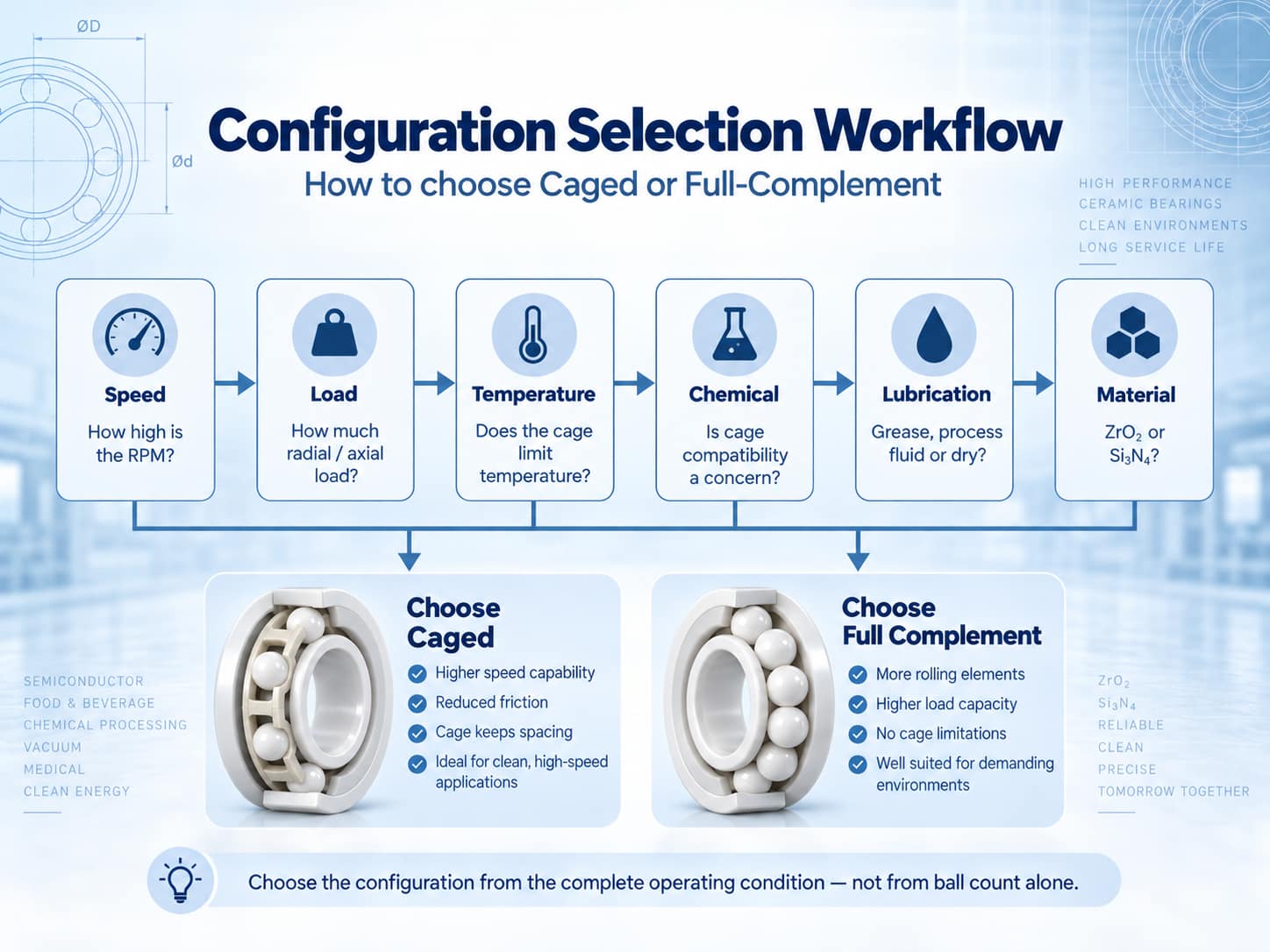
Higher RPM generally favors a caged design.
High load at relatively low speed can make full complement attractive.
Determine whether the cage becomes the temperature-limiting component.
Determine whether PEEK or PTFE is compatible with the process fluid.
Grease, oil, process fluid or dry-running operation?
Compare ZrO₂ and Si₃N₄ according to speed, temperature and mechanical requirements.
Choose caged when controlled spacing and speed dominate; choose full complement when additional rolling elements or cage elimination provide the stronger benefit.
Quick Selection Guide
| Application Priority | Usually Consider First |
|---|---|
| Higher RPM | Caged |
| Continuous rotation | Caged |
| Controlled ball spacing | Caged |
| Greater load capacity at low speed | Full complement |
| Cage is the temperature limitation | Full complement |
| Cage cannot tolerate process chemical | Full complement or another compatible cage |
| Chemical resistance + higher speed | Compatible PEEK / PTFE cage |
| Very low speed + demanding environment | Full complement may be attractive |
Common Selection Mistakes
Assuming Full Complement Is Automatically Better
More rolling elements provide advantages, but removing the cage reduces speed capability.
Choosing Full Complement for High Speed
This usually works against the main strength of the configuration.
Treating Cage Removal as Unlimited High-Temperature Capability
Other bearing components still impose temperature limits.
Selecting a Cage From Temperature Alone
Chemical compatibility, speed and cage strength also matter.
Ignoring Lubrication
Full complement does not mean self-lubricating.
Ignoring Shock Load
Ceramic materials behave differently from ductile steel under severe impact.
Frequently Asked Questions
What is a full-complement ceramic bearing?
A full-complement ceramic bearing has no conventional cage and contains additional rolling elements compared with a caged design.
Why does a full-complement bearing have more balls?
Removing the cage creates more space around the raceway, allowing additional balls to be installed.
Does full complement increase load capacity?
For comparable bearing geometry, additional rolling elements can increase load capacity. Actual ratings still depend on size, geometry, material and operating conditions.
Are full-complement ceramic bearings good for high speed?
Generally, caged bearings are better suited to higher RPM because the cage keeps the balls separated and guided.
Why does full complement have lower speed capability?
Without a cage, adjacent balls can interact directly, increasing friction and limiting suitable operating speed.
Are full-complement bearings better for high temperature?
They can be advantageous when a polymer cage is the temperature-limiting component, but other bearing limits still need to be considered.
Are full-complement bearings better for chemical environments?
They can help when cage compatibility is the limiting factor. A chemically compatible PEEK or PTFE cage may still be preferable when higher speed is required.
Is PEEK or full complement better?
PEEK is usually attractive when cage strength, ball separation and speed are important. Full complement becomes attractive when additional load capability or elimination of the cage is more important.
Does full complement mean no lubrication is required?
No. Full complement describes the rolling-element configuration, not the lubrication requirement.
Need Help Choosing Caged or Full Complement?
The best configuration depends on the complete operating condition.
Provide the bearing model or dimensions, normal and maximum RPM, load, operating temperature, chemical or water exposure, lubrication condition and required quantity. Confirm the complete zirconia bearing specification before final selection.
DISLAB Precision can help evaluate whether a PEEK-caged, PTFE-caged or full-complement ceramic bearing is the more appropriate configuration.
Technical information on this page is intended as a general engineering selection guide. Final speed, load, temperature and configuration limits should be confirmed for the specific bearing size and application.