Ceramic Bearings for Water, Seawater and Wet Environments
Water can be surprisingly difficult for a bearing. A bearing that performs reliably in a dry machine may fail quickly when exposed to washdown, condensation, seawater or permanent immersion.
Corrosion can damage raceways and rolling elements, wash lubricant out of the bearing and create contamination that accelerates wear.
Full ceramic bearings made from materials such as zirconia (ZrO₂) and silicon nitride (Si₃N₄) can provide strong corrosion resistance without relying on conventional bearing steel.
Zirconia is particularly attractive for many water, saltwater and general wet-environment applications. However, cold fresh water, seawater, hot water and steam should not be treated as the same operating condition.

Why Does Water Cause Bearing Problems?
Conventional precision bearings are commonly made from hardened chrome steel. This material provides excellent hardness, load capacity and speed capability, but its corrosion resistance is limited.
When moisture reaches an unprotected steel raceway, possible consequences include:
- rust on raceways and rolling elements;
- roughening of rolling surfaces;
- increased friction;
- contamination particles;
- lubricant degradation or washout;
- premature noise and vibration;
- shorter bearing life.
Even condensation can become important when equipment repeatedly cycles between warm and cold conditions.
Not All Wet Environments Are the Same
The description “wet environment” is too broad for reliable bearing selection.
Humidity and Condensation
The bearing is not immersed, but moisture can collect on metallic surfaces and initiate corrosion.
Intermittent Splash
The bearing is periodically exposed to water or process liquid but may dry between cycles.
Washdown
The bearing may repeatedly encounter water, detergent, disinfectant and temperature cycling.
Permanent Immersion
The bearing operates continuously under water, changing corrosion, lubrication and sealing requirements.
Seawater
Chloride-containing saltwater creates a particularly demanding environment for metallic bearings.
Hot Water and Steam
Elevated temperature adds thermal and material-aging considerations beyond ordinary water exposure.
Why Are Zirconia Ceramic Bearings Used in Water?
Zirconia does not rust like conventional bearing steel. This makes ZrO₂ full ceramic bearings attractive where water or moisture is the primary environmental challenge.
Potential advantages include:
- strong water corrosion resistance;
- strong saltwater corrosion resistance;
- electrical insulation;
- non-magnetic behavior;
- ceramic raceways and rolling elements;
- suitability for permanent immersion in appropriate applications.
For the basic material properties and construction of ZrO₂ bearings, see
What Are Zirconia Ceramic Bearings?
Zirconia Bearings in Water Environments
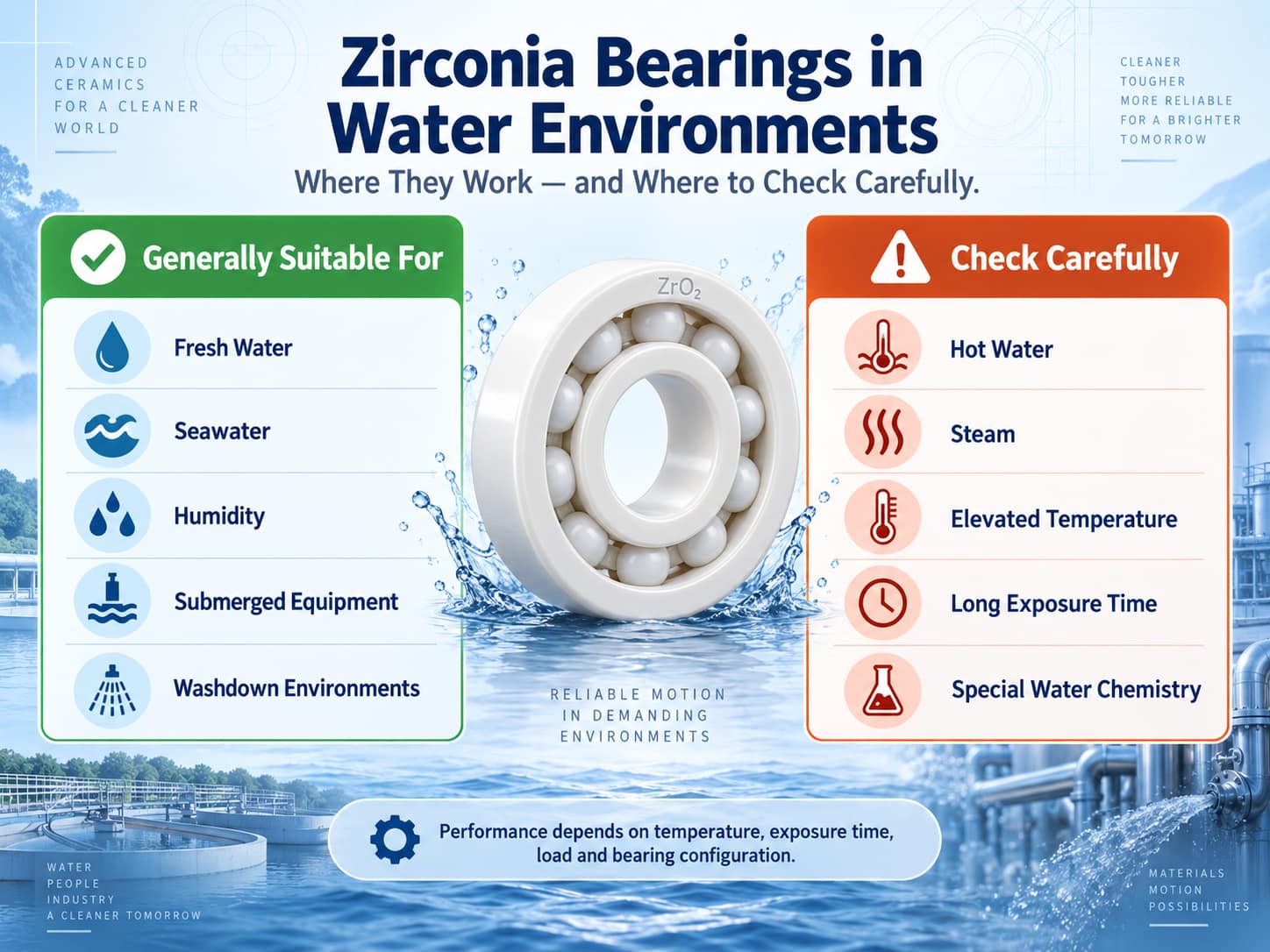
ZrO₂ is generally attractive in fresh water, seawater, humid environments, submerged equipment and washdown systems when the complete bearing design is suitable.
Ceramic Bearings in Fresh Water
Fresh water may appear relatively mild, but conventional bearing steel can still corrode quickly once water reaches the raceways.
Ceramic rings and balls remove conventional steel rust from the main rolling components.
Possible applications include:
- water-treatment equipment;
- pumps;
- washing machinery;
- laboratory systems;
- food-processing machinery;
- wet production environments;
- submerged mechanisms.
Water chemistry still matters. Fresh water may contain chlorine, minerals, detergents or other additives that affect cages, seals and lubricants.
Ceramic Bearings in Seawater
Seawater is considerably more demanding for metallic bearings because chlorides can promote localized corrosion.
Full ceramic bearings avoid the conventional metallic corrosion mechanism in ceramic rings and rolling elements.
This makes zirconia and silicon nitride attractive for applications such as:
- marine instrumentation;
- submerged mechanisms;
- seawater pumps;
- aquaculture equipment;
- coastal machinery;
- underwater inspection systems.
Can Zirconia Bearings Operate Permanently Underwater?
In suitable applications, yes.
One important advantage of full ceramic bearings is that the ceramic rings and rolling elements can remain submerged without the conventional rust problems associated with bearing steel.
Permanent immersion still requires review of:
- water chemistry;
- load;
- speed;
- cage material;
- seal strategy;
- lubrication;
- shaft and housing materials.
A corrosion-resistant bearing does not automatically make the entire machine corrosion resistant.
Bearing Materials for Water and Seawater
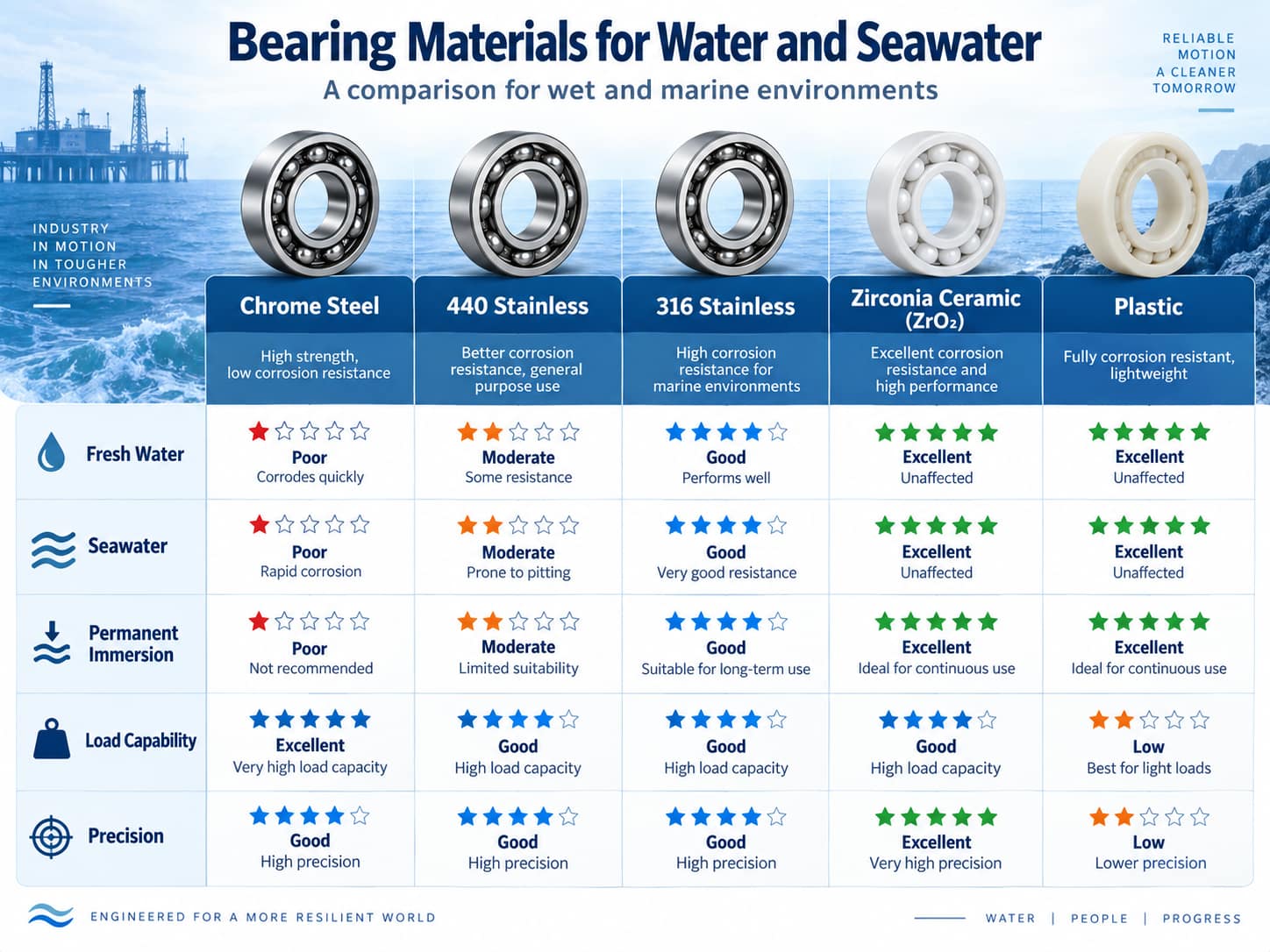
| Material | Wet-Environment Strength | Main Limitation |
|---|---|---|
| Chrome steel | Excellent conventional mechanical bearing performance | Poor corrosion resistance when directly exposed to water |
| 440 stainless steel | Better corrosion resistance while retaining conventional bearing hardness | Less suitable for severe or continuous saltwater exposure |
| 316 stainless steel | Strong marine corrosion resistance | Lower hardness and mechanical bearing capability than hardened bearing steels |
| ZrO₂ ceramic | Excellent water and saltwater corrosion resistance with useful precision and stiffness | Ceramic impact sensitivity and hot-water/steam considerations |
| Engineering plastic | Excellent corrosion resistance | Generally lower load, stiffness, precision and speed capability |
Zirconia vs 316 Stainless Steel in Seawater
316 stainless steel is widely used in marine environments and can be a practical solution where loads and speeds are moderate.
However, stainless steel depends on a passive oxide layer for corrosion resistance. Chloride-containing environments can still create pitting or crevice corrosion, particularly in confined or stagnant areas.
ZrO₂ ceramic rings and balls do not depend on a metallic passive film.
This makes full ceramic bearings worth considering where long-term saltwater exposure must be combined with useful mechanical bearing precision.
What About 440 Stainless Steel?
440-series stainless steels are widely used for corrosion-resistant precision bearings because they retain useful hardness.
They are often suitable for moisture and relatively mild corrosive exposure but are generally less attractive than 316 stainless or full ceramic bearings for prolonged seawater immersion.
Plastic Bearings in Water and Seawater
Plastic bearings can also offer excellent corrosion resistance and may be suitable for submerged or marine environments.
They can be a practical choice where:
- loads are low;
- speeds are low;
- precision requirements are moderate;
- corrosion resistance dominates the design.
When corrosion resistance needs to be combined with greater stiffness, precision or mechanical capability, full ceramic bearings deserve stronger consideration.
Zirconia vs Silicon Nitride for Water Applications
Both ZrO₂ and Si₃N₄ provide strong water and saltwater corrosion resistance.
Zirconia is often attractive for wet industrial environments, seawater, permanent immersion and general full ceramic applications.
Silicon nitride becomes more attractive where the same corrosion resistance must also be combined with lower rotating mass, higher-speed potential, lower thermal expansion or stronger thermal stability.
For a detailed comparison, see
Zirconia vs Silicon Nitride Ceramic Bearings: ZrO₂ vs Si₃N₄.
Water Resistance Does Not Mean Steam Resistance
This distinction is especially important with zirconia.
ZrO₂ performs well in many water environments, particularly near ordinary operating temperatures.
Long-term exposure to elevated-temperature water or steam should be reviewed separately.
For hot-water or steam applications, review:
- continuous temperature;
- peak temperature;
- exposure duration;
- zirconia grade;
- bearing load;
- speed;
- required service life.
What About Hot Washdown Equipment?
Food, beverage and pharmaceutical equipment may combine water, cleaning chemicals and elevated temperature.
A typical cycle may involve production, detergent washdown, hot rinse, cooling and another production cycle.
This can affect:
- cage materials;
- seals;
- lubricants;
- bearing clearance;
- shaft and housing fits.
For the broader chemical aspect of these environments, see
Ceramic Bearings for Corrosive and Chemical Environments.
Cage Material in Wet Environments
PEEK Cage
PEEK combines good resistance to water and many chemicals with stronger mechanical properties and dimensional stability.
PTFE Cage
PTFE offers very low friction and broad chemical resistance and may be attractive where unusual fluid chemistry is present.
For a detailed cage comparison, see
PTFE vs PEEK Cage for Full Ceramic Bearings.
What About Full-Complement Bearings Underwater?
A full-complement ceramic bearing uses no conventional polymer cage.
This can remove a cage-related chemical or temperature limitation.
However, adjacent balls are no longer separated by a retainer, so full-complement designs generally have lower speed capability than comparable caged bearings.
They may be worth considering where cage compatibility is difficult and operating speed is relatively low.
Do Ceramic Bearings Need Seals Underwater?
Not necessarily.
An open ceramic bearing can sometimes operate directly in the surrounding fluid if the machine design allows it.
A sealed bearing introduces another material into the system, and the seal must be compatible with water chemistry, salt, temperature and any cleaning chemicals.
In severe environments, the seal can become the limiting component even when the ceramic rings and balls remain unaffected.
What About Lubrication?
Water can wash conventional grease away from a bearing.
Certain full ceramic bearings can operate with reduced lubrication or without conventional grease under suitable conditions, but this should not be assumed automatically.
Performance depends on:
- bearing size;
- speed;
- load;
- cage configuration;
- surrounding fluid;
- required service life.
Underwater Bearings and Shaft / Housing Materials
A corrosion-resistant bearing does not protect the shaft and housing automatically.
If a ceramic bearing is installed on an ordinary steel shaft and the entire assembly remains submerged, the shaft may still corrode.
Review:
- shaft material;
- housing material;
- fasteners;
- retaining rings;
- other nearby metallic components.
Typical Water and Marine Applications
Potential applications include:
- washdown equipment;
- food and beverage machinery;
- pharmaceutical machinery;
- seawater pumps;
- marine instrumentation;
- aquaculture systems;
- water-treatment equipment;
- underwater mechanisms;
- swimming-pool equipment;
- laboratory equipment.
Fresh Water vs Seawater vs Hot Water
| Environment | Main Concern | Typical Material Direction |
|---|---|---|
| Humidity | Surface corrosion / condensation | Stainless or ceramic |
| Fresh water | Corrosion and lubricant washout | Ceramic, stainless or plastic |
| Permanent immersion | Long-term corrosion | Full ceramic or suitable plastic; stainless requires application review |
| Seawater | Chloride corrosion | Full ceramic, suitable plastic or selected stainless |
| Washdown | Water + chemicals + cycling | Application-specific ceramic / stainless / plastic configuration |
| Hot water | Corrosion + thermal / material aging | Configuration-specific evaluation |
| Steam | Moisture + elevated temperature | Special material review required |
How to Select a Bearing for Water or Seawater
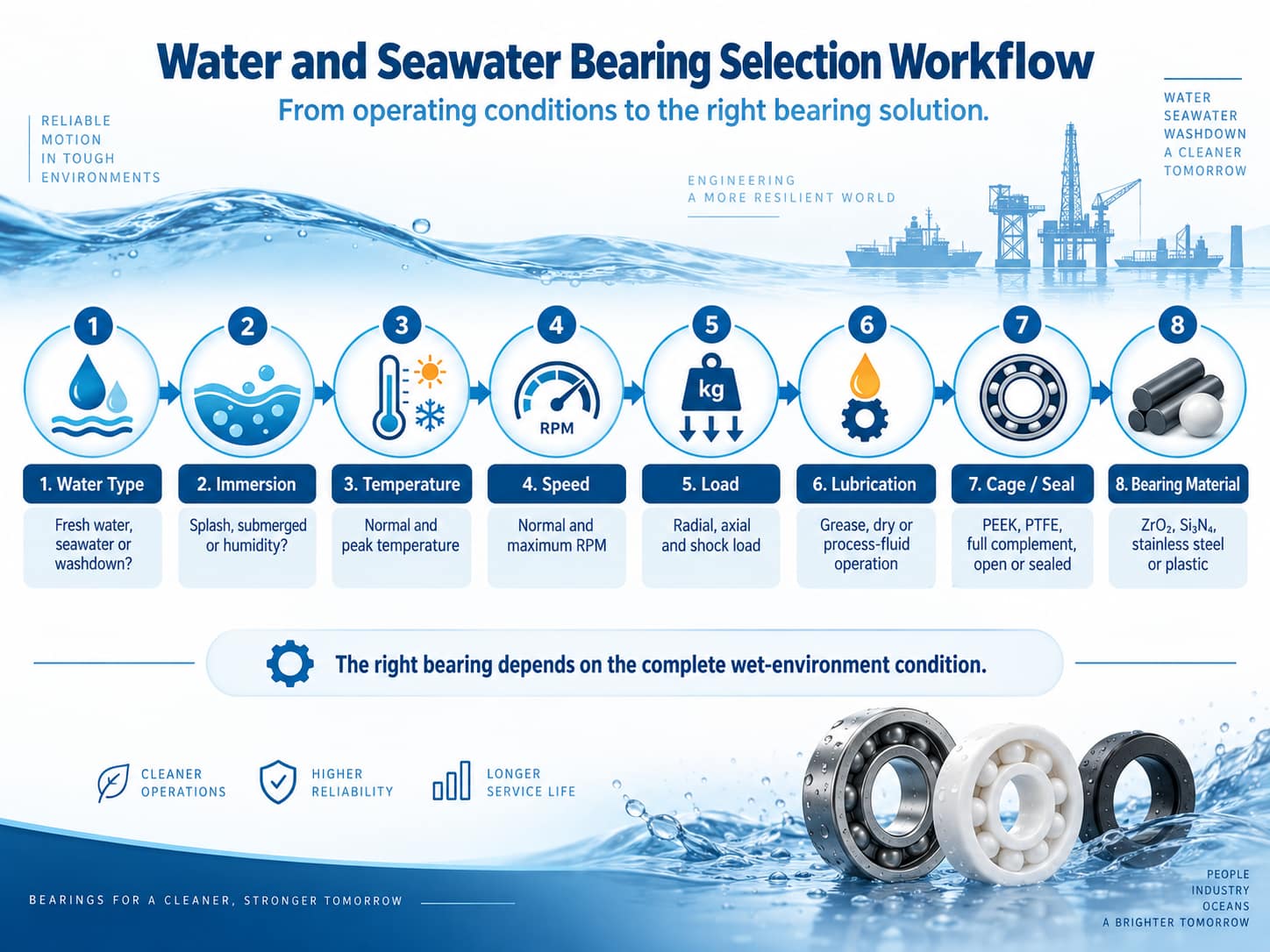
Fresh water, seawater, chlorinated water, washdown or another process fluid?
Humidity, intermittent splash, washdown or permanent immersion?
Provide continuous and peak operating temperature.
Provide normal and maximum RPM.
Identify radial, axial and shock loading.
Grease, oil, water/process fluid or dry-running operation?
Evaluate PEEK, PTFE, full complement, open or sealed construction.
Compare ZrO₂, Si₃N₄, stainless steel and plastic from the complete operating condition.
When Is Zirconia a Strong Choice?
ZrO₂ deserves strong consideration where the application combines:
- frequent or permanent water exposure;
- saltwater or marine conditions;
- strong corrosion-resistance requirements;
- useful bearing precision;
- electrical insulation;
- non-magnetic behavior;
- mechanical requirements beyond many plastic-bearing systems.
For available standard sizes and configurations, see the
DISLAB Precision Zirconia Full Ceramic Bearing range.
When Might Another Material Be Better?
Conventional Steel
If the bearing is effectively protected from moisture and conventional lubrication remains reliable, standard steel may remain the most economical choice.
316 Stainless Steel
For moderate-load and moderate-speed equipment where metallic construction is preferred, 316 stainless may be practical.
Plastic Bearings
For low-load and low-speed applications where corrosion resistance dominates, plastic may provide a simpler solution.
Silicon Nitride
When water resistance must be combined with higher-speed potential, low rotating mass or lower thermal expansion, Si₃N₄ deserves consideration.
Specialized Materials
Long-term steam, unusual chemicals or high temperature may require another bearing material or configuration.
Common Selection Mistakes
Assuming “Stainless” Means Waterproof
Stainless steel can still experience localized corrosion, particularly in chloride-containing environments.
Treating All Water as the Same
Fresh water, seawater, chlorinated water, hot water and steam are different engineering environments.
Ignoring the Cage and Seal
The ceramic rings can remain unaffected while the cage or seal becomes the weak point.
Assuming Ceramic Bearings Never Need Lubrication
Lubrication strategy still depends on load, speed and required service life.
Ignoring the Shaft and Housing
A corrosion-resistant bearing installed on a corroding steel shaft does not solve the complete machine problem.
Using ZrO₂ for Steam Without Evaluation
Long-term elevated-temperature moisture exposure requires additional review.
Frequently Asked Questions
Can ceramic bearings run underwater?
Yes. Full ceramic bearings can be suitable for permanent underwater operation when the complete bearing configuration matches the load, speed, temperature and water chemistry.
Are zirconia bearings waterproof?
ZrO₂ ceramic rings and balls have excellent resistance to ordinary water and do not rust like bearing steel. The cage, seal and lubricant still need to be evaluated.
Can zirconia bearings run in seawater?
Yes. Zirconia is commonly considered for saltwater and marine environments because of its strong corrosion resistance. Load, speed and bearing configuration must still be checked.
Is 316 stainless steel suitable for seawater?
316 stainless provides good marine corrosion resistance, but chloride-containing environments can still cause localized pitting or crevice corrosion under certain conditions.
Which is better underwater: ceramic or plastic?
Plastic can be an effective low-cost solution for low-load and low-speed applications. Ceramic generally provides greater stiffness, precision and mechanical capability.
Can zirconia bearings operate in hot water?
They can be used in some hot-water applications, but prolonged elevated-temperature moisture exposure should be reviewed carefully.
Can zirconia bearings operate in steam?
Steam service requires additional evaluation and should not be treated the same as ordinary room-temperature water exposure.
Do underwater ceramic bearings need grease?
Not always. Some ceramic configurations can operate without conventional grease, but speed, load, cage design and required service life determine whether this is appropriate.
Which cage is best for seawater?
PEEK provides a strong balance of mechanical performance and environmental resistance. PTFE offers exceptionally broad chemical resistance and low friction. The correct choice depends on speed, load, temperature and water chemistry.
Need a Bearing for Water, Seawater or Permanent Immersion?
A useful bearing recommendation requires more than the bearing number.
Provide the bearing model or dimensions, water or fluid type, immersion condition, operating temperature, RPM, load, lubrication conditions and required quantity.
DISLAB Precision can help evaluate whether a ZrO₂ full ceramic bearing, Si₃N₄ bearing, stainless steel solution or another corrosion-resistant configuration is appropriate.
Technical information on this page is intended as a general selection guide. Final bearing material, configuration and operating limits should be confirmed against the actual application conditions.