Zirconia vs Silicon Nitride Ceramic Bearings: ZrO₂ vs Si₃N₄
Zirconia (ZrO₂) and silicon nitride (Si₃N₄) are two important technical ceramics used in full ceramic bearings. Both offer corrosion resistance, electrical insulation and non-magnetic performance, but their density, thermal expansion and dynamic behavior are significantly different.
So which material is better for your application? There is no universal winner. ZrO₂ is often a practical choice for corrosive, wet and general industrial environments, while Si₃N₄ becomes particularly attractive when lower rotating mass, higher speed potential, low thermal expansion or demanding temperature conditions are priorities.
The correct selection should consider the complete bearing system—not only the ceramic material.

What Are ZrO₂ and Si₃N₄ Ceramic Bearings?
A full ceramic bearing uses ceramic materials for both the bearing rings and rolling elements.
In a zirconia ceramic bearing, the rings and balls are primarily manufactured from zirconium oxide, commonly written as ZrO₂. In a silicon nitride ceramic bearing, the ceramic components are manufactured from Si₃N₄. For a detailed overview, see our guide to zirconia ceramic bearing properties.
Both materials can be used in different bearing configurations, including caged and full-complement designs. Cage material, seals, internal clearance, lubrication, speed and load can all affect the final operating limits.
For available sizes and commercial configurations, see the
DISLAB Precision ZrO₂ full ceramic bearing range.
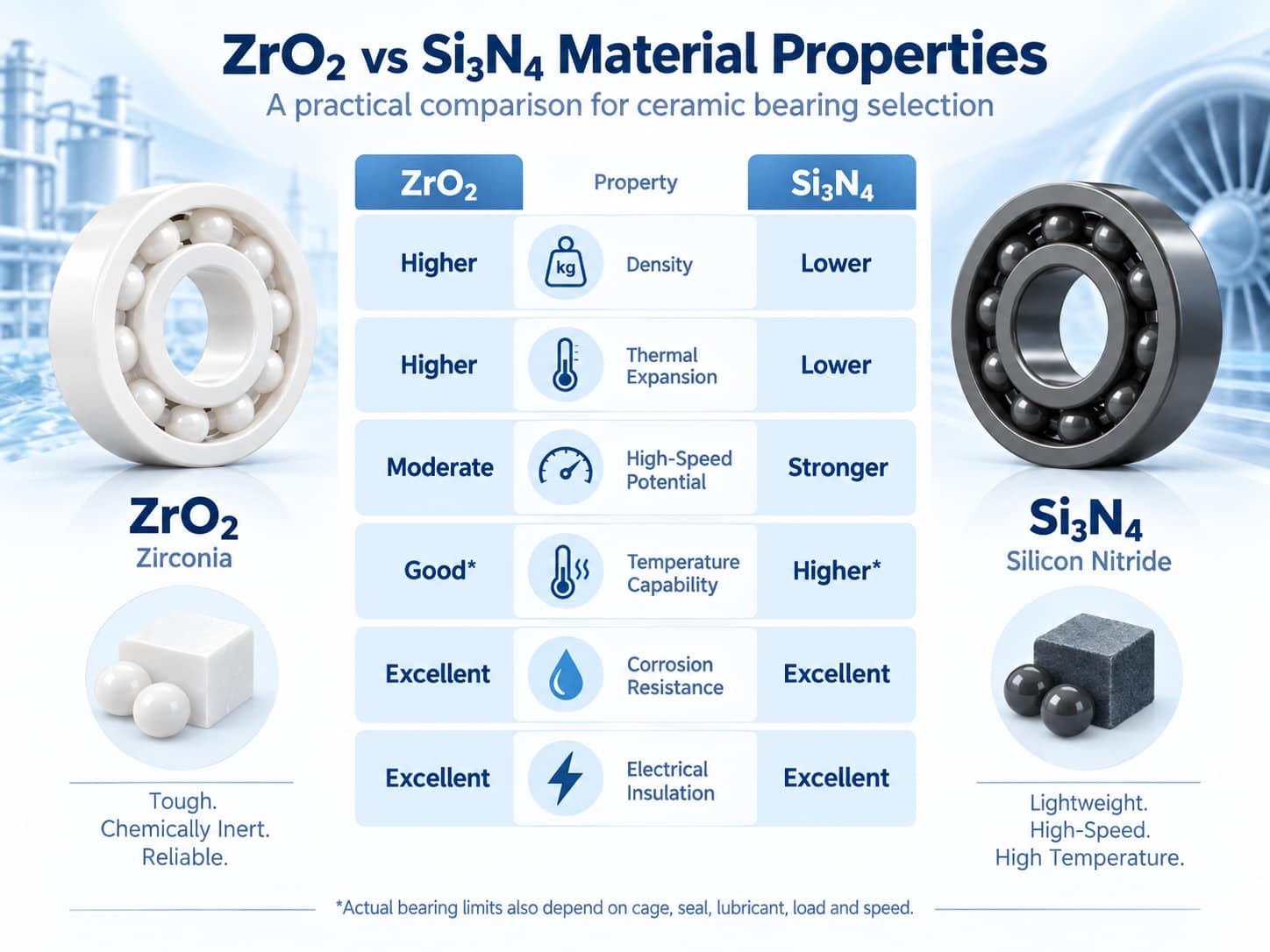
ZrO₂ vs Si₃N₄: Key Differences at a Glance
| Selection Factor | Zirconia — ZrO₂ | Silicon Nitride — Si₃N₄ |
|---|---|---|
| Density | Higher | Significantly lower |
| Corrosion resistance | Excellent | Excellent |
| Water / wet environments | Very suitable when correctly specified | Very suitable when correctly specified |
| Electrical insulation | Excellent | Excellent |
| Magnetic behavior | Non-magnetic | Non-magnetic |
| High-speed potential | Moderate | Generally stronger |
| Thermal expansion | Higher and closer to steel | Much lower |
| Temperature potential | Good, configuration dependent | Generally higher |
| Rotating mass | Higher | Lower |
| Typical selection focus | Corrosion, wet environments and general industrial use | Speed, low mass, thermal stability and demanding temperature conditions |
Density and High-Speed Performance
One of the clearest differences between ZrO₂ and Si₃N₄ is density.
Silicon nitride is substantially lighter than zirconia. As rotational speed increases, lower rolling-element mass can reduce centrifugal loading and make Si₃N₄ particularly attractive for dynamic applications.
Silicon nitride is commonly considered when an application emphasizes:
- higher rotational speed;
- lower rotating mass;
- rapid acceleration and deceleration;
- reduced centrifugal loading;
- demanding dynamic performance.
This does not mean a zirconia bearing is inherently a low-speed product. ZrO₂ can perform very well in many rotating applications. However, when very high speed is a primary selection criterion, Si₃N₄ deserves closer consideration.
For commercial Si₃N₄ configurations, see
silicon nitride full ceramic bearings.
Thermal Expansion and Temperature Changes
Thermal expansion is another important distinction between these ceramic materials.
Zirconia has a higher coefficient of thermal expansion, while silicon nitride expands considerably less as temperature rises. ZrO₂’s thermal behavior is also closer to many metallic engineering materials than that of Si₃N₄.
Low thermal expansion can be advantageous, but it also means the bearing ring, shaft and housing may expand by different amounts.
Depending on the assembly, temperature changes can influence:
- internal clearance;
- interference fit;
- ring stress;
- shaft or housing retention;
- running behavior.
This is why ceramic bearing selection should evaluate the complete mechanical assembly rather than comparing only material datasheets.
Which Ceramic Is Better for High Temperature?
Si₃N₄ generally offers stronger high-temperature potential than ZrO₂. But this statement requires an important qualification.
A complete bearing may also include:
- PTFE or PEEK cage materials;
- seals;
- lubricants;
- metallic components;
- other auxiliary materials.
Any of these may become the limiting component. Speed and load ratings may also need to be reduced as operating temperature rises.
For high-temperature applications, provide the continuous operating temperature, peak temperature, RPM, load, lubrication condition and surrounding component materials before selecting a bearing configuration.
Corrosion Resistance and Chemical Environments
Both ZrO₂ and Si₃N₄ offer significant advantages over conventional bearing steels in many corrosive environments.
Full ceramic bearings are therefore considered for applications involving:
- water and humidity;
- salt exposure;
- chemical processing;
- cleaning processes;
- laboratory equipment;
- semiconductor equipment;
- food and process machinery;
- other environments where metallic corrosion is undesirable.
Zirconia is particularly well established as a corrosion-resistant bearing material and is often considered for wet and chemically aggressive industrial environments. Silicon nitride also provides excellent corrosion resistance.
Therefore, the selection should not simply be reduced to “corrosion equals zirconia.”
For chemical applications, confirm:
- chemical type;
- concentration;
- temperature;
- exposure duration;
- whether exposure is continuous or intermittent;
- cleaning agents or secondary chemicals.
What About Water and Seawater?
Both ceramic systems may provide advantages over conventional bearing steel in water-related applications.
Potential uses include:
- marine equipment;
- washing and cleaning machinery;
- pumps;
- processing equipment;
- humid manufacturing environments;
- equipment exposed to salt water.
However, fresh water, seawater, hot water and steam are not equivalent operating environments.
For critical submerged or elevated-temperature wet applications, material grade, temperature, load and exposure duration should be reviewed before final selection.
Shock Load, Brittleness and Mechanical Handling
Ceramic materials are hard and wear resistant, but they do not behave like ductile bearing steels when subjected to impact or improper installation.
Both ZrO₂ and Si₃N₄ require attention to:
- impact loading;
- shock load;
- misalignment;
- excessive interference;
- installation damage.
Zirconia is valued for relatively high toughness among engineering ceramics. Silicon nitride combines high mechanical strength with low density, but ceramic rings can still be damaged by severe impact or incorrect fitting methods.
A full ceramic bearing should therefore be selected according to actual load type and installation conditions—not simply because ceramic is harder than steel.
Electrical Insulation and Non-Magnetic Applications
Both ZrO₂ and Si₃N₄ are electrically insulating ceramic materials and are non-magnetic.
These characteristics can be valuable in:
- electrical equipment;
- laboratory systems;
- semiconductor equipment;
- measurement systems;
- specialized motors and instruments.
It is important to distinguish a full ceramic bearing from a hybrid ceramic bearing. Hybrid bearings normally combine ceramic rolling elements with metallic rings, so the complete bearing does not necessarily provide the same electrical or magnetic characteristics.
For a broader material-family comparison, see
Ceramic Bearings vs Steel Bearings.
Lubrication: Can Both Materials Run Dry?
Some full ceramic bearings can operate under conditions where conventional lubricated steel bearings would be difficult to use.
However, this does not mean every ceramic bearing should automatically operate without lubrication.
Dry-running suitability depends on:
- speed;
- load;
- bearing size;
- cage design;
- temperature;
- required operating life;
- contamination;
- the surrounding medium.
A lightly loaded low-speed ceramic bearing and a continuously operating high-speed ceramic bearing represent very different engineering conditions.
Caged vs Full-Complement Ceramic Bearings
Material selection is only one part of ceramic bearing selection. The internal configuration is also important.
Caged Ceramic Bearings
A cage separates and guides the rolling elements. Depending on the design, this can support smoother operation and better speed capability.
Common engineering polymer cage materials may include PTFE and PEEK.
Full-Complement Ceramic Bearings
A full-complement bearing does not use a conventional cage and can contain more rolling elements.
This may suit particular load, temperature or lubrication requirements, but a cage-less design should not automatically be assumed to be suitable for higher speed.
When Should You Choose ZrO₂ or Si₃N₄?
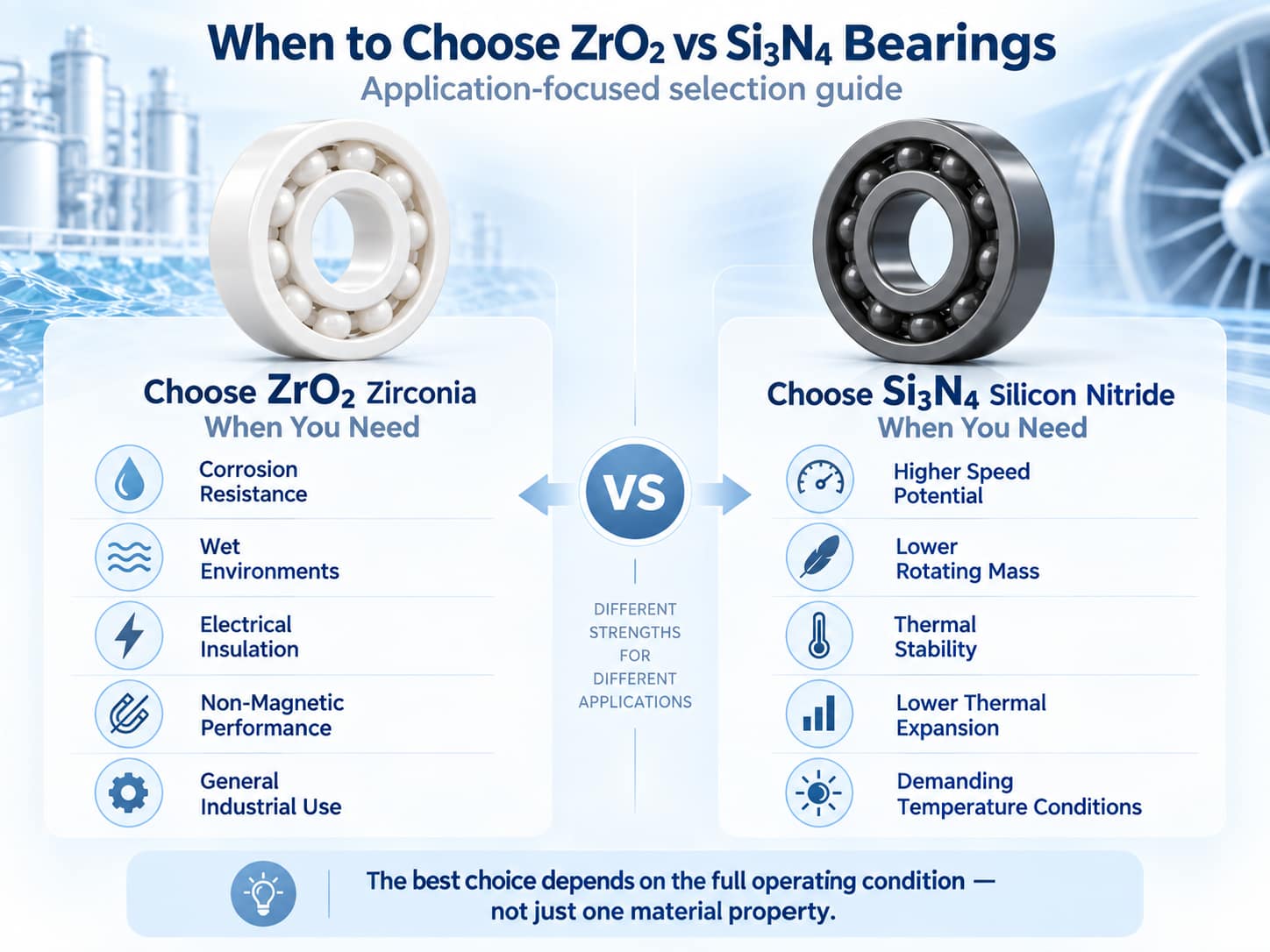
Choose ZrO₂ When You Prioritize
- corrosion resistance;
- humid or wet environments;
- electrical insulation;
- non-magnetic performance;
- general industrial full ceramic applications;
- thermal expansion behavior closer to metallic surrounding components.
For available dimensions and configurations, visit the
DISLAB Precision Zirconia Full Ceramic Bearing range.
Choose Si₃N₄ When You Prioritize
- lower rotating mass;
- higher-speed potential;
- low thermal expansion;
- thermal stability;
- demanding temperature conditions;
- dynamic performance combined with corrosion resistance.
For deeper technical information, see our
Silicon Nitride Ceramic Bearing Guide.
How to Choose Between ZrO₂ and Si₃N₄
Rather than choosing ceramic material from a single specification, evaluate the complete application step by step.
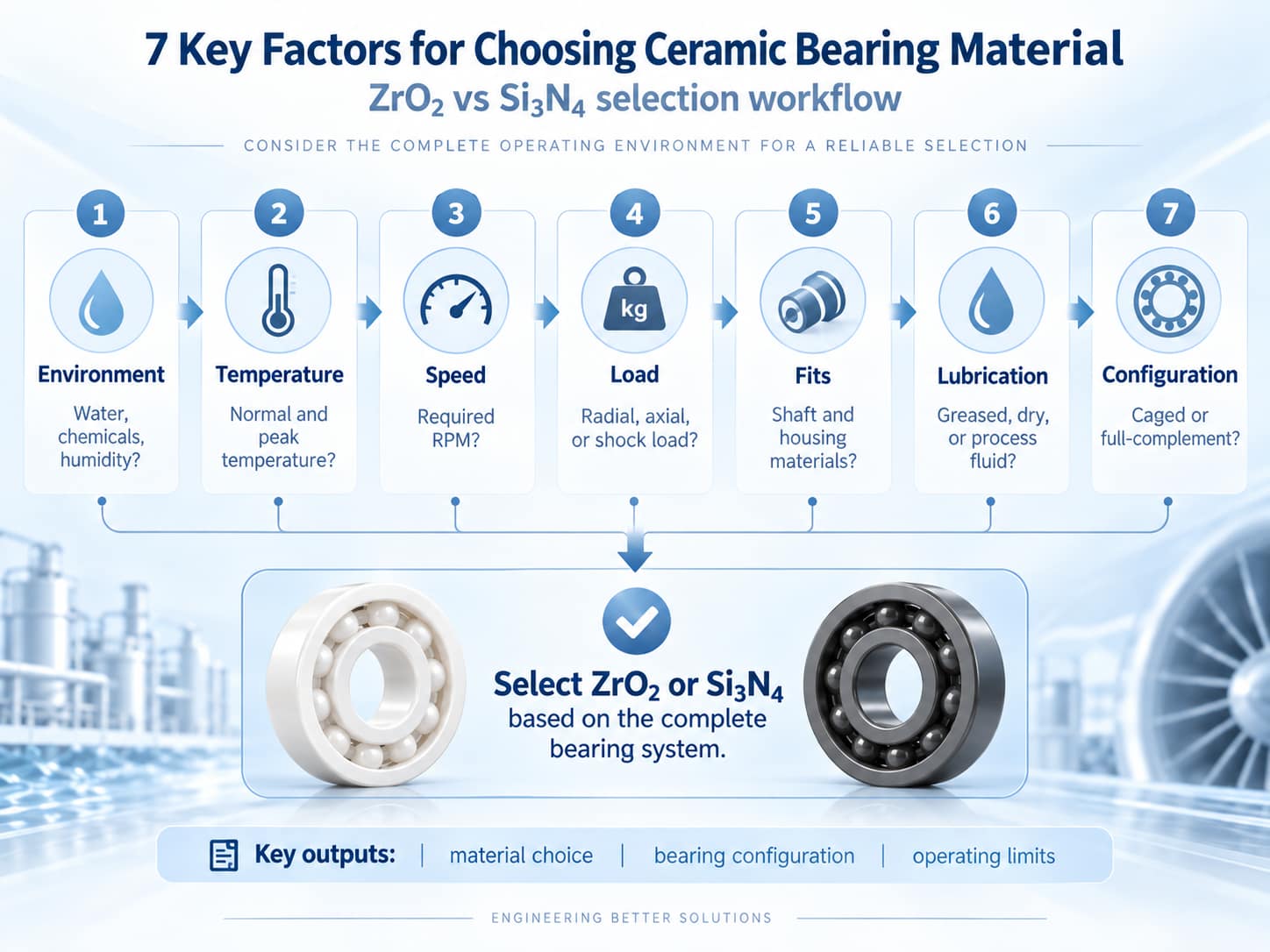
Is the bearing exposed to water, salt, chemicals, humidity, contamination or another process medium?
Specify both normal operating temperature and short-term peak temperature.
Provide actual RPM rather than simply describing the equipment as high speed.
Separate radial, axial and shock loads where possible.
Different thermal expansion rates may affect fit and internal clearance.
Confirm whether the bearing will operate with grease, oil, process fluid or under dry-running conditions.
Determine whether a caged, sealed or full-complement construction is appropriate.
Common Selection Mistakes
Choosing Material Only From Maximum Temperature
Material temperature capability does not equal complete bearing operating temperature. Cage, seals, lubricant, load and fit may impose lower limits.
Assuming All Ceramic Bearings Are Suitable for High Speed
Bearing material, geometry, cage, load and lubrication all influence speed capability.
Treating ZrO₂ and Si₃N₄ as Interchangeable
They share several ceramic advantages, but their density and thermal behavior are significantly different.
Assuming “Corrosion Resistant” Means Every Chemical
Chemical compatibility depends on medium, concentration, temperature and exposure time.
Replacing a Steel Bearing Based Only on Dimensions
Matching bore, outside diameter and width does not guarantee identical load capability, fit, speed or service life.
Frequently Asked Questions
Is silicon nitride better than zirconia for bearings?
Not in every application. Si₃N₄ generally offers advantages in lower mass, speed potential, low thermal expansion and demanding temperature conditions. ZrO₂ can be an excellent choice for corrosion-resistant and general industrial full ceramic bearing applications.
Which ceramic bearing material is better for high speed?
Si₃N₄ is generally the stronger candidate when high-speed performance is a major design priority because of its lower density. Final speed capability still depends on bearing geometry, cage, load and lubrication.
Are both ZrO₂ and Si₃N₄ electrically insulating?
Yes. Both are ceramic electrical insulators. If electrical isolation is required, confirm whether the complete bearing is full ceramic rather than a hybrid bearing with metallic rings.
Are zirconia bearings suitable for seawater?
Zirconia offers excellent corrosion resistance and can be suitable for many wet and salt-water environments. Actual temperature, exposure duration, load and operating conditions should still be evaluated.
Which material is better for high temperatures?
Si₃N₄ generally offers stronger high-temperature potential. However, complete bearing limits may be determined by the cage, seal, lubricant, load or shaft and housing fit.
Can ZrO₂ and Si₃N₄ bearings run without lubrication?
Certain full ceramic configurations can operate without conventional lubrication under suitable operating conditions. Dry-running suitability should be evaluated according to speed, load, temperature and required service life.
Need Help Choosing Between ZrO₂ and Si₃N₄?
The best ceramic bearing material depends on the complete operating condition rather than a single specification.
When requesting a recommendation, provide the bearing number or dimensions, speed, load, temperature, chemical or liquid exposure, shaft and housing materials, lubrication conditions and required quantity.
DISLAB Precision can help evaluate whether ZrO₂ zirconia or Si₃N₄ silicon nitride is the more appropriate full ceramic bearing solution for your application.
Technical information on this page is intended as a selection guide. Final bearing configuration and operating limits should be confirmed against the actual application conditions.