Zirconia vs Silicon Nitride Bearings: How to Choose ZrO₂ or Si₃N₄
Zirconia and silicon nitride are both widely used advanced ceramic materials for demanding bearing applications, but their performance priorities are different. This guide compares ZrO₂ and Si₃N₄ bearings by speed, temperature, corrosion resistance, toughness, electrical insulation and operating environment.
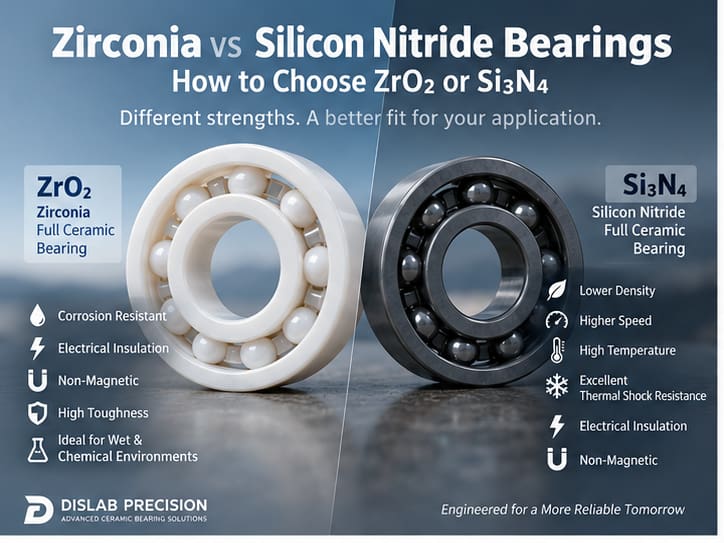
When engineers or buyers decide to move from conventional steel bearings to full ceramic bearings, one of the first questions is often: Should we choose zirconia (ZrO₂) or silicon nitride (Si₃N₄)?
Both materials can provide electrical insulation, non-magnetic behavior, corrosion resistance and operation in environments where conventional steel bearings may have limitations. However, they are not interchangeable.
Zirconia and silicon nitride differ in density, fracture toughness, hardness, thermal expansion, thermal-shock behavior and high-speed capability. The better material therefore depends on the problem the bearing is expected to solve.
Zirconia or Silicon Nitride: The Short Answer
Choose ZrO₂ When
- Water or moisture exposure is important.
- Corrosion resistance is a major concern.
- Chemically aggressive environments are involved.
- Higher ceramic fracture toughness is beneficial.
- Clean or low-lubrication operation is required.
Choose Si₃N₄ When
- Rotational speed is high.
- Lower rotating mass matters.
- Higher temperature capability is important.
- Rapid temperature changes are expected.
- Low thermal expansion is a major requirement.
Neither ceramic material is universally better. The correct choice should consider speed, load, temperature, chemical exposure, lubrication, cage material, seals, internal clearance and mounting conditions.

ZrO₂ vs Si₃N₄ Bearings at a Glance
| Selection Factor | Zirconia — ZrO₂ | Silicon Nitride — Si₃N₄ |
|---|---|---|
| Density | Relatively high | Much lower |
| Fracture toughness | Typically higher | High, but usually lower than zirconia |
| Hardness | High | Generally higher |
| High-speed capability | Suitable for appropriate moderate-speed applications | Generally better |
| Thermal expansion | Higher | Much lower |
| Thermal-shock resistance | Good | Excellent |
| High-temperature potential | Depends strongly on bearing configuration | Generally higher |
| Water and wet environments | Excellent candidate | Also suitable, application dependent |
| Chemical environments | Strong candidate; compatibility must be checked | Strong candidate; compatibility must be checked |
| Electrical insulation | Yes | Yes |
| Non-magnetic behavior | Yes | Yes |
| Lubricant-free operation | Possible in suitable configurations | Possible in suitable configurations |
| Typical selection priority | Corrosion, wet environments, clean operation | Speed, heat and thermal cycling |
This table is intended as an initial screening guide. Ceramic grades, bearing designs and manufacturing processes vary, and the operating limit of a complete bearing is not determined by the ceramic material alone.

1. Material Difference: Zirconia and Silicon Nitride Are Not the Same Ceramic
Zirconia, normally identified as ZrO₂, is a dense engineering ceramic known for its combination of hardness, corrosion resistance, electrical insulation and relatively high fracture toughness for a ceramic material.
Silicon nitride, identified as Si₃N₄, combines lower density with high hardness, mechanical strength, low thermal expansion and excellent resistance to thermal shock.
These differences explain why the two materials tend to serve different priorities in bearing selection rather than acting as direct substitutes for one another.
2. Which Is Better for High-Speed Bearings?
If rotational speed is the dominant requirement, silicon nitride normally deserves the first evaluation.
Si₃N₄ is substantially less dense than zirconia. Lower rotating mass can reduce centrifugal and inertial forces, which becomes increasingly important as bearing speed rises.
Silicon nitride is therefore commonly evaluated for:
- high rotational speed;
- rapid acceleration and deceleration;
- precision spindle applications;
- high-speed electric machinery;
- applications where lower rotating mass is important.
3. Which Is Better for Corrosive and Wet Environments?
When the principal concern is water, moisture, washdown, seawater or corrosive industrial surroundings, zirconia full ceramic bearings are often one of the first materials to evaluate.
Typical application areas include:
- chemical processing equipment;
- electroplating machinery;
- washdown systems;
- marine and underwater equipment;
- food-processing machinery;
- pharmaceutical equipment;
- laboratory and analytical instruments.
Chemical compatibility should never be judged from the ceramic name alone. The actual medium, concentration, temperature and exposure time must be considered together with cage, seal and surrounding component materials.
4. Which Ceramic Bearing Is Better for High Temperature?
For demanding thermal conditions, silicon nitride generally has the material advantage.
Si₃N₄ has substantially lower thermal expansion than zirconia and performs particularly well where repeated heating, cooling and thermal cycling are involved.
This makes it attractive for:
- elevated continuous temperatures;
- rapid heating and cooling;
- repeated thermal cycles;
- temperature gradients;
- high-temperature process machinery.
In the current DISLAB Precision zirconia bearing configuration, PTFE cages are used for applications up to approximately 180°C, while optional PEEK cages can support approximately 240°C. Cage-less configurations can be evaluated for higher application-specific temperatures.
5. Which Ceramic Is Tougher?
Zirconia typically provides higher fracture toughness than silicon nitride. This is one reason ZrO₂ is often described as one of the tougher technical ceramics.
Higher fracture toughness, however, does not make a full ceramic bearing automatically suitable for severe impact or heavy shock loads.
Ceramic bearings remain fundamentally different from steel bearings and should be evaluated carefully when the assembly experiences impact, misalignment, uncontrolled mounting force or severe shock.
6. Electrical Insulation and Non-Magnetic Applications
Both zirconia and silicon nitride can provide electrical insulation and non-magnetic behavior.
This makes them relevant to:
- electronic manufacturing equipment;
- electrical testing systems;
- laboratory instruments;
- semiconductor equipment;
- precision measurement systems;
- magnetically sensitive machinery.
If electrical insulation is the only requirement, it is usually not enough to decide between ZrO₂ and Si₃N₄. Speed, temperature, corrosion and load conditions should determine the final choice.
7. Can ZrO₂ and Si₃N₄ Bearings Run Without Lubrication?
Both full ceramic materials can support low-lubrication or lubricant-free operation in suitable applications.
This can be useful in clean manufacturing, laboratory, pharmaceutical, food-processing and special chemical equipment where grease contamination is undesirable.
However, the statement that “ceramic bearings do not need lubrication” is too broad.
Lubrication requirements still depend on:
- rotational speed;
- radial and axial load;
- cage material;
- contact stress;
- temperature;
- contamination;
- start-stop frequency;
- surface finish.
8. Full Ceramic Bearings vs Hybrid Ceramic Bearings
Full Ceramic Bearing
A full ceramic bearing normally uses ceramic materials for both the inner and outer rings and the rolling elements. The cage may use PTFE, PEEK or another suitable material, or the bearing may use a cage-less full-ball configuration.
Hybrid Ceramic Bearing
A hybrid bearing normally uses steel bearing rings together with ceramic rolling elements, most commonly Si₃N₄ balls.
This distinction is important. Hybrid bearings can benefit from lightweight ceramic balls while retaining metallic raceways, while full ceramic bearings remove the steel raceway itself.
For a broader comparison of metallic and ceramic designs, see: ceramic bearings vs steel bearings .
9. Which One Should You Choose?
| Application Requirement | Material to Evaluate First |
|---|---|
| Seawater or submerged operation | ZrO₂ |
| Wet or washdown equipment | ZrO₂ |
| Chemical processing | ZrO₂ — verify chemical compatibility |
| Electroplating equipment | ZrO₂ — verify process chemistry |
| High rotational speed | Si₃N₄ |
| Reduced rotating mass | Si₃N₄ |
| High-temperature operation | Si₃N₄ |
| Rapid thermal cycling | Si₃N₄ |
| Electrical insulation | Either |
| Non-magnetic requirement | Either |
| Lubricant-sensitive clean equipment | Either, depending on configuration |
| Heavy impact or shock loading | Engineering review required |
10. Example Selection Scenarios
Seawater Exposure
A moderate-speed bearing operates continuously in seawater. Corrosion is the dominant concern.
First material to evaluate: ZrO₂.
High-Speed Precision Spindle
High RPM, controlled environment and low rotating mass are the primary design requirements.
First material to evaluate: Si₃N₄.
Chemical Washdown Equipment
Repeated exposure to water and cleaning chemicals requires evaluation of the exact medium, concentration and temperature.
ZrO₂ can be a strong candidate.
Rapid Thermal Cycling
Repeated heating and cooling makes thermal expansion and thermal shock important selection factors.
First material to evaluate: Si₃N₄.
11. Seven Parameters to Confirm Before Selecting a Ceramic Bearing
Before requesting a quotation or technical recommendation, preparing the following information will make material and bearing selection much more accurate.

1. Bearing Model or Dimensions
Provide the existing model number or the inner diameter, outer diameter and width. A drawing is recommended for special assemblies.
2. Operating Temperature
Provide the normal continuous operating temperature.
3. Peak Temperature
Specify temporary temperature spikes separately from normal operating temperature.
4. Rotational Speed
Provide both normal and maximum RPM.
5. Radial and Axial Load
Provide calculated load values when available, or describe the equipment and operating condition.
6. Chemical or Liquid Exposure
Specify the actual medium, concentration and temperature where possible.
7. Lubrication and Cleanliness Requirements
Explain whether the bearing will operate with grease, oil, reduced lubrication or lubricant-free operation, and whether contamination is a major concern.
12. Frequently Asked Questions
Is zirconia or silicon nitride better for ceramic bearings?
Neither material is universally better. Zirconia is often selected for wet, corrosive and chemically exposed environments, while silicon nitride is generally more attractive for high-speed, high-temperature and thermally demanding applications.
Which ceramic bearing material is better for high speed?
Silicon nitride is generally the first material to evaluate because its lower density reduces rotating mass and centrifugal forces. Actual bearing speed capability still depends on design, cage, load, lubrication, clearance and installation.
Which is better for seawater and wet environments?
Zirconia full ceramic bearings are commonly evaluated for seawater, washdown and corrosion-sensitive environments. The complete bearing configuration and surrounding components must also be compatible with the operating medium.
Which ceramic is better for high temperature?
Silicon nitride generally has the stronger material-level thermal characteristics. The practical operating temperature of a complete bearing, however, may be limited by its cage, seals, lubricant, clearance or mounting arrangement.
Are both ZrO₂ and Si₃N₄ electrically insulating?
Yes. Both materials can provide electrical insulation and non-magnetic behavior. Speed, temperature, corrosion and mechanical conditions should then be used to determine the better material.
Can zirconia and silicon nitride bearings operate without grease?
Both can support low-lubrication or lubricant-free operation in suitable full ceramic designs, but lubrication requirements still depend on speed, load, contact conditions, cage configuration, temperature and contamination.
Can a steel bearing be replaced directly with a full ceramic bearing of the same size?
Not necessarily. Matching dimensions alone do not guarantee a direct engineering replacement. Load, speed, shaft and housing fits, internal clearance, temperature, vibration, mounting method and lubrication requirements should also be checked.
The Better Ceramic Bearing Is the One That Matches the Failure Mode
The most useful question is not whether zirconia is simply “better” than silicon nitride. The better question is: what is making a conventional bearing unsuitable for the application?
If the dominant problem is corrosion, water, chemical exposure, electrical insulation or clean operation, zirconia is often the logical first material to evaluate.
If the dominant problem is high speed, reduced rotating mass, elevated temperature, low thermal expansion or rapid thermal cycling, silicon nitride normally deserves the first evaluation.
When several conditions occur at the same time, the final decision should consider the entire system: material + bearing structure + cage + seals + clearance + load + speed + temperature + operating environment.
Need Help Choosing Between ZrO₂ and Si₃N₄?
Send your bearing model, dimensions, drawing, operating temperature, rotational speed, load and environmental conditions. DISLAB Precision can help evaluate the appropriate ceramic material, cage structure, sealing option and bearing configuration.