Quick Release Hose Clamps: How They Work, Selection and Applications
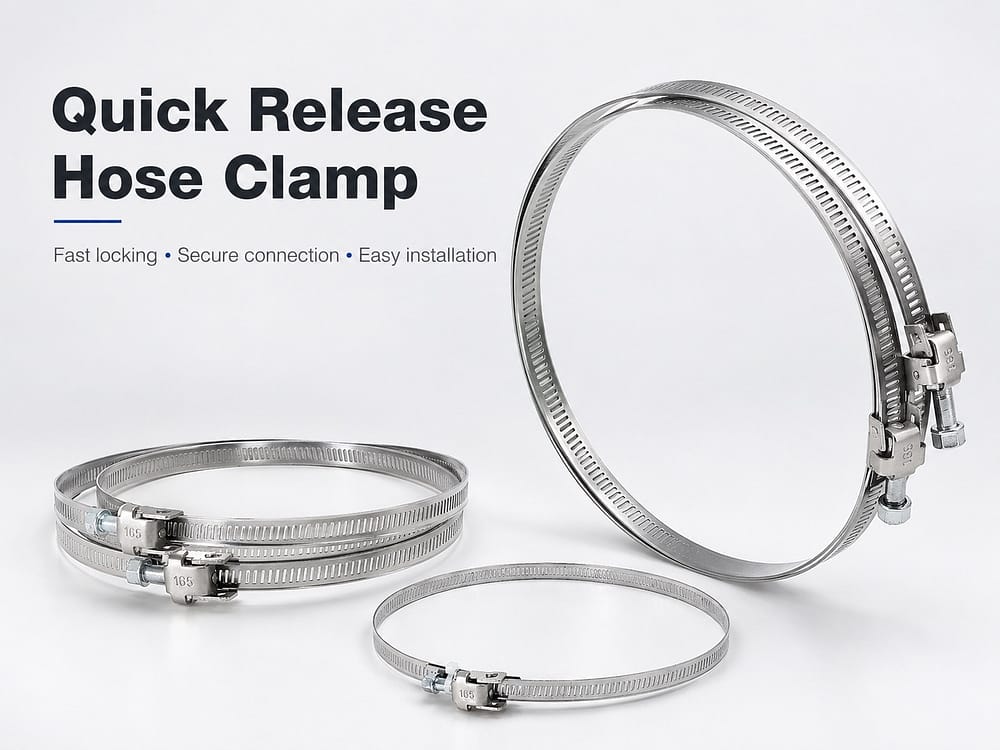
Quick release hose clamps are designed for assemblies that need faster installation, easier removal and a broad adjustment range. This technical guide explains their construction, operating principle, selection criteria, installation method and practical limitations.
Article Overview
A quick release hose clamp is a variation of the adjustable worm-drive clamp. Its housing can be opened or disengaged so that the band can be wrapped around an installed hose or duct. The operator then closes the housing and uses the screw for final adjustment.
This design is especially useful when the clamp cannot be passed over the open end of the hose, or when the connection needs to be opened repeatedly for inspection, cleaning or servicing.
Quick release does not mean that the connection can be opened safely while pressurized. The system must be shut down, depressurized and made safe before the clamp is released.
What Is a Quick Release Hose Clamp?
A quick release hose clamp is an adjustable band clamp with a housing that can be opened without fully winding the screw through the complete adjustment range.
On a conventional worm-drive clamp, the clamp usually needs to be slid over the end of the hose before the connection is assembled. A quick release design can be opened, placed around an existing assembly and then closed before the final tightening step.
The design is commonly associated with larger-diameter hose, ventilation ducting, maintenance connections and assemblies that require periodic removal.
The term “quick release” describes the installation and removal mechanism. It does not indicate a specific material, pressure class, temperature rating or tightening torque.

Main Components and Their Functions
Clamp performance depends on the interaction between the band, perforations, screw, housing and release mechanism. A defect in any one of these areas can affect installation or holding performance.
Release Mechanism
Allows the housing to disengage from the band so the clamp can be opened and positioned around an existing assembly.
Perforated Band
Provides the adjustment range and the engagement surface for the screw. Slot shape and consistency affect smooth tightening.
Screw
Pulls the band through the housing after the release mechanism has been closed. The screw creates the final radial clamping force.
Housing
Supports the screw, keeps the band aligned and transfers tightening force into the clamp band.
Band Edges
Smooth and properly finished edges help reduce cutting, abrasion and localized damage to flexible hose covers.
Size Marking
Markings may identify the nominal diameter range or product size, but the installed outside diameter should still be measured before selection.

Details to Inspect Before Use
How the Quick Release Mechanism Works
Although individual housings may differ, the basic operating sequence is similar.
Open the Housing
The housing is disengaged so the band can open rather than being unwound through its full diameter range.
Position the Band
The band is placed around the hose and fitting at the intended clamping location.
Engage the Release Section
The free section of the band is seated in the housing and the release mechanism is fully closed.
Tighten the Screw
Turning the screw draws the band through the housing and reduces the clamp diameter.
Quick Release vs. Standard Worm-Drive Clamps
| Comparison Point | Quick Release Clamp | Standard Worm-Drive Clamp |
|---|---|---|
| Installation method | Opens so it can be wrapped around an installed hose or duct. | Normally installed by sliding it over an open hose end. |
| Installation time | Usually faster for large diameters or restricted assemblies. | Efficient for normal installations with accessible hose ends. |
| Repeated servicing | Convenient for connections that require periodic opening. | Reusable when undamaged, but normally requires more screw travel. |
| Adjustment | Coarse opening by the release mechanism and fine adjustment by the screw. | Adjustment is primarily completed through screw travel. |
| Pressure suitability | Must be verified for the complete hose and fitting assembly. | Must also be verified for the complete hose and fitting assembly. |
How to Select the Correct Clamp
The clamp should be selected using the installed assembly dimensions and operating conditions, not only the nominal hose size. The DISLAB Product Selector can help compare available clamp families before an RFQ.
Installed Outside Diameter
Measure the hose after it has been placed over the fitting. Measure at the exact location where the clamp will sit.
Adjustment Range
Select a clamp whose working range includes the measured diameter without operating at the extreme end of its range.
Band Width
Wider bands spread force across a larger area, while narrower bands may fit more easily in restricted spaces.
Material
Match the band, screw and housing material to humidity, chemicals, salt exposure and the surrounding equipment.
Hose Construction
Soft, thin-wall or highly flexible hoses may need smoother edges, wider load distribution or a protective liner.
Service Conditions
Consider temperature cycling, vibration, pressure, maintenance frequency and expected service life.

Recommended Installation Procedure

Typical Applications
Quick release hose clamps are most useful where access, diameter range or repeated servicing makes a conventional clamp less convenient. Browse the hose clamp range to compare related designs for permanent and serviceable connections.
Ventilation Ducting
Flexible ducts that need to be removed for cleaning, maintenance or repositioning.
Dust-Collection Systems
Detachable hose and duct connections in workshop or industrial extraction equipment.
Large-Diameter Hoses
Assemblies where the clamp cannot easily be passed over the open hose end.
Maintenance Connections
Equipment that requires scheduled disassembly, inspection or component replacement.
Agricultural Equipment
Suitable hose and air-handling connections requiring broad diameter adjustment.
Temporary Assemblies
Non-permanent connections where the system design permits an adjustable and removable clamp.
Limitations and Common Installation Mistakes
Assuming the Clamp Has a Pressure Rating
System pressure capability depends on the hose, fitting, clamp, assembly method and operating conditions. The clamp should not be evaluated in isolation.
Selecting by Nominal Hose Size
Nominal hose size is often an inside diameter. Clamp selection must be based on the installed outside diameter.
Positioning Too Close to the Hose Edge
Incorrect placement may reduce retention and may damage or distort the hose end.
Overtightening
Excessive torque can damage the band slots, distort the housing, cut the hose cover or create an uneven seal.
Reusing a Damaged Clamp
A clamp with a bent housing, torn slots, damaged screw or unreliable release mechanism should be replaced.
Opening an Energized System
The assembly must be depressurized, cooled and isolated before the clamp is released.
Frequently Asked Questions
Can a quick release hose clamp be reused?
It may be reused when the screw, housing, band perforations and release mechanism remain in good condition. Inspect the clamp before every reinstallation.
Is a quick release hose clamp suitable for high-pressure use?
The quick release feature alone does not establish pressure suitability. The complete hose, fitting and clamp assembly must be evaluated for the intended pressure, temperature and safety requirements.
How is the correct clamp diameter determined?
Measure the outside diameter of the hose after it has been installed over the fitting. Use the measurement taken at the planned clamp position.
What is the main advantage over a standard worm-drive clamp?
The band can be opened and wrapped around an existing assembly, reducing the need to unwind the screw or slide the clamp over the hose end.
When should the clamp be replaced?
Replace it when the housing is deformed, the screw is damaged, the release mechanism does not lock reliably, the slots are torn or the band is cracked or heavily corroded.
Can band width, diameter and packaging be customized?
Depending on the required quantity and manufacturing feasibility, diameter range, band width, material, finish, screw configuration and packaging may be specified for OEM sourcing projects.
Technical Note
This article provides general product and application guidance. Actual clamp selection should be confirmed using the dimensions, materials, operating pressure, temperature, vibration level, chemical exposure and safety requirements of the complete assembly.
For critical, high-pressure, safety-related or regulated applications, selection and installation should be reviewed by a qualified engineer or the relevant equipment manufacturer.
Need Help Specifying a Hose Clamp?
DISLAB PRECISION supplies standard and custom industrial clamps for international B2B buyers. To evaluate a suitable option, provide the installed hose outside diameter, band width, preferred material, operating environment, application details and required quantity.
Clear application information helps reduce incorrect sizing and improves quotation accuracy.